Our team talks with family offices and their advisors every day, and many say their reports hold up until the third currency, the tenth entity or the fiftieth private fund. The question is which reports an office truly needs, who reads each one and where software fits. This guide covers seven core reports, why capital calls and K-1s break manual processes and what to look for, so your office can choose reporting software with clear criteria.
We used AI tools to help gather research and speed up the first draft. That left more of our time for checking each figure against its original report and adding what we see in client conversations. A Masttro editor reviewed every claim, and members of our team read the article before it was published.
Key Takeaways
Family office reporting software consolidates data from every custodian, legal entity and private investment into one reconciled record. Then it produces the reports that principals, investment teams and the family council rely on. In 2026, the biggest reporting challenge for most families is private markets: alternatives averaged 35.5% of single-family office portfolios in 2026, per J.P. Morgan Private Bank.
Many families still assemble reports by hand from custodian statements, fund PDFs and spreadsheets. That process works until the third currency, the tenth entity or the fiftieth private fund. This guide covers what family office reporting should include, who reads each report, how automation works, and how to choose family office reporting software.
Last reviewed October 29, 2026. Statistics are linked to their original sources, listed at the end.
What is family office reporting software?
Family office reporting software is a single platform that aggregates portfolio data from multiple custodians, fund administrators and private investments, organizes it by entity and owner, and calculates performance, allocation and liquidity. It replaces a monthly reconciliation exercise with a centralized reporting platform: data aggregation from every source, consolidated reporting that updates every day, and portfolio data, private assets and cash balances that stay current.
For UHNW families, a platform should also reflect ownership structures the way the family actually holds its wealth: through trusts, foundations, LLCs, partnerships and operating companies, often across several countries.
Which reports does a family office need?
Seven reports carry most of the weight. Each one answers a question the family asks repeatedly.
| Report | Question it answers |
|---|---|
| Consolidated net worth | What do we own, in total and by entity? |
| Performance | How is portfolio performance tracking against benchmarks? |
| Private-fund activity | What have we committed, called, received and still owe? |
| Cash and liquidity | Can our cash flow meet upcoming capital calls and expenses, and what do cash projections show? |
| Asset allocation | Are we within our investment policy across multi-asset portfolios? |
| Entity and trust reports | What does each trust or holding company own across our ownership structures? |
| K-1 and tax status | Which tax documents have arrived, and which are late? |
Who reads family office reports, and what does each need?
Good reporting answers questions before anyone has to ask them, whether the reader is an analyst or a principal. Every report should pull from the same reconciled data, because the same numbers reach very different readers: the principal, the CIO, the COO or controller, trustees and the family council, and the family's CPA firm.
The principal: clarity in one view
A principal wants to see net worth, liquidity and major changes without a training session, so user experience matters as much as data. Masttro's Global Wealth Map shows every entity and asset in one interactive view, and the mobile app puts the same view on the principal's phone.
"Visually, from a user interface perspective, this is by far the easiest platform to add assets and to see our family mapping," said Daniel Forman, CIO of Jefferson River Capital.
The CIO: total oversight across asset classes
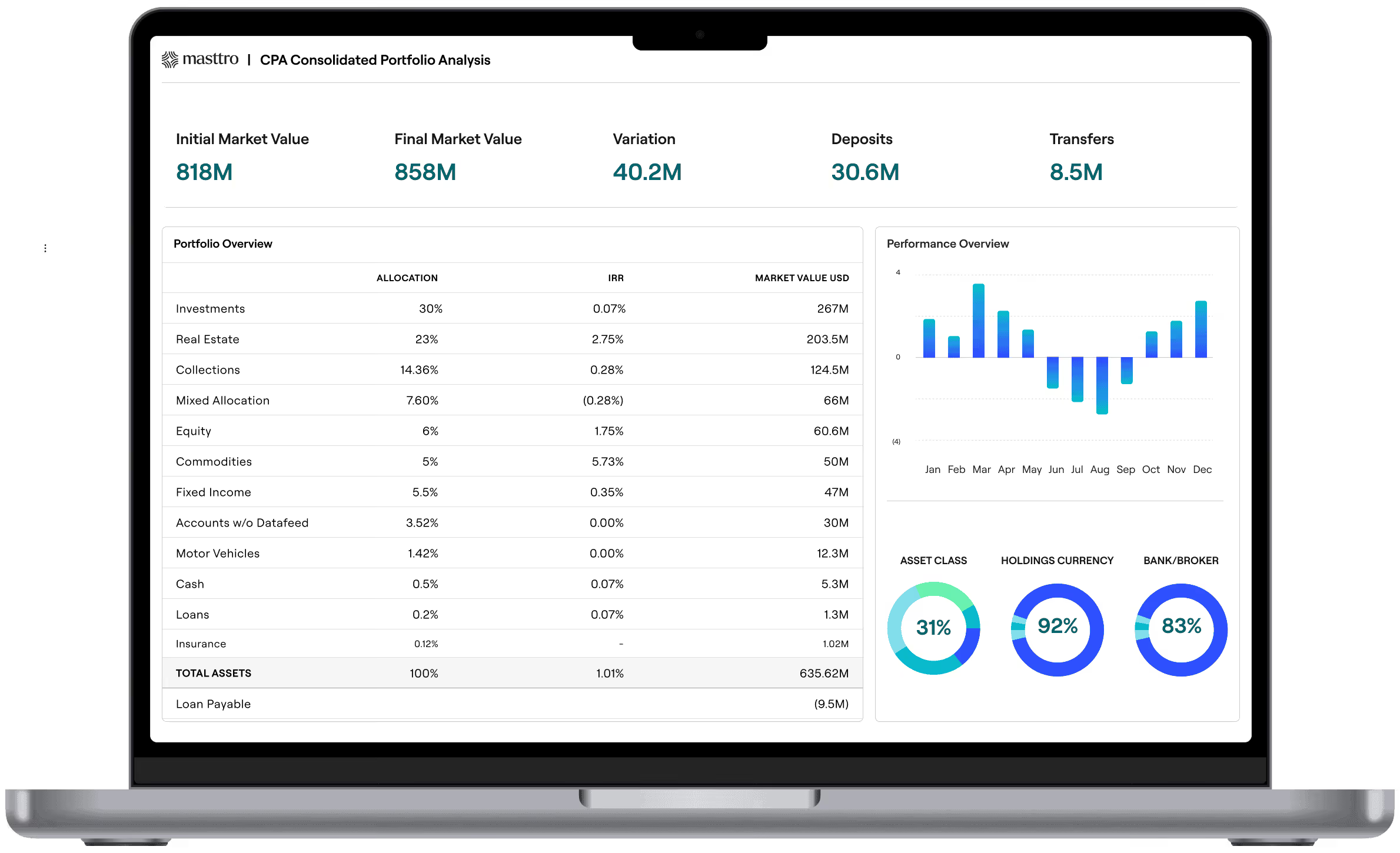
The investment team needs performance dashboards and real-time analytics covering public and private markets, with asset class visibility in one place and attribution by manager and entity. Consolidated Portfolio Analysis aggregates every asset class, custodian, bank account and manager in one view, with currency references and FX rates for multi-currency positions.
The COO: fewer manual hours
Operations teams carry the reconciliation work between custodians, fund documents and the general ledger. Their reporting priorities are exception lists, document status and audit trails. Reporting automation, starting with document intake, is the fastest way to give them time back and to retire Excel processes.
Advisors and multi-family offices: client-ready reporting at scale
MFOs and advisors serving UHNW households need consistent reports across families and households, a secure client portal and their own branding. See white-label reporting and multi-family office software.
Why do capital calls and K-1s break manual reporting?
Private equity funds and other alternative assets do not send data feeds. They send documents: capital call notices, distribution notices, quarterly NAV statements and annual K-1s. Every fund produces several of these each year, and in a manual process each one is keyed by hand into a spreadsheet. The Institutional Limited Partners Association released version 2.0 of its Capital Call & Distribution Template in September 2025, but formats still vary by fund.
That inconsistency is where errors enter. A missed capital call can trigger default penalties. A mistyped NAV distorts net worth. A late K-1 delays the family's tax return: calendar-year partnerships file by March 15 under the IRS Form 1065 instructions, and many extend to September 15.
Masttro's Documents AI reads these documents, extracts figures and dates, and reconciles each capital call and distribution to bank activity, so private assets stay current in the portfolio data. Alternatives AI processes valuations and fund activity, and Masttro tracks 300,000+ alternative investments across its clients. For more detail, see our guide to alternative investment reporting for family offices.
“We went from having no consolidation tool or data feeds to having both capabilities in a single platform - that also happens to track private equity investments perfectly.”


Building an Effective Family Office Tech Stack

How is reporting software different from accounting software?
Reporting software and accounting systems do different jobs. Reporting software organizes portfolio data by owner, entity and asset class, and calculates performance across investment portfolios.
Accounting software maintains the general ledger, posts journal entries, handles intercompany transactions and produces financial reporting for each legal entity. Multi-entity consolidation in the general ledger answers what each entity owns on paper, in financial reporting your auditors accept. Consolidated reporting answers what the family owns, how it is performing and what cash it needs.
Families that try to make one system do both often end up with a compromise: a general ledger that cannot show look-through ownership, or a reporting tool asked to close the books. Accounting-first vendors such as FundCount, Asseta and Asset Vantage build reporting on top of a general ledger. Asset Vantage, for example, pairs an integrated ledger with analytics, and its pricing is tiered by entity count.
Masttro is reporting-first. Its Investment Sub-Ledger bridges the two, exporting reconciled investment entries to the accounting system your controller and CPA firm already use, whether that is Sage Intacct, NetSuite or another multi-entity ledger. See family office accounting software for how the setups compare.
What should you look for in family office reporting software?
- Direct custodian feeds in every country where the family banks. Masttro connects to 750+ custodians in 40+ countries through data aggregation.
- Ownership mapping with partial ownership and look-through reporting across trusts and holding companies, drawn as an ownership graph the family can read.
- Private assets handled as primary data, with IRR, TVPI and DPI for every private equity and venture fund.
- Multi-currency reporting in each entity's base currency and the family's, across multi-asset portfolios.
- Lifestyle assets such as real estate, art and aircraft in the same net worth view.
- Dashboards by role for the principal, CIO and COO. See our guide to family office dashboards.
- Audit trails showing where every number came from, from custodian file to general ledger entry, with automated workflows for review.
- Portfolio monitoring and liquidity planning that flag upcoming capital calls against cash balances by entity, using the cash management registry and private markets forecasting.
- Data security with Swiss hosting for wealth data, role-based access controls and multi-factor authentication. Masttro hosts client data on dedicated infrastructure in Switzerland; see data security.
- AI on reconciled data. Masttro Intelligence answers natural-language questions across live portfolio and document data.
How do legacy reporting tools compare with modern platforms?
| Spreadsheets and legacy tools | Modern family office reporting software | |
|---|---|---|
| Data | Custodian PDFs and manual entry | Data aggregation through direct daily feeds from custodians |
| Private funds | Quarterly updates keyed by hand | Documents read and reconciled automatically |
| Structure | One tab per entity, consolidated by hand | Multi-entity consolidation with look-through ownership |
| Delivery | Emailed PDFs | Secure portal and mobile app |
| Questions | Ask the analyst, wait a day | Automated, real-time reporting; ask in plain language and get an answer from live data |
| Key-person risk | High; the model lives in one person's head | Low; the logic lives in the platform |
What results do family offices see?
- Stonebridge Family Office cut monthly reporting from 8–10 hours to a matter of hours and lets clients log in to see their own reports.
- Jefferson River Capital loaded 200+ alternative investments into Masttro and began tracking performance in three months or less, for a $1B+ portfolio.
- Henco, a single-family office in Mexico City, chose Masttro in part for privacy: "Our information doesn't go through other people's hands, and where we live that can be of concern," said Director Pola Zaga.
What will change in family office reporting in 2027?
The next generation becomes the audience. About one-third of the 351 family offices surveyed by Citi expect leadership transitions within five years, according to the Citi Wealth 2026 Global Family Office Report. Reports must be readable by family members, and reporting becomes part of family governance: the shared record a family council uses to discuss family wealth, liquidity planning and the next generation's role.
AI moves from novelty to workflow. The same Citi report found family offices deploying AI across investment analysis, information management and reporting, with a focus on productivity rather than alpha generation.
Fewer systems, not more. The average family office handles data from more than a dozen systems, per Simple's 2025 Family Office Software and Technology Report. Consolidated reporting is the first step to reducing that number.
Frequently asked questions
What is family office reporting software?
It is a platform that aggregates data from custodians, fund administrators and private investments, organizes it by entity, owner and ownership structures, and produces consolidated reports on net worth, performance, private funds and liquidity.
What reports should a family office produce?
Most offices produce seven: a consolidated net worth statement, performance reports, private-fund activity, cash and liquidity, asset allocation against policy, entity and trust reports, and K-1 status.
How does family office reporting software handle capital calls?
Platforms with document AI read the capital call notice, capture the amount and due date, match the payment to the bank, and update the fund's record. Masttro does this with Documents AI and Alternatives AI.
Is family office reporting software the same as accounting software?
No. Reporting software organizes and analyzes portfolio data. Accounting systems such as Sage Intacct maintain the general ledger and produce financial statements. Masttro's Investment Sub-Ledger connects the two by exporting reconciled entries to your general ledger.
Can family members access reports directly?
Yes, with a secure client portal and mobile app. Stonebridge Family Office cites self-service login as a major benefit.
How long does it take to set up family office reporting software?
It depends on custodians, entities and private funds. Jefferson River Capital loaded 200+ alternative investments into Masttro and began tracking performance in three months or less.
Can reporting software track art, real estate and other lifestyle assets?
Masttro places real estate, art, yachts, aircraft and collections in the same consolidated net worth view as financial portfolios.
What is the best family office reporting software?
For offices with alternative assets, many entities and assets in several countries, Masttro offers 750+ direct custodian feeds in 40+ countries, native AI for capital calls and K-1s, and serves 400+ family offices. Compare options in our guide to the best family office software.
About this guide
Masttro's team wrote this guide for principals, family office COOs and CIOs, and the advisors who report to them. The seven reports and the reader map reflect how Masttro clients configure reporting. Masttro sells family office reporting software and has no general ledger, so we explain where reporting ends and accounting begins rather than claim one system does both.
Sources
- J.P. Morgan Private Bank, 2026 Global Family Office Report: asset allocation of 333 single-family offices.
- Citi Wealth, 2026 Global Family Office Report: succession and AI adoption, 351 respondents.
- Simple, 2025 Family Office Software and Technology Report: number of systems per office.
- Internal Revenue Service, Instructions for Form 1065: partnership filing deadlines.
- Institutional Limited Partners Association, Capital Call & Distribution Template v2.0, September 2025.
- Masttro client results: Stonebridge Family Office, Jefferson River Capital and Henco, as published by Masttro.
Next steps
Download Five Dashboards Every Wealth Owner Needs or schedule an intro to see your own entity map in Masttro.
Related guides: family office accounting software, portfolio reporting software, best family office software and Masttro alternatives.
“We use the CPA in every investment committee, especially the portfolio breakdown capabilities.”
“I appreciate the ease of use and the pre-produced library of reports that Masttro provides. It has significantly streamlined our processes, allowing us to produce reports in minutes that would have taken hours before.”
“Consolidating the positions, I don’t have to do the reporting performance manually.”