Family offices and advisors shopping for portfolio reporting software ask us which type of platform they need and how to test it fairly. With alternatives taking a larger share of family office portfolios, a tool that handles custodial accounts well can still miss private funds. This buyer's guide explains the three types on the market and the capabilities to check, and suggests testing each vendor on your own data, including one private fund, one trust and one capital call.
We used AI tools to help gather research and speed up the first draft. That left more of our time for checking each figure against its original report and adding what we see in client conversations. A Masttro editor reviewed every claim, and members of our team read the article before it was published.
Key Takeaways
Portfolio reporting software pulls holdings from every custodian, fund and entity into one set of performance reports, allocation and risk views that a principal, investment committee or wealth management client can trust. The 2026 test is private markets: alternatives averaged 35.5% of single-family office portfolios in 2026, according to J.P. Morgan Private Bank's 2026 Global Family Office Report.
That figure changes what a reporting platform has to do. A tool that reads custodial statements well but treats a private equity fund as a quarterly PDF will leave a third of the balance sheet out of date. This guide covers what portfolio reporting software is, the three types on the market, the capabilities that matter for 2026, how to run an evaluation, and what it costs.
Last reviewed October 10, 2026. Statistics are linked to their original sources, listed at the end.
What is portfolio reporting software?
Portfolio reporting software is a system that collects position, transaction and valuation data, the investment data held by custodians, fund administrators and private investments, then calculates performance and produces performance reports. A good platform replaces the spreadsheet that someone rebuilds every month with a cloud-based system of record that reconciles to source data, so data management stops being a monthly project.
It is related to, but different from, portfolio management software, which adds trading, automated rebalancing and order management. Many wealth managers and RIA firms buy portfolio management software first and later find that its reporting stops at the edge of the custodial account.
At minimum, it should do four things:
- Aggregate data through direct custodian integration and document ingestion, not manual uploads.
- Calculate performance with time-weighted and money-weighted returns, plus private-fund metrics such as IRR, TVPI and DPI, for performance analysis across the whole investment portfolio.
- Report by account, entity, family member, currency, manager and across asset classes.
- Distribute reports securely through a client portal, mobile app or scheduled PDF and Excel exports.
Which type of portfolio reporting software do you need?
Three categories share the name, and they solve different problems.
| Category | Built for | Strength | Typical gap for a family office |
|---|---|---|---|
| Advisor and RIA reporting platforms | RIA firms, wealth managers and investment advisors reporting on client investments in custodial accounts | Billing automation, rebalancing, tax-loss harvesting, CRM links, client reporting | Weak on multi-entity ownership, private funds and lifestyle assets |
| Portfolio monitoring software for private markets | Fund managers and LPs tracking portfolio companies and private funds | Fund KPIs, LP reports, ILPA templates, deal-level data | Little or no view of public markets, cash or the family's wider balance sheet |
| Family office wealth platforms | Single- and multi-family offices, private banks and advisors to UHNW families | Consolidated reporting across custodians, entities, currencies and alternatives | Varies by vendor; check accounting integration and implementation time |
Advisor platforms such as Black Diamond, Orion, Tamarac and Morningstar Office grew up serving RIAs and their client relationships. Black Diamond and Morningstar Office focus on the advisor's book of business. Private-markets portfolio monitoring software serves fund managers tracking portfolio companies and venture capital holdings. Family office platforms such as Masttro and Addepar cover the whole investment portfolio, including alternative assets held outside any custodian.
Once trusts, holding companies, private funds, real estate and more than one currency enter the picture, you need a platform designed for consolidated family office reporting.
Do you also need portfolio management software?
Portfolio management software and portfolio reporting software overlap, and buyers often confuse them. Portfolio management software is built for RIA firms and wealth managers who trade: model portfolios, rebalancing, tax-loss harvesting and order management across hundreds of client accounts. Portfolio reporting software is built to explain what a family owns and how it is performing.
Most family offices need deep reporting and light portfolio management: an investment policy, risk limits and a way to spot drift. Masttro's Portfolio Management Center covers that ground. It sets firm-wide investment policies and risk thresholds, builds model portfolios with a target allocation for each security, and tracks user-defined blended benchmarks. It does not trade or rebalance; that work stays with your managers and custodians.
If you are an RIA or wealth management firm with active trading, you will likely run dedicated portfolio management software alongside a reporting platform. If you are a family office, choose the reporting platform first and confirm it covers the portfolio management you actually do.
What should portfolio reporting software do in 2027?
These are the capabilities family office operations teams ask about most during evaluations.
1. Data aggregation through direct custodian feeds
Every report is only as good as the data feeds behind it, so data aggregation and custodian integration are the first things to test. Ask how many custodians connect directly, how often data refreshes, and what happens when a feed breaks. Screen-scraped or third-party aggregator connections add a failure point and a privacy question. Masttro connects to 750+ custodians in 40+ countries through direct data aggregation feeds.
2. Private funds, capital calls and NAV statements
Private equity, venture capital, private credit and hedge fund positions arrive as capital call notices, distribution notices, capital account statements and K-1s. The platform should read those documents, extract the amounts and dates, and reconcile them to bank activity. Ask to see a capital call processed end to end. Formats are converging: the Institutional Limited Partners Association released version 2.0 of its Capital Call & Distribution Template in September 2025 to make these notices more uniform, but most families still receive a mix of layouts. Fund managers send LP reports and capital account statements on their own schedules, so the platform should read them as they arrive and keep any look-through data on underlying portfolio companies the fund provides.
3. Performance reporting and attribution
Time-weighted returns suit liquid managers; money-weighted returns and IRR suit private investments where you control the timing of cash flows. Strong performance reporting shows both, plus performance attribution by asset class, manager and entity, and benchmarks you choose. Performance reports should also separate currency effects from manager returns. Portfolio analytics and advanced analytics should let investment teams slice the same portfolio data by any of those dimensions without rebuilding a report.
4. Asset allocation and risk analytics
Allocation views should roll up through ownership structures. If a trust owns 60% of a holding company that holds a $10M fund position, the trust's look-through exposure is $6M, and the report should show it, not the top-level entity alone. Risk analytics should cover concentration, currency and liquidity.
5. Client portal, mobile access and client reporting
For an advisor or multi-family office, client reporting is the client experience: it is the document a family reads most often, and it shapes client relationships more than any meeting. RIA firms and wealth managers judge platforms on that client experience as much as on the data. Principals and next-generation family members want answers on their phones and in interactive dashboards, not a quarterly binder. Look for a secure client portal, a mobile app, interactive dashboards and white-label options if you are a multi-family office or advisor serving several households. A good client experience also means fewer ad hoc report requests.
6. Workflow automation
Workflow automation is where the hours come back, for family offices and wealth management firms alike. Ask which manual tasks the platform removes: document collection, data entry, reconciliation, report packaging. Masttro's Documents AI ingests capital calls, NAV statements and K-1s, and Alternatives AI processes capital calls, distributions and private-fund valuations.
7. Exports, APIs and accounting integration
Your reporting platform should not become a walled garden. Check for Excel and PDF exports, API access and a clean handoff to your general ledger. Masttro's Investment Sub-Ledger bridges reporting and accounting and exports to the GL you already use.
8. Security and access control
Ask where data is hosted, who at the vendor can see it, and how access is granted inside your own team. Multi-factor authentication and role-based access controls are the baseline. Investment advisors also need audit trails that support regulatory compliance. Masttro hosts client data in a Swiss private cloud, and not even Masttro employees can access it. Masttro is ISO/IEC 27001:2022 certified; see data security.
“Visually, from a user interface perspective, this is by far the easiest platform to add assets and to see our family mapping.”

Alternatives Reporting: From Below the Line to All of the Above

How do family office reporting needs differ from an RIA's?
An RIA reports on accounts. A family office reports on a family. That difference drives every requirement:
- Ownership, not accounts. Family wealth sits in trusts, foundations, LLCs and operating companies, often with partial ownership. Reports must follow the ownership structures, not the custodial account list.
- More than one currency and jurisdiction. A family with assets in New York, Zurich and Mexico City needs reporting in each base currency and a consolidated view across all three.
- Assets that never sit at a custodian. Real estate, art, aircraft and direct investments belong on the same balance sheet as public equities.
- A principal as the audience. The person reading the report may be a G2 family member, not a portfolio manager. Clarity matters more than density.
How does Masttro handle portfolio reporting?
Masttro was built inside a multigenerational family office and now serves 400+ family offices. It combines the capabilities above in one platform:
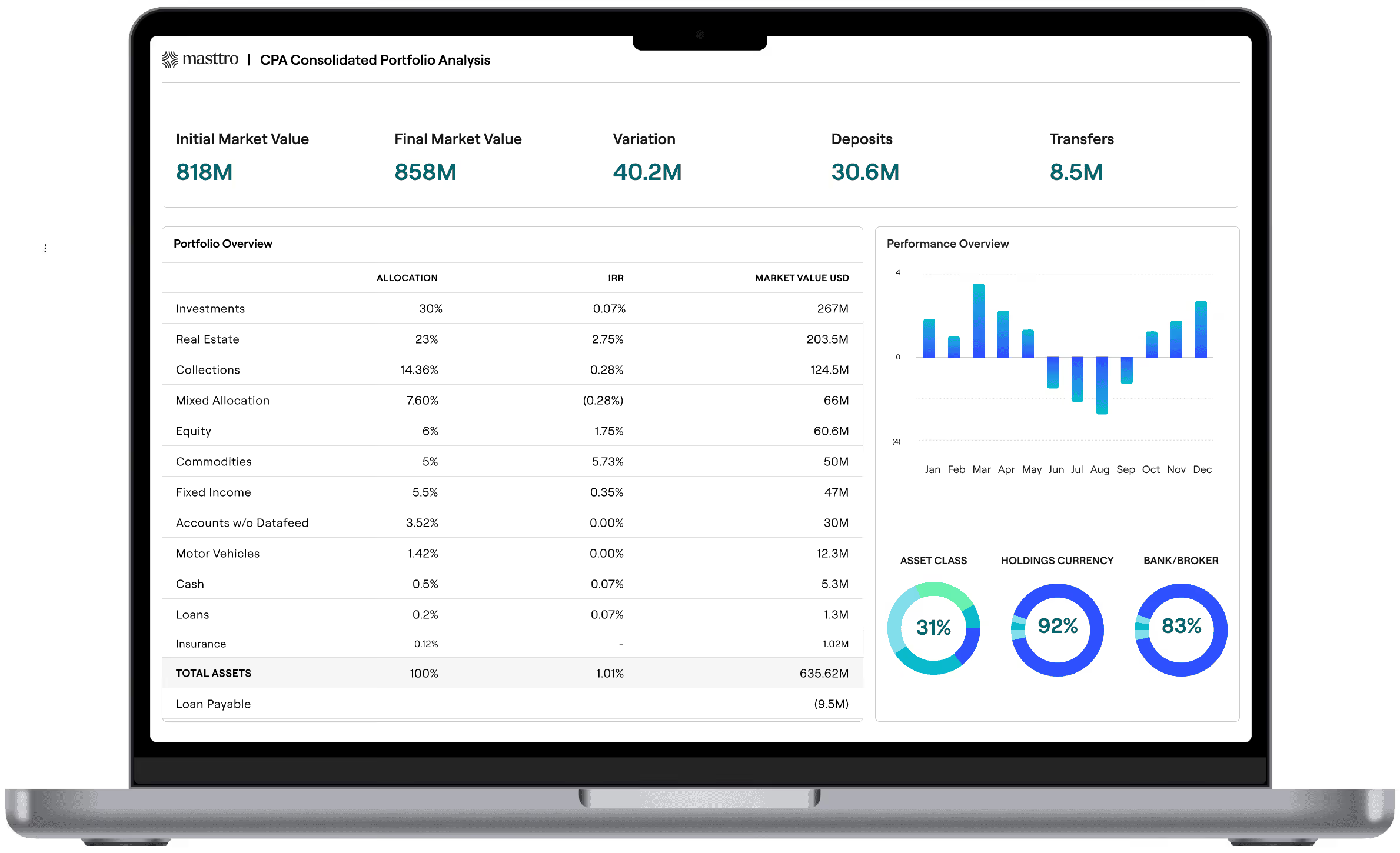
- Consolidated Portfolio Analysis for real-time multi-asset performance reporting, risk and portfolio monitoring, and the Portfolio Management Center for investment policy monitoring.
- Global Wealth Map for an interactive view of every entity and ownership percentage.
- Alternatives AI and Documents AI for capital calls, distributions, NAV statements and K-1s.
- Masttro Intelligence for natural-language questions across live portfolio and document data.
- A secure communication portal, mobile app and white-label reporting for advisors and multi-family offices.
Jefferson River Capital, a $1B+ portfolio, loaded 200+ alternative investments into Masttro and began tracking performance in three months or less. Stonebridge Family Office cut monthly reporting from 8–10 hours to a matter of hours.
"With Doc AI, we're able to tag [capital calls and distributions] appropriately, get the date in, get the amount right, and map it and reconcile it to our bank accounts accurately," said Mitchell at Jefferson River Capital.
How should you evaluate portfolio reporting vendors?
Demos use clean sample data. Your data will not be clean. Run every shortlisted vendor through the same test.
| Test | Why it matters | A good answer looks like |
|---|---|---|
| Load one private fund with a recent capital call | Shows whether alternatives are automated or manual | The call is read from the notice, matched to the bank debit and reflected in IRR |
| Map one trust that owns part of a holding company | Shows look-through ownership | Exposure appears at the correct percentage in every report |
| Add a non-USD account | Shows multi-currency handling | Reports in local and base currency, with FX effect shown separately |
| Ask for an export to your GL | Shows whether you can leave | A documented export or API, not a services project |
| Ask who at the vendor can see your data | Shows the security model | A specific answer about hosting, encryption and staff access |
| Ask for a reference with your complexity | Shows real-world results | A client with similar entities, assets and jurisdictions, live for 12+ months |
What will change in portfolio reporting in 2027?
Three shifts are already visible in vendor roadmaps and family office surveys.
AI on live data. Several vendors now connect their portfolio management software and reporting platforms to AI assistants. That is only useful if the underlying data is consolidated and reconciled first. An assistant reading a stale spreadsheet gives confident, wrong answers.
Private markets move to the center. With a third of the average family office investment portfolio in alternatives, quarterly private-fund updates entered by hand are no longer acceptable. Expect buyers to test document ingestion before anything else.
Succession raises the bar for clarity. About one-third of family offices surveyed by Citi expect leadership transitions within five years, according to the Citi Wealth 2026 Global Family Office Report. Reports must make sense to the next generation, not only to the operator who built them.
How much does portfolio reporting software cost?
Vendors use three main pricing models: a percentage of assets on the platform, common with wealth management and RIA tools; a per-seat or per-account fee; or a platform fee scoped to complexity. Some publish prices; many do not. Ask each vendor how the price changes if assets double, if you add an entity, and if you add a custodian.
Masttro's pricing is not based on assets under management, so the cost stays predictable as the family's wealth grows. Stonebridge Family Office chose Masttro because, as Saul Dyne put it, "we were priced out by other solutions, which would've been at least double the cost." See Masttro pricing.
Frequently asked questions
What is the best portfolio reporting software for family offices?
The best fit for a family office is a platform built for consolidated reporting across custodians, entities, currencies and alternatives. Masttro connects 750+ custodians in 40+ countries, automates capital calls and K-1s with native AI, and serves 400+ family offices.
What is the difference between portfolio reporting and portfolio management software?
Portfolio reporting software consolidates data and reports performance. Portfolio management software adds trading, automated rebalancing, tax-loss harvesting and order management for RIA firms. Family offices usually need deep reporting and light portfolio management, such as investment policy monitoring.
Can portfolio reporting software track private equity and hedge funds?
Yes, if it ingests capital call notices, distribution notices and capital account statements from private funds and venture capital managers, and tracks portfolio companies where the fund reports them. Look for IRR, TVPI and DPI calculations and automatic reconciliation to bank activity.
How do custodian data feeds work?
Custodians send position and transaction files to the reporting platform every day through direct connections. Direct feeds are more reliable and more private than screen scraping or third-party aggregators.
What reports should a family office produce each month?
Most offices produce a consolidated net worth statement, performance by asset class and manager, cash and liquidity, private-fund activity, and entity-level reports for trusts and holding companies.
How long does implementation take?
It depends on the number of custodians, entities and private investments. Jefferson River Capital, with a $1B+ portfolio, loaded 200+ alternative investments into Masttro and began tracking performance in three months or less.
Is portfolio reporting software secure?
It should be. Ask about hosting location, encryption, multi-factor authentication, role-based access and vendor staff access. Masttro hosts data in a Swiss private cloud, and its employees cannot access client data.
Does Masttro replace my accounting system?
No. Masttro is reporting-first. Its Investment Sub-Ledger bridges reporting and accounting and exports to your existing general ledger.
About this guide
Masttro's team wrote this guide for family office principals, COOs, CIOs and advisors evaluating reporting platforms. The capability checklist and vendor tests reflect what we see in evaluations across the 400+ family offices on Masttro. Market figures come from the third-party reports below. Masttro sells portfolio reporting software, so we state where our product stops: it has no general ledger and connects to the one you use.
Sources
- J.P. Morgan Private Bank, 2026 Global Family Office Report: asset allocation of 333 single-family offices.
- Citi Wealth, 2026 Global Family Office Report: leadership transition expectations.
- Institutional Limited Partners Association, Capital Call & Distribution Template v2.0, September 2025.
- Masttro client results: Jefferson River Capital and Stonebridge Family Office, as published by Masttro.
Next steps
Download the Alternatives Reporting guide or schedule an intro to see Masttro process one of your own capital calls.
Related guides: family office reporting software, family office accounting software, best family office software and Masttro alternatives.
“I appreciate the ease of use and the pre-produced library of reports that Masttro provides. It has significantly streamlined our processes, allowing us to produce reports in minutes that would have taken hours before.”
"I find Masttro simple to use. It's great because it allows us to keep all our assets in one place and use it as a repository for documents, track investments, and create dashboards and reports on assets."

“Consolidating the positions, I don’t have to do the reporting performance manually.”