Key Takeaways
For family offices, direct investing means putting capital straight into a private company, deal, or SPV, instead of into a fund. The strategy is growing in popularity, with 70% of offices in Citi’s latest survey stating they invest directly (Citi Wealth, 2025).
Direct investing comes with its own challenges. When you invest in a fund, for instance, your investment is managed by a GP who sends the capital calls, the NAV statements, and the K-1s. Direct deals, by contrast, provide none of those documents, so you become responsible for the back-office work. In one survey, 64% of single-family offices said they expect to make six or more direct investments in the next 12 months (BNY Wealth, 2025).
In this article we’ll discuss why families go direct, then cover the five reporting jobs that each deal adds. We’ll also explore how to report on funds and direct deals in the same view.
What is family office direct investing?
In BNY Wealth’s terms, direct investing is when the office negotiates directly with a private company to provide equity or debt, rather than committing capital to a third-party fund. Direct investing can take many forms, from a startup seed round to a buyout or a private credit loan.
Citi found that 52% of family offices favor growth-stage targets, while 37% target early-stage and 30% target secondaries (Citi Wealth, 2025). There are three paths to direct investing, and each one reports differently.
| Route | Who leads | Your control | Reporting you receive |
|---|---|---|---|
| Direct deal | Your office | High, often a board seat | Whatever the company sends |
| Co-invest with a GP | The GP | Deal choice only | GP reports |
| Club deal or SPV | A lead family or sponsor | Shared | SPV capital account statements |
Direct deals
In a direct deal, your office finds the company, runs the diligence, and sets the terms. Families that ran a family business are often effective direct investors because they’ve run a P&L and managed staff in the past. Some families write angel checks or join venture capital rounds, but most back operating businesses in industries they know.
Co-investments alongside a fund manager
A fund manager you already back offers you a slice of a given deal next to the fund. The GP leads and reports. You pick the deals and usually pay lower fees.
Club deals and SPVs
Several families pool capital into a special purpose vehicle (SPV) that holds the stake, splitting the check and the diligence. The SPV is also a legal entity with its own bank account, statements and box on your ownership chart.
Why are family offices investing directly?
Seventy percent of offices invest directly, and North American offices are the most engaged at 77% (Citi Wealth, 2025). Direct investment is increasingly popular because it affords control, alignment, and fees.
A direct stake gives you a seat next to management and removes the management fee and performance fee (although you pay for diligence and lawyers instead). It applies the family’s operating experience. And, families with long-term investing horizons are open to allocating to illiquid asset classes.
In 2024, the average office held 21% of its portfolio in private equity, 11% in direct investments, and 10% through funds or funds of funds (UBS, 2025).
UBS also puts next-generation involvement in direct private equity deals at 31% of offices. For family members who want a hands-on role, there is appeal to the board seat that sometimes comes with a direct investment. In summary, taking a direct stake is the part of private investing where the family’s own judgment shows most, which is one of the four reasons offices are allocating to PE.
What makes direct investing hard in practice?
The hard part isn’t writing the check, but rather the resources that each deal consumes. 44% of U.S. offices cite understaffing as a key challenge for direct investing, an 83% rise year over year (BNY Wealth, 2025).
Offices with more than $500 million in assets under management are more engaged (74%) than smaller ones (67%), and Citi links that gap to the cost of in-house due diligence (Citi Wealth, 2025).
A direct deal gets weeks of diligence before close and very little attention after it. There’s no fund administrator, so no valuation statement arrives unless you build one. Each deal ends up as a spreadsheet row with cost and the last mark, and within a year that mark is stale. No one notices until the principal asks what it’s worth.
Those failures trace back to five jobs a fund does for you and a direct deal doesn’t.
What does each direct deal add to your reporting?
Every direct deal adds five reporting jobs: a new entity, cash flows on no schedule, a valuation you set yourself, scattered documents, and hidden exposure.
A new entity in the ownership structure
Most deals sit in an LLC, holding company or SPV for liability and tax reasons. The principal needs to know which entities own what, because unmapped stakes get missed in distributions, tax filings and estate conversations. Masttro’s Global Wealth Map compiles a visual representation of the ownership structure from live data.
Cash flows that follow no calendar
Follow-on rounds, bridge notes, dividends, and exit proceeds arrive when they arrive. Is the cash for next quarter’s follow-on sitting in the right entity? A cash management view across accounts and entities answers that without chasing down answers.
A valuation you have to mark yourself
When you direct invest, there is no GP to send a NAV statement. Your office marks the stake off the last priced round, public comparables or cost, and records the method and date. Masttro’s venture capital reporting keeps venture funds, SPVs and direct stakes in one view with a tear sheet per deal. You set the mark; Masttro records it and its history.
Documents that live in inboxes and data rooms
Subscription agreements, cap tables, board packs from portfolio companies, capital account statements (PCAPs) from SPVs, and K-1s for taxes, all arrive by email or portal. Masttro’s Documents AI and Alternatives AI read capital calls, distributions, capital account statements and K-1s as they arrive, so the numbers are normalized and accessible in one place.
Exposure that hides across the portfolio
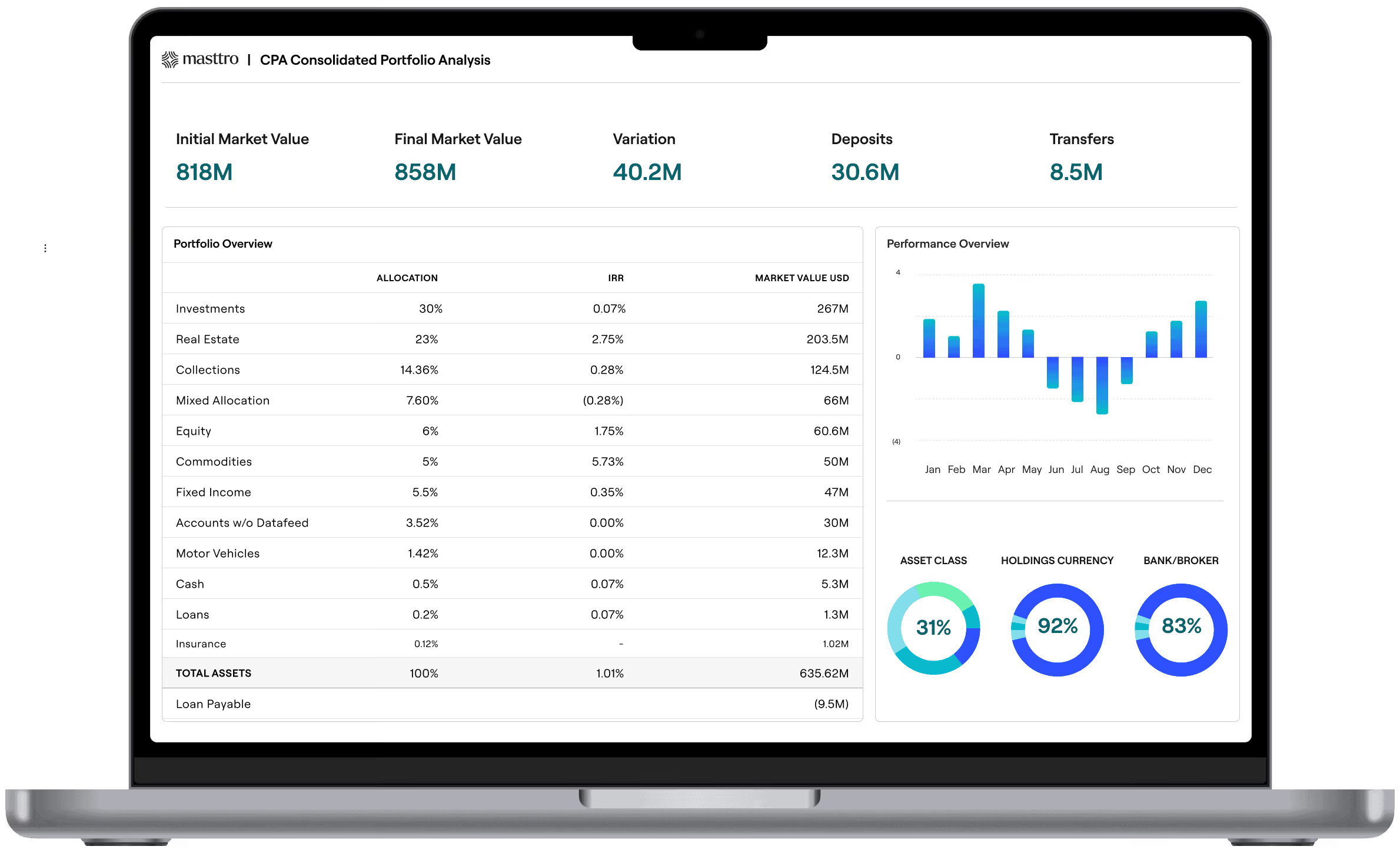
One sector can show up in three different ways: as a direct stake, a co-invest, or a fund commitment. Tag every position by asset class, sector and owning entity, and Masttro’s consolidated portfolio analysis shows them side-by-side alongside the rest of the portfolio.
These five jobs are manageable when the family has two direct deals. But as the number of deals grows, the principal needs to be able to see them on one page.
How should you report on direct investments?
Report every deal on the same small set of metrics, then roll the direct book up next to the fund book so the principal can see the entire private book at once.
| Metric | What it shows | Source |
|---|---|---|
| Cost basis | Paid in, including follow-ons | Subscription documents, wires |
| Current mark and method | Today’s value and how you got it | Last round, comparables or cost, dated |
| Ownership % | Your fully diluted share | Cap table |
| MOIC | Value plus proceeds, over cost | Cost, mark and proceeds |
| IRR | Return timed to cash flows | Dated cash flows |
| Follow-on reserves | Cash held for future rounds | Committee decision |
| Realized proceeds | Dividends, sales and exits | Bank statements |
| Owning entity | Which LLC, trust or SPV holds it | Ownership chart |
List those eight metrics on a one-page tear sheet per deal, then produce a consolidated private markets statement that reports on the direct book beside your funds, tracked on DPI, TVPI and IRR (see private equity reporting).
For hedge funds, real estate and the rest of the portfolio, see how to report on alternatives.
Jefferson River Capital tracks a $1B+ portfolio with 200+ alternative investments in Masttro, implemented in three months or less. Read the case study
Building a direct investing program that lasts
An enduring direct investing program starts with written criteria and governance processes, then matches the deal pace to the office’s capacity.
Investment criteria and governance
For each investment, document the sector, stage, check size, and holding period. Family governance decides who sits on the committee. Fold the program into succession planning, with a named successor for each board seat.
Deal flow and due diligence
Deal flow comes from the family’s network, GPs, and other families. Diligence is actually a more common bottleneck than sourcing, so if your team can properly examine three deals a year, don’t sign up for five.
In-house, co-invest or outsource
BNY points to co-investing as a way to build experience before leading deals. Bring in legal and tax advisors for structuring early, and plan your reporting capacity for the entities you’ll have in five years. It’s part of setting the office’s broader strategy.
“We went from having no consolidation tool or data feeds to having both capabilities in a single platform - that also happens to track private equity investments perfectly.”


Alternatives Reporting: From Below the Line to All of the Above

Keeping direct deals and fund commitments in one view
The five reporting jobs are the same at 5 deals or 50. The biggest difference is whether they live in one system, or in a separate spreadsheet per deal that slowly loses entities and marks.
Purpose-built family office software consolidates direct deals, fund commitments, and their owning entities. Built in 2010 inside a multigenerational family office by operators solving their own problem, Masttro covers venture funds and direct stakes alike, through funds, SPVs or directly, with a tear sheet per fund and deal.
Alternatives AI and Documents AI process capital calls, distributions and valuations as documents arrive. Every position maps to its owning entity in the Global Wealth Map, beside hedge funds, public equities and fixed income. You still decide each mark. Masttro records it.
With Masttro, Stonebridge cut its reporting from 8 to 10 hours a month to a few. Read more on private markets reporting automation.
Frequently Asked Questions
What percentage of family offices make direct investments?
About 70%, and 77% in North America (Citi Wealth, 2025). Offices above $500 million are more engaged (74%) than smaller ones (67%).
What is the difference between a direct deal and a co-invest?
In a direct deal your office sources the company, runs the diligence and sets the terms. In a co-invest, a GP leads and reports, and you join one deal alongside its fund, usually at lower fees or none.
How many people does it take to invest directly?
Enough to diligence every planned deal and report on every held one. Understaffing is a key challenge for 44% of U.S. offices (BNY Wealth, 2025), so many start with co-invests and outside counsel.
How do you value a private company stake between funding rounds?
Most offices use the last priced round, public comparables or cost, and record the method and date each time. Your accountants and auditors should set the policy.
Should a direct deal be held through an LLC or SPV?
Many families hold each deal in its own LLC or SPV to ring-fence liability and keep records and cash separate; others use one holding company. Each vehicle typically adds its own filings and documents to track, such as K-1s. Structuring is a question for legal and tax advisors, since it turns on jurisdiction and tax position.
How do you report direct deals alongside private equity funds?
Give each deal a tear sheet with the eight metrics above, report funds on DPI, TVPI and IRR, and combine both in one private markets statement.
Can Masttro track direct deals and SPVs?
Yes. Direct stakes, SPVs and fund commitments sit in one view, each mapped to its owning entity with a tear sheet per deal. You set the valuation; Masttro records each mark.
“Masttro has helped us uncover and map companies and assets that were not clearly identified or centralized before.”
“With Masttro we have the tools to manage assets that are nontraditional, and that’s translated into an opportunity to provide a much broader service than investment management.”

“We can fully visualize our portfolio and give full transparency to each family member. Additionally, we can now track our performance across alternative investments extremely well and accurately.”