
Every quarter, someone on your team logs into a series of GP portals. They download the capital call notices and capital account statements from each one, and type the numbers into a spreadsheet.
That routine now sits behind 42% of the average family office portfolio (BlackRock, 2025).
That routine is only necessary because private market data is communicated in documents. Manually recopying that data from each document into a spreadsheet takes time, but it also introduces human error. For instance, a distribution can land in the wrong entity, or a Euro call can convert at the wrong rate. Even worse, a principal can ask to forecast next year’s cash flows, and the honest answer can be, "give us two days."
Private markets reporting automation fixes that, but only as long as every figure that the system produces can be traced back to the document it came from.
Below, you'll see the five-step workflow from GP document to principal report, along with guidance on what your team should still review and which documents you should try to automate first.
Key Takeaways

What is private markets reporting automation?
Private markets reporting automation is software that reads the documents fund managers send (such as capital call notices and quarterly statements) and turns them into trusted figures and consolidated reports without anyone re-keying anything. It meets a widespread need that 73% of family office software platforms name as their hardest problem to solve (Simple, 2025).
Every private fund has two sides. The general partner (GP) runs the fund and sends the documents. The limited partners (LPs) invest in the fund and receive the documents.
A family office is almost always the LP. For LPs, automation helps them handle the documents that arrive from GPs. They don’t need help drafting or issuing documents of their own.
That distinction is where most buyers get lost. A lot of investor reporting software is built for general partners and fund administrators. It tracks portfolio companies, handles portfolio monitoring for the deal team, and produces LP reports for outside investors.
Family offices usually sit on the other side of the table. They receives capital call notices, distribution notices, capital account statements and K-1s from dozens of managers. Then, they have to fold that financial data into one view alongside custodial accounts, real estate, direct investments, and operating companies.
If you’re still deciding on a platform, our guide on how to choose private markets reporting software covers the selection criteria. This article covers the workflow itself.
Why do quarterly reporting processes break in Microsoft Excel?
Monthly reports from advisors are still consolidated into Excel by hand at many family offices, according to the Citi Institute (Citi Institute, May 2026). Excel holds up until the family wants to track additional entities, currencies, managers, and asset classes. Then the quarterly cycle starts to slip.
Excel breaking is a when, and not an if. Spreadsheets simply weren’t designed to track private markets data. A capital call can be booked to the family holding company when the wire went out from a trust, or a euro-denominated distribution can be converted at month-end instead of on the payment date. Such mistakes are common when humans are responsible for entering every line of data, and spreadsheets don’t make it obvious when a figure or a formula is wrong.
The real risk is that financial reports and decks prepared for the principal inherit whatever errors sit upstream. What’s more, the logic that contains the errors may live in one person’s laptop.
Henry Urquidi of Futura Asset Advisors described the old approach: “we had to set up monstrous macro spreadsheets.” That’s not a preference for this tool or that one; it's key-person risk attached to every number the principal reads.
For a deeper look at why alternatives deserve the same reporting precision as public assets, download our whitepaper, Alternatives Reporting: From Below the Line to All of the Above.
How does private markets reporting automation work, step by step?
Private markets reporting automation works as a five-step pipeline:
- Ingest the documents
- Extract the figures
- Validate them
- Reconcile them to cash
- Consolidate and report
With alternatives at 42% of family office portfolios (BlackRock, 2025), each step touches a large share of what principals own.
Step 1: Document ingestion from every GP
Automation starts by collecting documents from wherever they land: GP portals, email inboxes, or shared drives. Documents can cover investments across private equity, venture capital and private credit funds, plus co-investments and direct deals.
For example, Masttro’s Documents AI ingests files through bulk upload or email forwarding, then classifies each one before anyone opens it.
Step 2: Extract capital calls and distributions, NAV, and transactions
Next, the system pulls structured fields out of each document. In a capital call notice, that means the amount, due date, fund, investing entity, and wire details. In a capital account statement, it means NAV, contributions, distributions, fees and unfunded commitment.
The most robust extraction methods work at the transaction level, so transaction reporting doesn’t stop at quarterly totals. Our guide to capital call processing walks through that process in detail.
Step 3: Validation checks and entity matching
Extracted numbers are only useful once they’re tied to the right investment. Entity matching links each document to the commitment it belongs to, which matters when the same fund is held by a dynasty trust, an LLC, and two investment companies.
Validation checks then test the figures: does paid-in capital plus unfunded commitment equal the original commitment? Does NAV roll forward from last quarter? Any fund identifier, currency, or commitment amount that doesn't match the master record gets flagged automatically.
Step 4: AI-powered reconciliation against cash
A capital call isn’t complete until the cash has moved. AI-powered reconciliation matches GP activity to custodian cash movements, so a $2.4 million call either ties to a wire or shows up as a break.
Masttro’s Alternatives AI collects and categorizes GP communications, pulls transaction-level details and reconciles them to cash flows. Reconciliation teams stop hunting for matches and start clearing exceptions.
Step 5: Consolidation and document generation
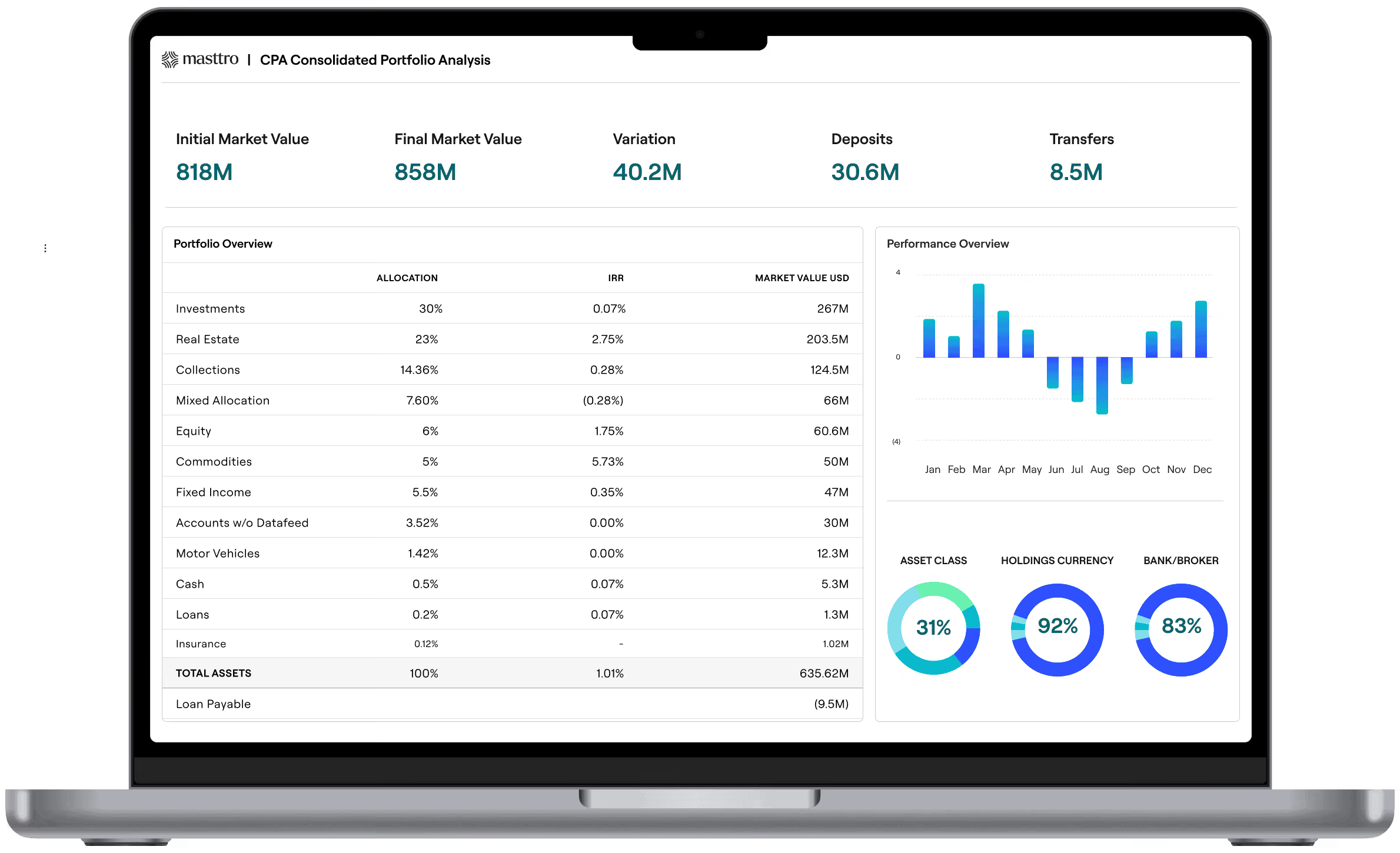
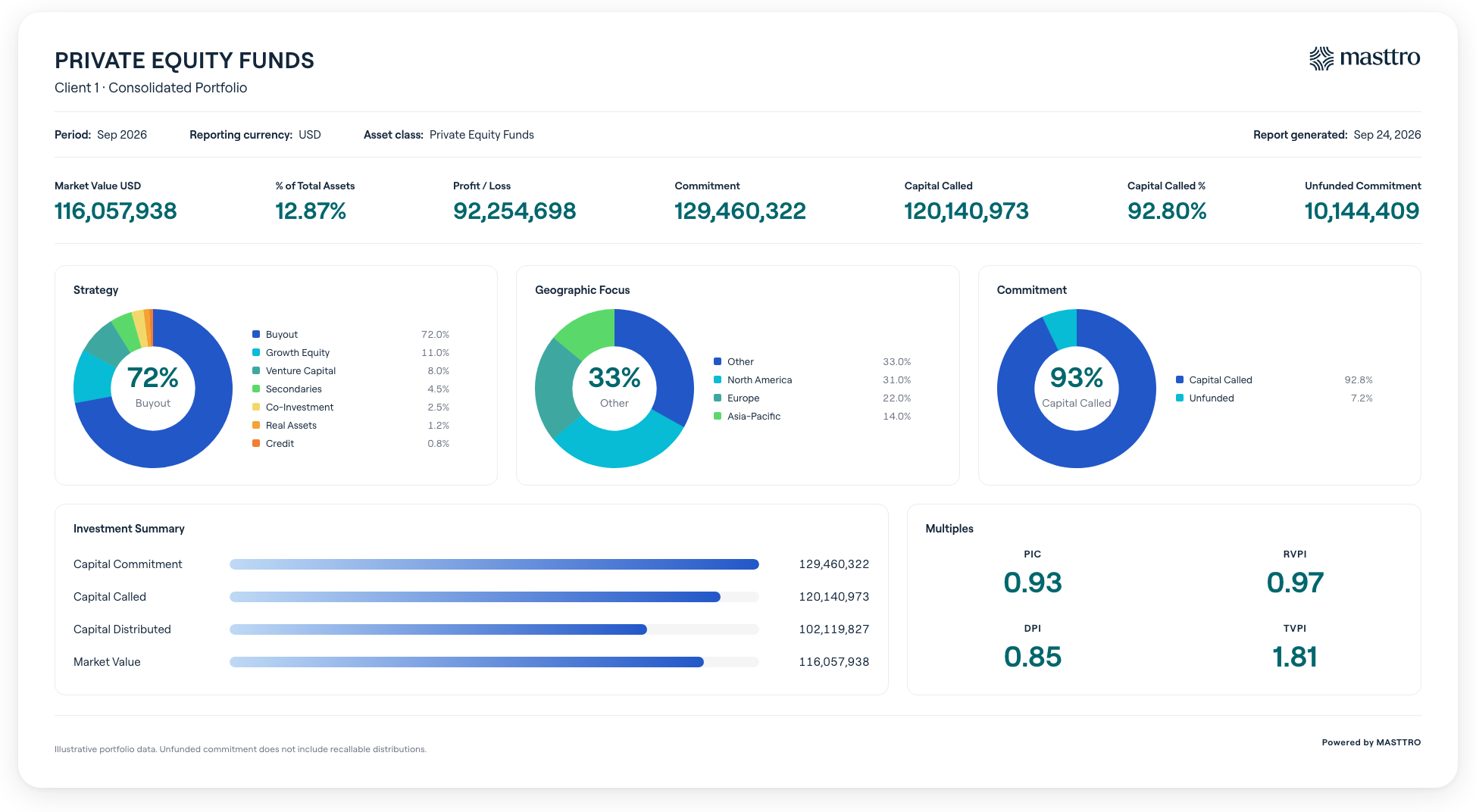
Finally, validated private holdings roll into the consolidated view alongside everything else the family owns. Data consolidation happens by entity, currency and asset class, and fund performance metrics such as IRR and TVPI update with it. Document generation then produces the reports: principal summaries, committee packs and, for MFOs, client reporting.
Permission-based sharing lets you control who sees which entity, and real-time communication through a secure portal replaces emailed PDFs.
Compare your current processes against this table. Every cell where your answer is “an analyst in a spreadsheet” is a place where automation can contribute.
Data lineage decides whether principals trust automated reports
Data lineage engenders trust, and principals won’t act on a number they can’t trust. The Citi Institute found that many family offices lack confidence in the accuracy of reports produced by AI tools, and called it a major roadblock to full automation (Citi Institute, May 2026).
In practice today, lineage means a reviewer can click any figure in a report and land on the page of the GP statement it came from. It also means an audit trail exists, showing who approved the figure, when it was approved, and what changed since last quarter.
To practice good data lineage, each fund, commitment, and entity needs one golden record, so a single fund doesn’t appear under three spellings across three trusts. That record should also carry the non-financial data that affects reporting: side-letter terms, commitment dates, and whether a K-1 has arrived.
Masttro’s Alternatives AI keeps data traceable to the document source, and the AI runs entirely inside Masttro’s private environment on a Swiss-hosted private cloud. Permissions can be set by role, entity or individual, with audit logs behind them.
What does automated private equity reporting look like in practice?
Oftentimes, UHNW families hold large private equity positions with managers around the world. These teams need a platform that can ingest capital calls and distributions automatically, with no manual input and no scrutinizing PDFs.
With automated reporting, clients log in and see live data instead of waiting for a monthly report. In a case study, Saul Dyne of Stonebridge highlighted the value of commitment visibility: “Masttro lets clients who are really strong on private equity quickly log on to see their outstanding commitments so they can decide if they’re in a position to make another commitment.”
That’s the value of real-time data in private markets. A principal deciding on a new fund commitment needs to know what’s still uncalled across every vehicle, today.
Read the full Stonebridge case study to see how the team made the move.
Which private markets use cases should you automate first?
Automate the documents with deadlines and the highest error cost first. The Citi Institute found that reporting, account reconciliation, and investment intelligence are the AI uses family offices mentioned most (Citi Institute, May 2026).
Among private markets use cases, capital call processing is the no-brainer.
Capital call notices are the only documents that come with a wire deadline. Miss one and the problem isn’t a stale report, but rather a potential default. That makes them a strong candidate to automate before any others.
Building a Successful Family Office Tech Stack

Real estate asset reports and document management for legal and insurance files can follow the same pattern once the fund workflow is stable.
For tax documents, see how family offices are fixing the K-1 workflow.
For forecasting, Masttro’s Cash Projection Hub projects calls, distributions, NAV and unfunded commitment for every closed-end fund using the Yale Model framework.
How much human oversight does agentic AI still need?
Agentic AI still needs a human to validate every decision that moves money or changes a reported value. Adoption is climbing: 22% of family offices have automated some operational tasks with AI, and 16% use it for investment performance reporting (Citi Wealth, 2025).
AI is most useful for handling the repetitive parts of data processing: classifying a document, finding the NAV line on an unfamiliar statement, or spotting a figure that doesn’t roll forward. Agents can chain those tasks together.
What they shouldn’t do is approve a wire, override a valuation, or decide whether a manager deserves a re-up. Those are human decisions.
The Citi Institute makes the same call on investment work. AI can speed up due diligence by screening documents and flagging risks, but it serves as an assistant rather than a decision-maker. Far from acting as a brake on automation, human judgment is what gives investors enough trust to actually use the output of an AI.
A rule of thumb is to let the system prepare, check, and propose. Give humans the job of approving anything with cash or risk attached.
For more on where agents fit, read our piece on agentic AI in the family office.
How to put private markets reporting automation in place
Most family offices can put private markets reporting automation in place in four steps. Surprisingly, lack of internal expertise was the top barrier to technology adoption, cited by 57% of family offices (Citi Wealth, 2025).
- Create a full inventory: List every GP, portal, commitment and investing entity.
- Fix the reporting template: Decide what the principals, the investment committee, and each MFO client should see before you automate anything.
- Connect documents and cash on one data platform: Instead of stitching specialized tools together, Masttro pairs its AI suite with 700+ direct custodian feeds, so documents and cash meet in one place.
- Run one quarter in parallel, then retire the spreadsheet: Compare outputs line by line. Once they tie, you don’t need to maintain both.
See how Masttro automates capital calls, NAV and reconciliation for family offices, and bring your hardest fund documents. Schedule an intro.
FAQs about private markets reporting automation
How long does it take to automate private markets reporting for a family office?
Timing depends on how many GPs, entities and currencies you hold, and how clean your commitment records are today. Plan to run at least one full quarter in parallel before retiring the spreadsheet. Offices that inventory funds and entities first move faster, because matching documents to commitments is where most setup time goes.
Can AI read capital call notices and K-1s accurately?
AI extraction handles standard fields such as amounts, dates and NAV well, even across different GP layouts. Accuracy comes from what surrounds it: validation checks, confidence flags and a person reviewing exceptions. That matters because many family offices still lack confidence in AI-produced reports, according to the Citi Institute (May 2026).
How much does private markets reporting automation cost?
Costs vary by the number of entities, data feeds and documents in scope, and few vendors publish figures. Pay attention to the pricing model as well as the price. Masttro’s pricing is not based on your AUM, so adding commitments or growing the portfolio doesn’t raise the platform fee the way an asset-based model would.
Does reporting automation replace a family office’s reconciliation team?
No. It changes what the team works on. Instead of matching every capital call to a wire, reconciliation teams clear the breaks the system can’t resolve and approve cash movements. The Citi Institute notes that a human stays in the loop across family office AI use, with AI acting as an assistant.
How does private markets reporting automation support SEC regulations for MFOs and RIAs?
Automation doesn’t make a firm compliant on its own, but it helps. Retained source documents, timestamped approvals and an audit trail make it easier to show how a reported figure was produced. Futura Asset Advisors once built SEC compliance reports from individual bank statements and spreadsheets. Confirm specific obligations with your compliance counsel.
How do you automate private equity reporting across multiple entities and currencies?
Start with entity matching, so each commitment is tied to the trust, LLC or holding company that owns it. Then convert flows at the rate on the transaction date and roll positions up by entity and currency. Masttro serves family offices in 40+ countries. As one single family office founder, Alejandro Bazúa, put it: “Masttro pulls all the information together, no matter the jurisdiction, no matter the entity or structure.”
Does Masttro automate capital calls, distributions, and NAV statements?
Yes. Masttro’s Documents AI ingests and classifies fund documents, and Alternatives AI collects and categorizes GP communications, pulls transaction-level details and reconciles them to cash flows. The result is clean data ready for review and reporting, with each figure traceable back to its source document.
Is Masttro’s Alternatives AI a fit for multi-family offices?
Yes, particularly for MFOs with heavy private equity exposure. Stonebridge Family Office uses Masttro to serve six families across three regions, and its clients log in to see outstanding commitments directly. Masttro’s forecasting also lets an MFO apply different assumptions to the same fund for different client families.