Key Takeaways
Masttro and Truewind connect wealth reporting to the family office general ledger
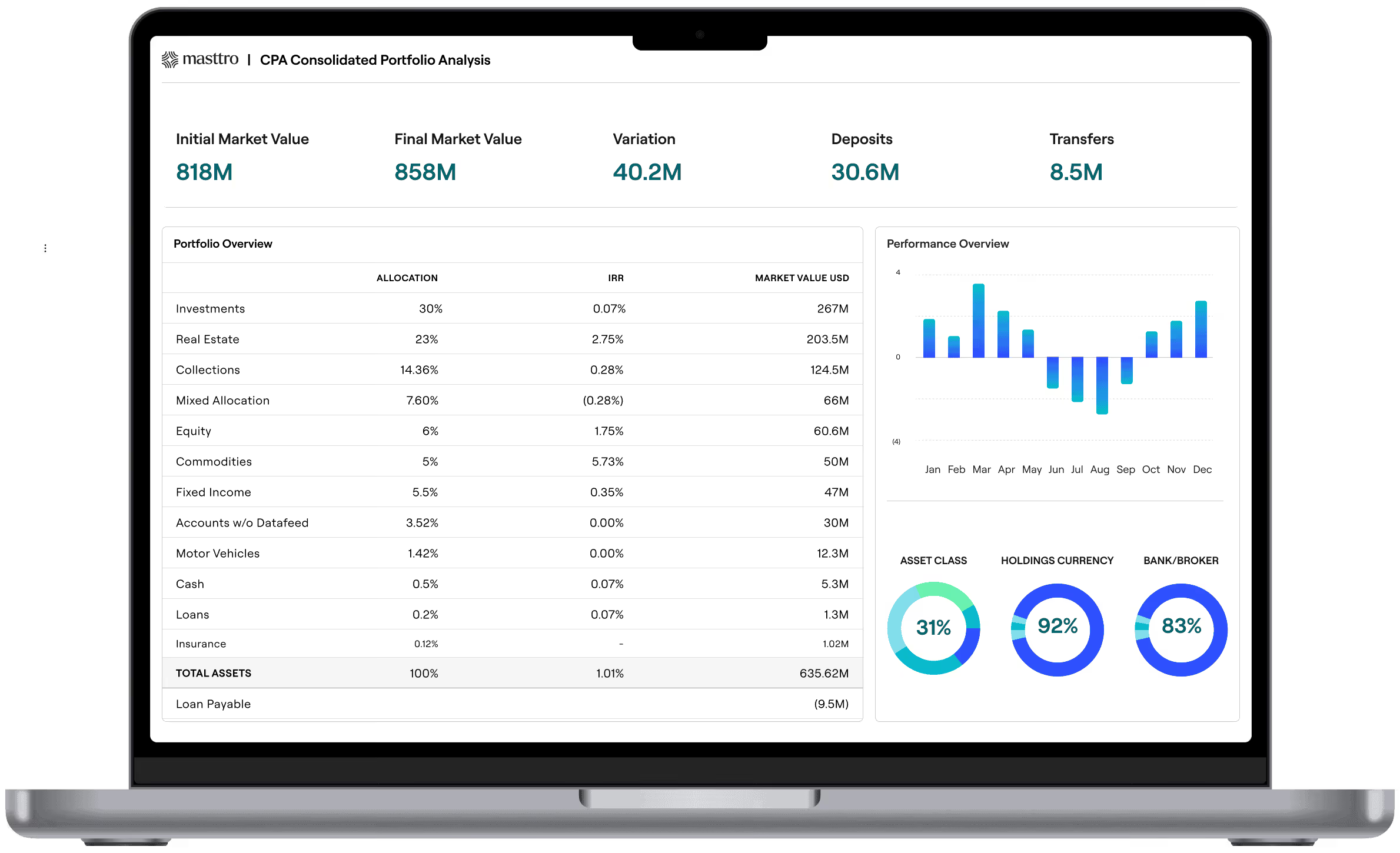
Masttro clients can now move consolidated wealth data into their accounting platform without rebuilding it by hand each month. Through a new partnership with Truewind, the San Francisco AI accounting platform used by finance and family office teams, positions, transactions, and entity detail from Masttro are converted into review-ready journal entries and delivered into systems such as Sage Intacct.
Why does the same data get rebuilt every month?
Because reporting and accounting have never spoken the same language. Masttro organizes wealth by entity, ownership, and asset class — the way a family actually holds it. An accounting system organizes everything by account. Someone in the middle has always been responsible for translating one into the other, usually in a spreadsheet, usually in the last week of the close.
That gap is not a niche complaint. Simple’s 2025 Family Office Software & Technology Report identified data integration as the most requested capability among family offices, and also the most common point of failure. Every month the translation happens by hand is a month where the general ledger lags the portfolio, and where a keying error can survive review.
How the integration works
Clients map Masttro’s data to their own chart of accounts once, at setup. After that, information flows into the accounting platform in a structure it recognizes, with entity, ownership, and asset class detail preserved rather than flattened. Truewind produces the journal entries; the accounting team keeps final review and posting decisions. The general ledger stays current, and Masttro remains the system of record for wealth data across the full estate.
Nothing about the reporting side changes. The data aggregation layer keeps pulling from 750+ direct custodian feeds across 40+ countries. Documents AI keeps extracting from capital calls, NAV statements, and K-1s. Alternatives AI keeps valuing private positions. What’s new is where that consolidated picture can go next.
“Our clients have told us clearly what they want: their wealth data in one place, and the ability to put it to work with the tools their teams already use,” said Jay McNamara, CEO of Masttro. “Truewind built a translation layer that respects both sides of that equation. The reporting stays in Masttro, and the accounting stays in the accounting system. The manual work in between is what goes away.”
Who controls the data?
The client does. Data moves only where the client directs it, with full encryption and permissioned access enforced at every step. Masttro does not use client data to train models, and Masttro employees cannot see client data — the same data security posture that governs every other part of the platform.
Why Truewind
Truewind is an AI digital accountant built to compress the month-end close, automating bank transaction categorization, accrual workpapers, and reconciliations. The company has raised $17 million from investors including Y Combinator, Thomson Reuters Ventures, Rho Capital Partners, Fin Capital, and Pathlight Ventures.
“Family offices manage some of the most complex financial structures in the world, yet too much accounting work still depends on moving data between systems by hand,” said Alex Lee, co-founder and CEO of Truewind. “Masttro brings together investment data across accounts and assets, and Truewind helps translate that data into traceable, review-ready journal entries. By connecting those workflows, we can reduce manual re-entry and help finance teams close faster with greater confidence in their accounting.”
What this changes for family office operations
For a single family office running an in-house controller, it removes the monthly re-keying that sits between the investment book and the ledger. For a multi-family office, it means the same close process holds up across households without adding headcount for every new one. For the professional service firms that support both, the numbers arriving in the accounting system now carry the entity and ownership detail that made them defensible in the first place.
Masttro clients interested in the Truewind integration can book a demo to see how the mapping works against their own chart of accounts.
Building an Effective Family Office Tech Stack