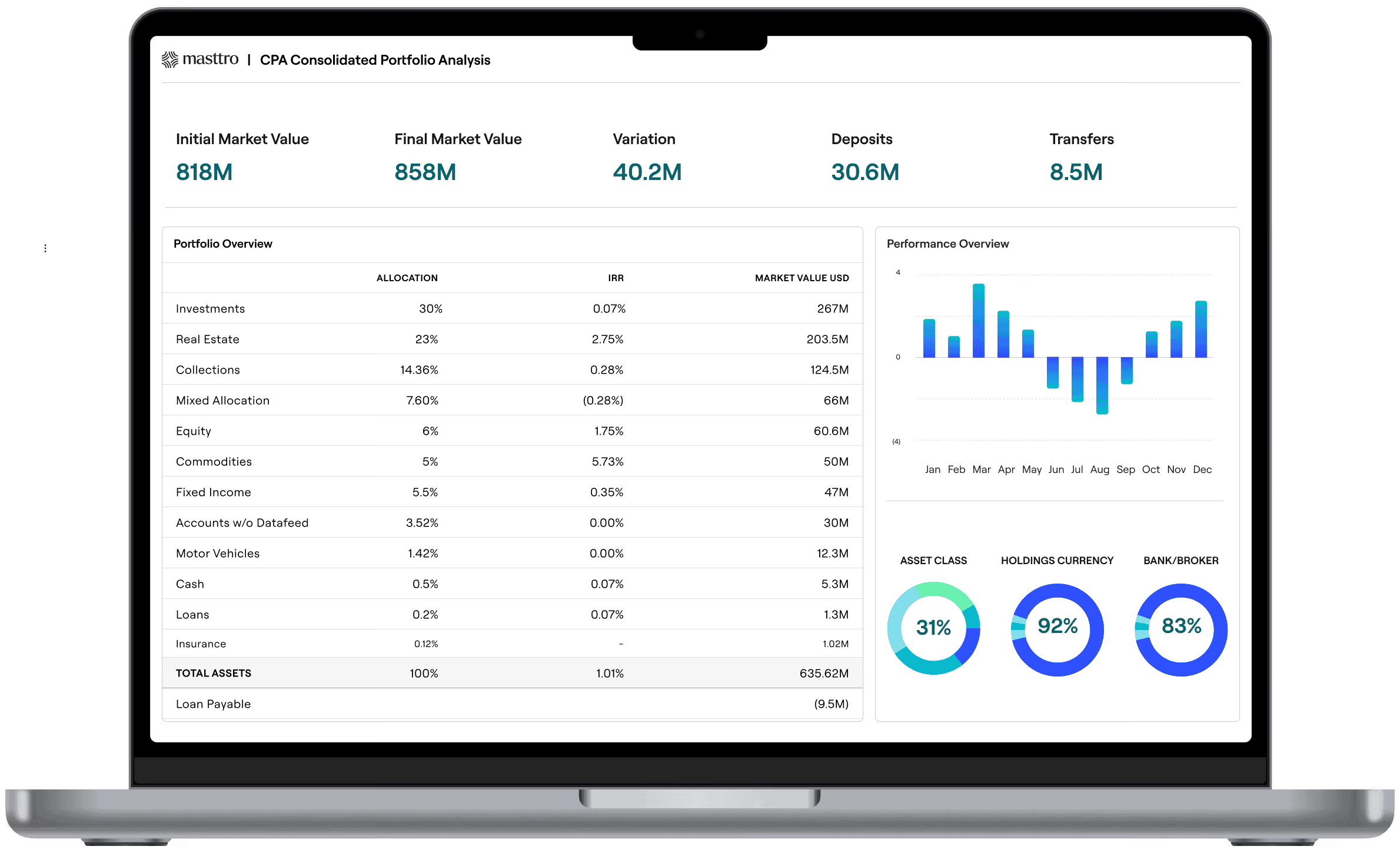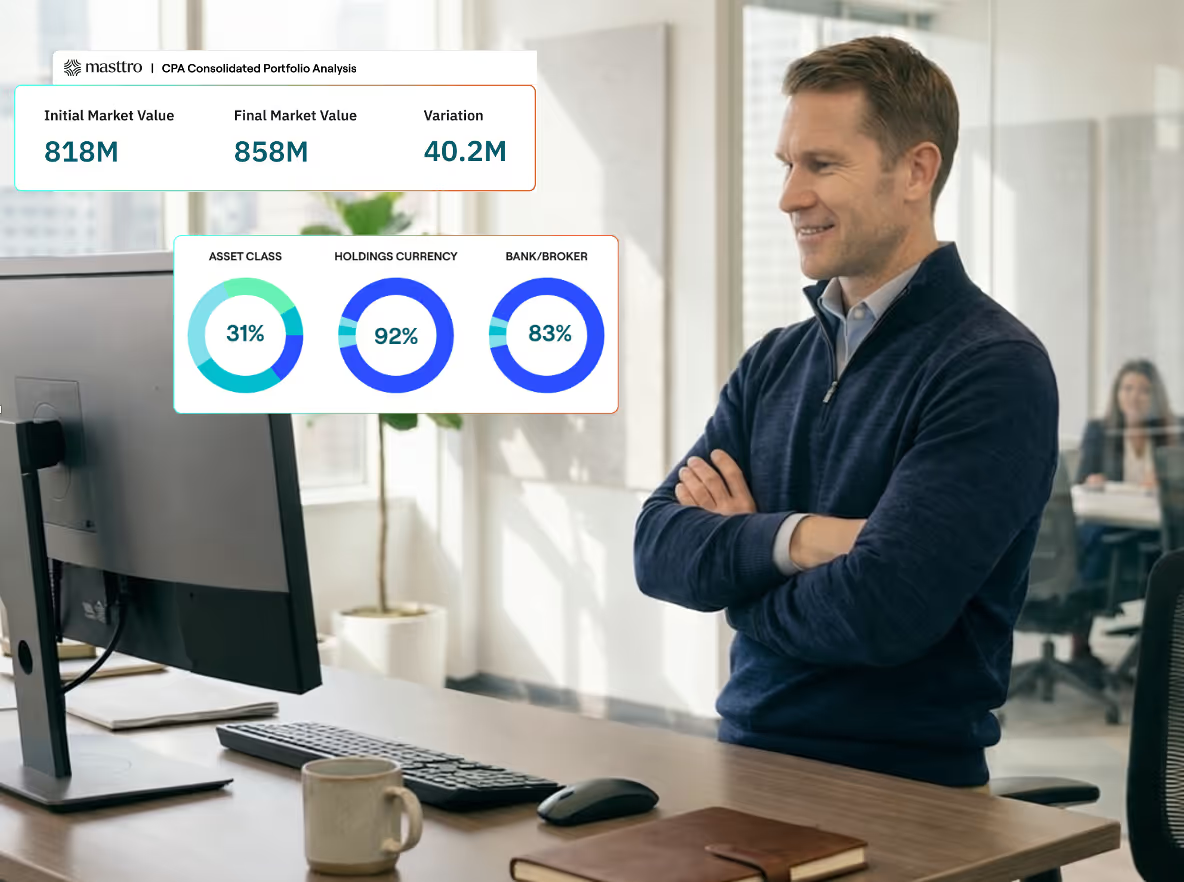

It’s the last week of the quarter, and the controller at your family office is chasing the same numbers from three directions. Statements from a dozen custodians, cash movements from several banks, and a stack of capital-call PDFs from private equity sponsors. Each arrives in its own format, on its own schedule, and none of them quite agrees with the spreadsheet ledger.
Before a single quarterly report can go to the principal, every line has to be matched, checked, and explained. That slow, manual, and unforgiving work is known as data reconciliation, and in the typical family office, it’s upstream of everything from a credible net worth number to a report breaking down private equity performance.
This guide explains what data reconciliation for family offices actually involves, why it’s harder here than almost anywhere else in finance, what a modern automated reconciliation engine does differently, and how to evaluate the tools that promise to fix it.
Key Takeaways

What is data reconciliation for family offices?
Data reconciliation is the process of confirming that the financial records a family office holds internally match the records held by every external source (like custodians, banks, and investment managers). Reconciliation ensures that the final picture of wealth is accurate and can withstand scrutiny.
In practice, it means matching positions, transactions, and cash flows line by line across all asset classes until the internal ledger and the outside world tell the same story.
Note that data reconciliation isn’t the same as data aggregation. Aggregation gathers information from many places into one system, while reconciliation verifies that the gathered information is correct. Aggregation answers, “do I have everything?” while reconciliation answers, “is what I have right?”
A family office needs both, but reconciliation is where data integrity is won or lost.
Reconciliation vs. aggregation: what’s the difference?
Aggregation without reconciliation produces a dashboard that looks complete but cannot be trusted. You can pull portfolio data from a dozen sources into a single screen, but without some way to check that it’s right, that data can’t reasonably be used for financial reporting.
Mistakes happen; transactions can be double-counted, or a cost basis can fail to tie back to the custodian’s tax lot. Reconciliation is what turns your aggregated view into a mistake-free one.
Why reconciliation is uniquely hard for family offices
Most financial institutions reconcile within a single asset class, a handful of systems, and one reporting entity. A family office does almost the opposite. It manages multi-asset portfolios that span liquid and illiquid assets, public and private assets, and a web of ownership structures like trusts, holding companies, LLCs, foundations, and partnerships. All of this can take place across several currencies and jurisdictions. The data for all of it has to reconcile, and not just per account, but across the entire multi-entity structure.
Complexity is also growing within family offices. According to the UBS Global Family Office Report 2025, family offices allocate roughly 44% of their portfolios to alternatives, including private equity, real estate, private debt, and hedge funds. Every one of those allocations carries accounting, capital flow, and valuation requirements. Furthermore, alternatives have to be reported alongside the family office’s public equity holdings.
Wealth rarely lives in one place. It’s typically held through multiple entities, at multiple custodians, in multiple currencies, and across multiple generations. Aggregation unites that wealth, and reconciliation validates it. However, the complexity means that reconciliation processes built for a single brokerage account break when applied to multi-entity family office structures.
The single-source-of-truth problem
Financial data flows into a family office from custodians, asset managers, and other systems. Each of these systems has its own version of the truth. Without mapped ownership structures and disciplined reconciliation, these versions end up competing with one another. The goal of reconciliation is to arrive at a single, overarching source of truth that every stakeholder, from the principal to the auditor, can rely on.
The hidden cost of manual reconciliation processes
When the volume is modest, a spreadsheet feels manageable. The risk is that manual reconciliation doesn’t scale linearly with volume. Doubling the number of holdings can triple or quadruple the time required to reconcile, because every new custodian, entity, and asset class multiplies the number of connections that have to be checked. A reconciliation methodology that worked last year can fall dramatically behind this year, despite apparently minor changes to the portfolio.
The costs show up in four ways:
- Accuracy: Manual data entry and re-keying introduce inconsistencies. A single mistyped figure can flow into performance measurement and a client report before anyone notices, and error correction after the fact is far more costly than catching the mistake at the source.
- Time: Teams lose hundreds of hours per year gathering statements, balancing ledgers, and rechecking outputs before quarterly reports can go out. When data sources are consolidated into one place, the hours required drop sharply. One analysis of family office data aggregation describes a family trust cutting report-preparation time by roughly 60%, and manual data gathering by about 80% after automating.
- Control and confidence: Version-control problems proliferate when several people work on different copies of the same workbook. Sharing financial data through unsecured channels also creates real exposure and can even constitute a compliance breach.
- Opportunity: Every hour spent matching numbers is an hour not spent on strategy, allocation, or service.
How an automated reconciliation engine works
An automated reconciliation engine replaces the manual matching loop with a pipeline that runs continuously. Knowing the steps involved makes it much easier to judge whether a given platform delivers reconciliation or aggregation.
Here are the steps, in order:
- Ingestion through custodian connectivity: Direct data feeds pull positions and transactions from custodians and financial institutions. The most secure systems rely on direct feeds rather than screen-scraping, because scraped data can break the moment a portal changes.
- Normalization: Incoming data arrives in dozens of formats. The engine transforms all of it into one consistent shape, so that a transaction from a Swiss bank and a transaction from a US broker can be compared apples-to-apples.
- Matching against the investment book of records: The normalized data is reconciled against the family office’s investment book of records and general ledger. Positions, transactions, and cash flows that agree are confirmed automatically.
- Exception handling: When items don’t match, they’re routed to a human for resolution. This allows your team to spend more time exercising judgment over genuine discrepancies instead of re-checking the thousands of lines that already tie out. This is where automated workflows save the most time.
Exception handling and audit trails
Good reconciliation doesn’t just find the break, but also documents the fix. Each correction should be logged with a timestamp, the person who resolved it, and the supporting documentation. That audit trail is what makes financials defensible at year-end.
Reconciling alternatives and private markets
Reconciling public holdings is a breeze compared to private holdings. Alternatives (e.g., private equity, real estate, direct deals, and credit) don’t arrive through clean data feeds. They arrive as documents: capital calls, distribution notices, and GP statements, often in the form of PDFs attached to an email. The relevant details inside them have to be read, entered, and then reconciled against the actual cash that moved. Cost basis and the custodian tax lot have to be tracked over years, across vintages, and through partnership accounting.
This is the work that frustrates private-markets data tools and back-office teams alike. The right answer today is to let AI read the documents. A capable wealth platform can ingest capital calls, distributions, and valuations directly from the source file, then extract the figures, and reconcile them automatically against cash flows. That sequence replaces manual entry with a process that is both faster and more auditable. Managed and held-away investment information can also be folded into the same picture, so a family’s private markets exposure reconciles alongside everything else, rather than living in a separate spreadsheet.
Case Study: Futura Asset Advisors Multi Family Office

What to look for in a family office reconciliation tool
Most platforms claim to offer reconciliation, but the difference is in the details. Follow the checklist below to assess whether their claims are credible.
1. Direct feeds, not screen-scraping:
Direct custodian connectivity is more reliable and more secure than scraping portals or third-party intermediaries. Ask how the data actually arrives.
2. Breadth of coverage
Count the custodians and financial institutions the platform connects to directly, and confirm it is active in your currencies and jurisdictions.
3. Multi-entity consolidation
The tool must reconcile and roll up across trusts, companies, and partnerships. You want true multi-entity investment accounting, not multiple single-account views stitched together by hand.
4. Alternatives handling
Verify that it reads capital calls, distributions, and GP statements and reconciles them to cash flows. This is where most generic tools come up short.
5. Audit-ready financials
Look for complete audit trails, exception logging, and consolidated investment reporting that ties back to source.
6. Reporting and analytics
Performance reporting, performance measurement, custom client statements, and quarterly reports should flow from the reconciled data automatically.
7. Data privacy and security
Confirm that encryption, permission control, and clear data ownership are part of the platform. Security and privacy guarantees are not optional at this level of wealth.
8. A pricing model that doesn’t penalize growth
Fees tied to assets under management create drag every time your office has good year. A fixed model keeps incentives aligned.
It’s reasonable to compare platforms like Addepar, Asset Vantage, Aleta, Asora, and Archway against these criteria rather than against feature lists alone. The right question isn’t, “who has the most features?” but rather, “whose reconciliation will my auditor trust?”
How Masttro approaches data reconciliation
Masttro was built for exactly this problem. Founded in 2010 by practitioners working inside a complex, multi-generational single-family office, the platform assumes from the outset that wealth spans multiple entities, custodians, asset classes, and generations. Masttro is designed to reconcile it all as one.
Masttro connects to more than 700 custodians directly across 40+ countries, with no screen-scraping and no third-party aggregators, and processes over 7 million transactions a day. On the alternatives side, the platform’s AI ingests capital calls, distributions, and valuations from documents and reconciles them automatically against cash flows. That’s the hardest reconciliation work, taken off your team’s plate.
Ownership structures are mapped visually through Masttro’s Global Wealth Map, so you can consolidate across multiple entities without reassembling the underlying structure each quarter. The result is a single source of truth that feeds consolidated investment reporting, interactive dashboards, a digital client portal, and mobile access for principals.
“Masttro allows us to consolidate all custodians and set up the entire legal structure to offer our clients a true holistic vision of their assets.” — Patricia Correa, Digital Strategy Director, Santander
Two design choices make reconciliation durable within Masttro. First, security is a foundation, not a feature. Data is encrypted at rest and in transit. It is hosted on private Swiss-based infrastructure, and never accessible to third-party intermediaries or even to the internal Masttro team. Second, pricing is fixed rather than AUM-based, so growth does not raise the cost of your reporting function.
You can see how the underlying data aggregation and automated document processing and reconciliation work, or explore the platform built specifically for single family offices and multi-family offices.
Frequently asked questions
What is data reconciliation in a family office?
It is the process of matching every position, transaction, and cash flow across custodians, banks, and internal records so the family office has one accurate, defensible picture of wealth that can withstand audit and inform decisions.
How do family offices reconcile alternative investments?
Capital calls, distributions, and valuations typically arrive as PDFs. Modern platforms use AI to read those documents and reconcile them automatically against cash flows, replacing manual data entry and reducing errors across private equity, real estate, and other private assets.
Why is manual reconciliation risky?
Spreadsheets require manual entry across disconnected sources, which introduces data inconsistencies, version-control problems, and security exposure. Moreover, this model does not scale as holdings and entities grow.
What should a family office reconciliation tool do?
Connect directly to custodians (not via screen-scraping), reconcile across multiple entities and asset classes, handle alternatives, maintain audit-ready trails, and keep data private and permissioned.
How is reconciliation different from data aggregation?
Aggregation gathers data from many sources into one place; reconciliation verifies that the gathered data is accurate and consistent by matching it against custodian records and the investment book of records.
See your whole portfolio reconcile itself
Manual reconciliation is the work that keeps a family office honest — and the work most worth automating. Book a demo to see how Masttro reconciles 700+ direct custodian feeds and AI-ingested alternative documents against cash flows, automatically, so your team can return to the work that actually moves wealth forward.