
"I'm the one person who knows how any of this works. If something happens to me, I don't know what the family would do."
Across the many conversations we have with single family office COOs and CFOs, they often surface the same concern, just phrased differently. One operator called himself a “one-man back office.” Another remarked that if he were hit by a bus tomorrow, the family would be “lost.”
When family office operators express worries like these, it’s often characterized as “key person risk.” The fear is that something could happen to the key person who understands the systems, procedures, and gaps in how the family office operates. If that person suddenly can’t do their job anymore, all their knowledge goes with them, and the family office can’t run.
It’s rational to fear the worst. But whether the worst takes the form of a bus, a health scare, or something else, the actual business risk isn’t that something unfortunate happens, but rather that there’s no redundancy plan in case it does. So, key person risk is not really about the person. It’s about the process (or lack thereof).
Unlike those unexpected life events, the ‘process’ is something you can control.
Key Takeaways

How one person becomes the system
An employee becomes the family office’s single point of failure through competence.
An employee joins (or builds) the family office. The family needs a way to track investments, performance, taxes, and more. That tracking needs to live somewhere. So, the employee uses Excel to make something that works.
Time goes by, and the estate becomes more complicated. New custodians and entities are introduced. Capital is increasingly allocated to private market investments, each with its own capital call calendar. With each quarter that passes, the employee adds tabs, formulas, and logic to the spreadsheet.
The situation only spirals from there. One family office operator we spoke with reconciles his reporting in a workbook with more than 90 tabs. He built it and maintains it himself, because at this point, he’s the only person on earth who can.
When a spreadsheet becomes that byzantine, there’s never a good moment to share the knowledge. No level of documentation will transfer the spreadsheet author’s intuitive speed and understanding. Training someone would take longer than just doing the work.
Complexity continues to compound over time, but the danger is concealed by the fact that the system works. Every month that passes without the system breaking is a month where key person risk increases.
The cost you're already paying
It’s a common instinct to file key person risk under “rare emergencies.” But consider this famous Warner & Swasey machine tool ad copy from the 1950s:
“The man who needs a new machine tool, and hasn’t bought it, is already paying for it.”
Key person risk is not a rare emergency. It's a weekly cost, and the office is paying it as we speak. Here’s how this cost can erode an otherwise-functional family office:
- Time off. The key person never really takes it. The laptop comes along on holiday, because capital calls don't wait and no one else can meet them. That's not free coverage for the office; it's a debt run up against its only operator, waiting to be collected.
- Scale. Every new entity, investment, or account adds load to the key person. The family's wealth can grow, but capacity can’t. Even if the office increases headcount, the one-person bottleneck remains.
- The family itself. From their vantage point, the principal sees an effective team and a system that works. In reality, it all hinges on one arcane spreadsheet. The family is exposed to an invisible risk, and it never gets fixed because the reporting always shows up on time.
- Succession. A family office that lives in one person's hard drive cannot be handed to a successor, a deputy, or the next generation. There’s no such thing as a continuity plan without a durable source of truth.
Add it up: holidays not taken, growth capped at one person's capacity, a family blind to its own exposure, and a succession plan that lives on one laptop.
None of that requires a calamity to be activated. It's just how the office runs. That’s what the ad was trying to tell us: the family office that needs a durable system, and hasn't built one, is already paying for it. The only choice is whether to keep paying the cost invisibly or deal with it on your own terms.
The one-month test
Here’s a simple way to assess the risk. If your key person were unreachable for a month, could someone else produce the numbers and stand behind them?
Break it down by need:
- Could someone else produce a consolidated net worth statement? That means a current one, across every custodian and entity, that the individual would be comfortable presenting to the principal.
- Would capital calls get met? Without a better system in place, someone has to catch the notice, verify the amount, and move the money on deadline. Missed calls have real consequences.
- Could the principal get an answer without calling your key person? Even a basic request, like “how much cash do we have, and where?” can be unanswerable if the family office depends on the knowledge of one individual.
- Can anyone else explain how the numbers fit together? Someone needs to know the architecture (as in, which tabs feed which) along with the sourcing (where up-to-date numbers come from). An educated guess isn’t good enough.
If you answered “no” to two or more, that’s a signal to act. The longer the office relies exclusively on one key person’s inputs, the more painful it will be to undo that dependency.
Moving the office to safety
Palliative measures, like writing better documentation or hiring a deputy to shadow the key person, don’t address the problem at its source. The real fix must be structural: move the knowledge off one person’s laptop and into a system that doesn't need a chaperone to do its job. It can be done in three steps:
- Put everything in one source of truth. Custodian accounts, alternatives, entities, currencies, and documents. Data should flow from multiple places into one platform automatically, not into a personal workbook.
- Automate the work that only one person can do. Statement reconciliation, document intake, or capital call processing, for example. Work that can be done by a system is work that no longer carries key person risk.
- Treat transparency as foundational. Your team, your principal, the key person, and everyone else should see the same numbers, with permissions appropriate to each person. When the data stops routing through one person, it enables anyone on the team to arrive at answers quickly.
Implementing these steps doesn’t mean replacing your tech stack in one fell swoop. It does mean identifying the tools that your key person leans on (likely Excel), and emancipating your family office from dependence on those tools.
An office that outlasts the operator
Key person risk is one of the challenges that Masttro was built for.
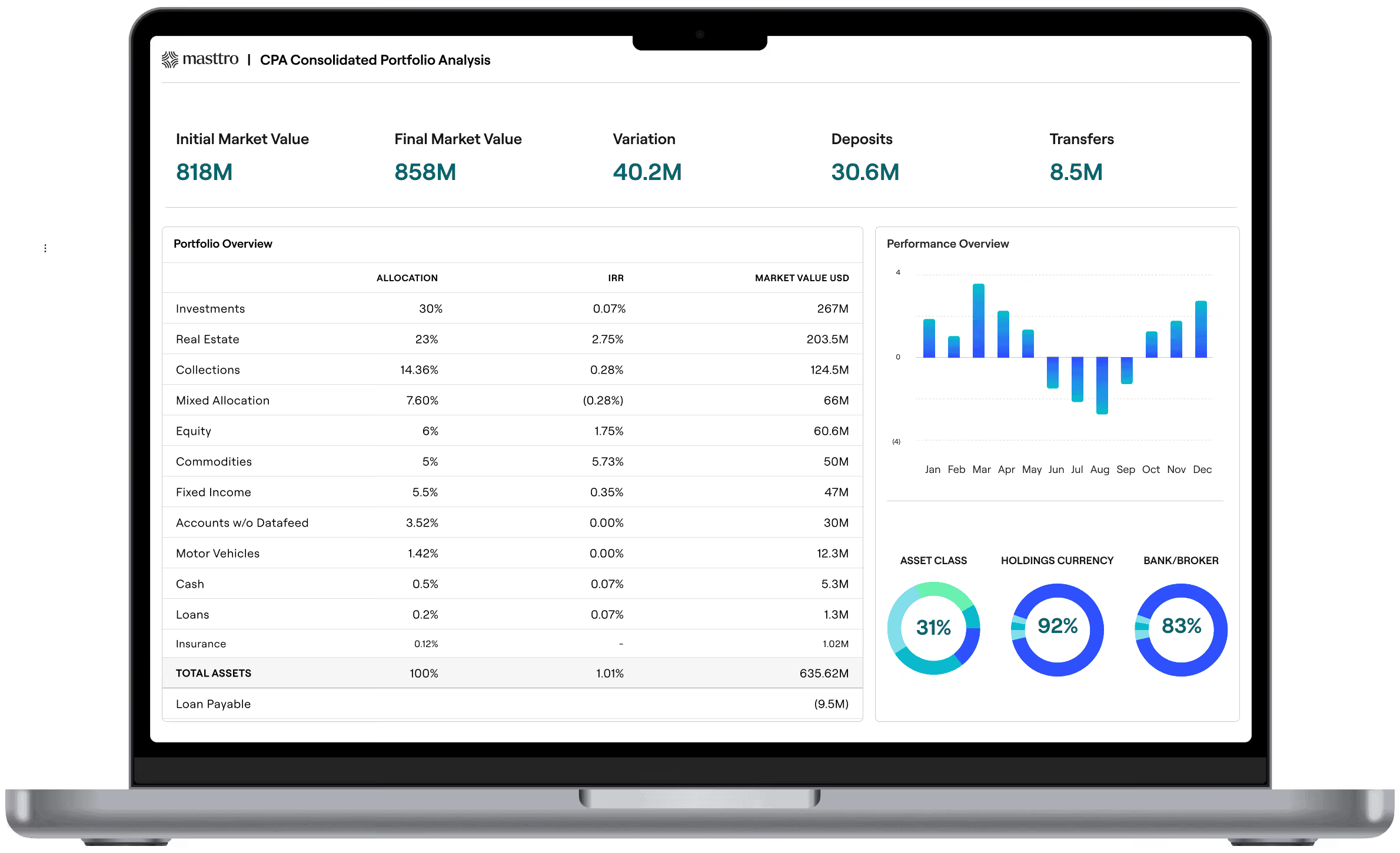
The ability to ingest documents and custodian data feeds automatically within Masttro removes the need to copy and paste data across GP portals or spreadsheets. When the system does that work and hosts the consolidated information, there’s no person needed (let alone a key person). The platform also features powerful AI capabilities that allow your team to find answers in the data by simply asking in plain english.
Masttro is the global operating system for complex wealth, built inside a family office by people who lived through this exact problem. It consolidates the full estate across 700+ direct custodian feeds, automates the reconciliation, document, and capital call work that traps knowledge in one person's domain, and gives the whole team (principal included) direct access to one trusted set of numbers.
With Masttro, you can hand the next generation a working system instead of a puzzle that only one person can solve.
See what your office looks like when it no longer depends on one person. Request a demo.
Five Dashboards Every Wealth Owner Needs