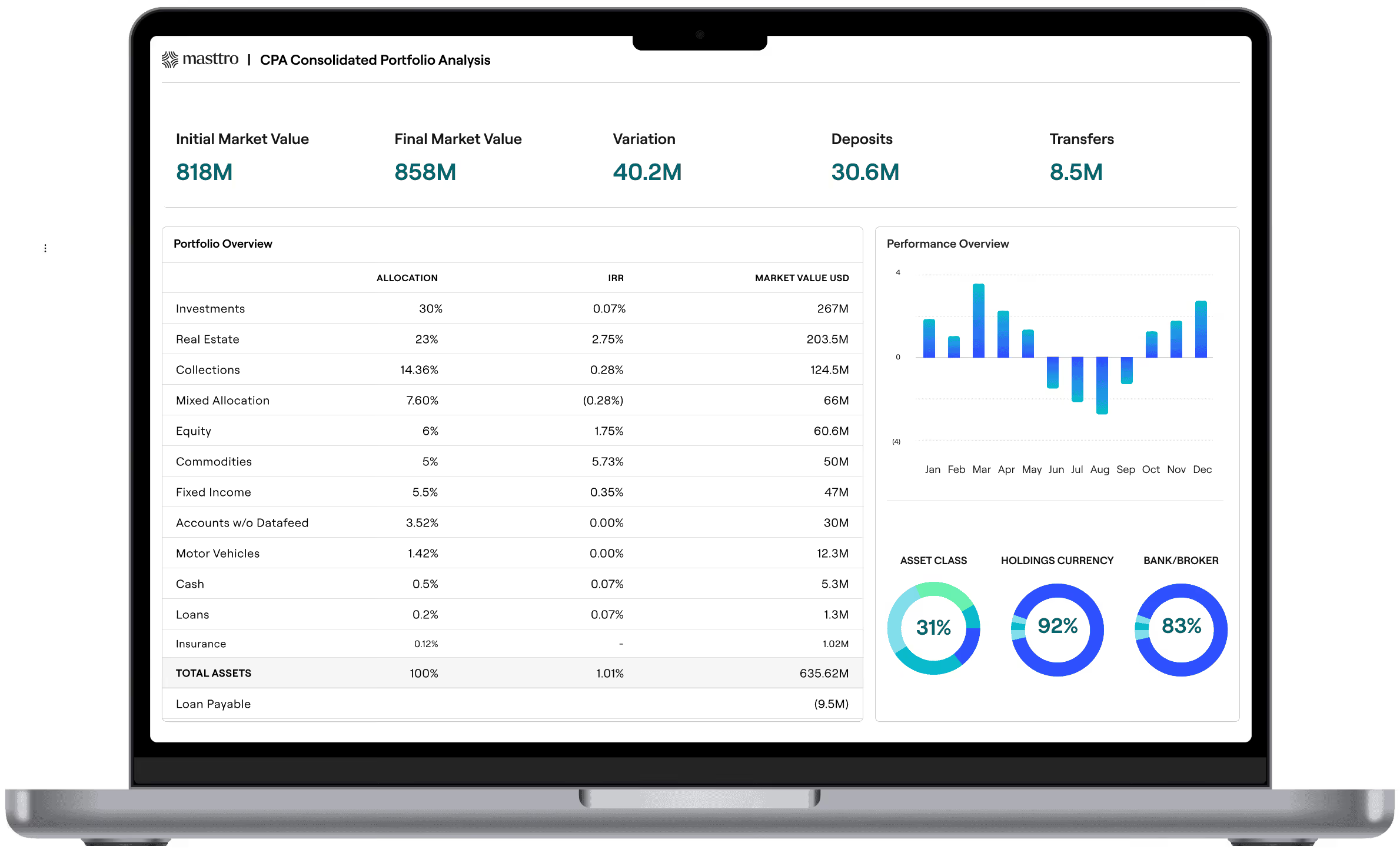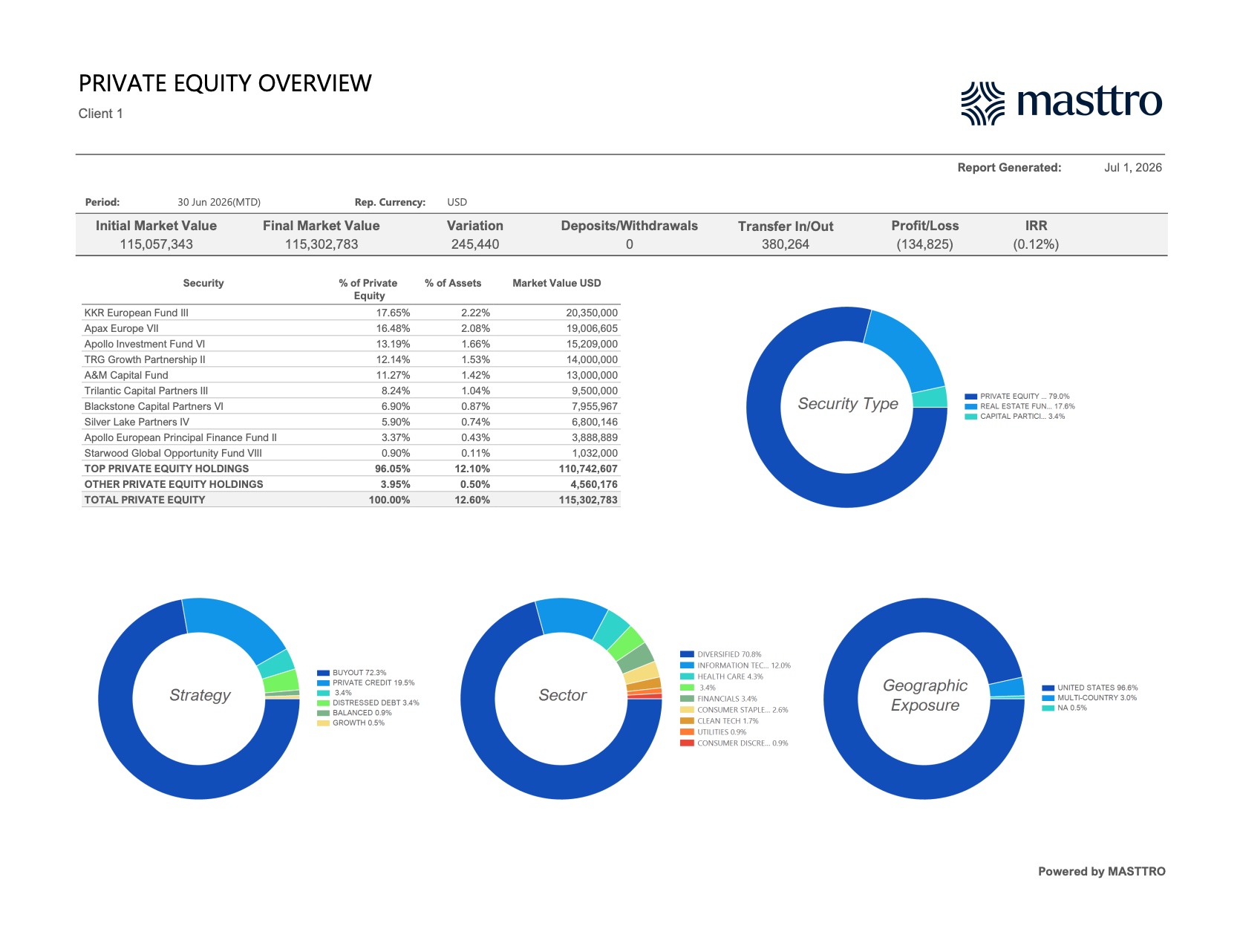

Private markets now average 29% of the family office portfolio, according to RBC's 2025 North America Family Office Report. That share is climbing.
Also climbing is the total size of the alternative assets market. Globally, this category is expected to reach $32 trillion by 2030 (Preqin Private Markets in 2030; McKinsey Global Private Markets Report).
Typically, family offices act as limited partners (LPs) across dozens of fund relationships. The data pertaining to these investments doesn’t live in one place; to access it, you need to log into GP portals, download PDF statements, or search for capital call notices in your email. And even with the data in hand, a spreadsheet that can reconcile these positions at scale (alongside public equities, real estate, and direct holdings) will always risk breaking due to complexity and size.
Some software that’s sold as "private markets reporting" only makes matters worse. Often, these systems are built for general partners (GPs) looking to monitor portfolio companies, not for LPs trying to see across an entire portfolio.
This guide covers what private markets reporting software can actually do for LPs, why the family office use case is distinct, which capabilities matter, and how to evaluate platforms.
Key Takeaways

What is private markets reporting software?
Private markets reporting software consolidates and reports on non-liquid holdings.
Family offices hold stakes in companies, funds, and vehicles that aren't publicly listed. With no market price, value comes from the documents managers send. The primary source is the quarterly capital account statement reporting NAV. Capital call and distribution notices track cash in and out. K-1s cover tax.
These documents are the only source of truth for LPs who want to manage private markets positions and adequately evaluate risk.
The category spans a wide set of holdings: private equity funds, private debt, venture capital, growth equity, and direct stakes in private companies. A recent report from RBC revealed that allocation to each of these subcategories (with the exception of hedge funds) is growing among family offices:
How to Build Deeper Relationships with Wealthy Families

Private markets average 29% of the family office portfolio in 2025, down only marginally from 30% the prior year (According to RBC). Roughly thirty cents of every dollar sit in non-liquid investments. That’s why accurate private-market reporting matters today, and why it will matter even more tomorrow.
Why private markets reporting breaks the spreadsheet
Data integrity (meaning the accuracy, transparency, and timeliness of wealth data) is the most frequently cited operational weakness in private markets, according to State Street’s 2026 Private Markets Study. Private market investments are defined entirely by documents, and extracting data from those documents manually can lead to errors and delays which jeopardize your firm’s data integrity.
The problem is fragmentation. Data reaches the family office in inconsistent formats; one fund may format capital calls a certain way, while another firm structures the document completely differently. In order to track capital committed and cash movements across multiple entities, considerable time and manual effort are needed.
Some family offices build these report using Excel. Eventually, the scale becomes a problem. Not only does a spreadsheet-based system become brittle and slow as it grows, but at some point, the institutional memory required to manage these sheets results in key person risk.
When only one person knows how the system works, the system doesn’t really work.
Consider the time required to process a capital call by hand. To download the PDF from the GP portal, extract the amount and wire details, rout it for approval, pay the actual sum, and then record it in the commitment register consumes one to three hours. (Carta, 2025). Multiply that across a portfolio of funds and a year of drawdowns, and the cost is not just an inconvenience but a legitimate bottleneck.
Family offices start to consider consolidated reporting when something breaks, or is about to. It can take the form of a new currency layer, a new trust entity, or a backlog of capital calls that delays closing the books. If that moment hasn’t arrived yet for your family office, chances are good that it will.
The family office is the LP, not the GP — and most tools miss it
Most private markets technology is built for general partners monitoring their portfolio companies. A family office is, in most cases, a limited partner; it needs LP reporting that can consolidate its fund commitments alongside everything else it owns.
GP-side portfolio monitoring tools exist. The LP-side need is different: it is consolidated exposure across multi-manager funds, situated in the context of the whole portfolio. Public and private markets belong in one view for asset allocation, not in a separate private equity silo that has to be manually stitched back to everything else.
This matters more each year. 39% of family offices plan to increase private equity allocations in the next 12 months (Goldman Sachs 2025 Family Office Investment Insights). Investment management from the LP seat across many fund managers and asset managers is becoming a central reporting job, not a side task.
With the right structure, the job can run at scale. Masttro tracks more than 300,000 alternative investments across LP portfolios and processes over 7 million daily transactions, which is the kind of depth a GP-monitoring tool isn’t designed to consolidate.
What to look for: core capabilities of private markets reporting software
The capabilities that distinguish LP-side reporting software from basic dashboards are document processing automation, accurate performance metrics, and consolidated reporting. Eventually, these all become must-haves.
The market is starting to catch on. Integration and data quality have now overtaken visual reporting as family offices’ top technology priorities, according to the Simple Family Office Software & Technology Report 2025. Buyers have learned that a beautiful chart built on stale, hand-entered data is just as useless as an ugly chart built on the same data.
Instead of experimenting with exotic visualizations, focus on core capabilities.
Document and capital-call automation
The highest-value capability for family offices with private investments is automated ingestion of capital calls, distributions, and K-1s. Software can read investor-portal documents and reconcile each cash-in and cash-out to the right fund and entity, with commitment allocation tools tracking capital committed against drawn capital. That means no more chasing down PDFs.
Automated extraction, meanwhile, pulls data from capital calls, distribution notices, and NAV statements automatically. Figures are reconciled with the underlying bank accounts across the investment life cycle, and as a result, K-1 and tax-documents don’t collapse at year-end. This is the work that consumes analyst hours, so it’s where automation pays the most initial dividends.
Performance metrics built for private capital
Private markets need their own performance metrics. Look for net IRR, investment multiple (MOIC), and deal-level benchmarks, with visibility into fund vintage year, fund size, and both active and exited partnership investments.
A credible platform reports net IRR, MOIC, and DPI/TVPI across the portfolio and by manager. It sets each number in its vintage-year and capital-commitment context for a meaningful fund performance review. It also supports return-on-investment comparison across multi-manager funds. Without vintage context, the raw IRR tells you very little.
Consolidated reporting across the whole portfolio
Private markets should report as one sleeve of the whole portfolio, not a standalone private equity database. The platform should fold portfolio investments and private investment data into total asset allocation across public and private markets, entities, and currencies.
When alternative investment reporting for family offices stops being a standalone exercise, the team can capture and analyze risk and exposure more honestly. Private markets data should sit alongside public equities, real estate, and lifestyle assets. Multi-entity, multi-currency rollups produce the full picture, and business intelligence and asset allocation models allow the principal to see U.S. private markets and global holdings in one place.
Jefferson River Capital described the payoff of using Masttro for this purpose:
“Masttro has allowed us to have a single source of truth for all of our investments, which is critical and enables us to execute a world class, institutional-quality middle office infrastructure.”
Build, buy, or point tool: evaluating your options
Limited partners typically weigh three paths: fund-administration software, a single-purpose point solution, or a consolidated wealth platform. Fund accounting suites and fund administrators serve GPs and funds; point solutions cover one slice; a consolidated platform reports private markets inside the family’s full picture.
Match the choice to the LP job, not to the vendor’s origin story.
Fund-admin and data-warehousing suites offer deep accounting, but they are GP-oriented and heavy to run. Point solutions and alts-only add-ons, including a dedicated private credit platform, cover one slice well but still leave the family office with a mess to consolidate afterward. Consolidated platforms with cloud-based analytics and data management solutions report across asset classes in one place, which is usually the better match for an LP that wants the whole picture rather than another silo.
How AI is changing private markets reporting
AI now does the ingestion work that used to consume much of your analysts’ time. That includes reading capital calls, distributions, and NAV statements, as well as tagging and reconciling them. Family-office AI adoption tripled to 34% in 2025 (Simple), and an agentic AI approach is moving private markets technology from dashboards toward automation.
The work breaks into three pieces.
- Document ingestion: extracting private markets data from PDFs and investor-portal statements.
- Reconciliation and valuation: matching cash in and cash out to the right fund and entity.
- Forecasting and business intelligence add genuine value up to a point. It’s useful to model outcomes, but no model should invent a NAV that the underlying fund has not reported.
A team member at Jefferson River Capital described using Masttro’s Documents AI on alternatives documents:
“We’re able to tag [capital calls and distributions] appropriately, get the date in, get the amount right, and map it and reconcile it to our bank accounts accurately.”
Masttro’s Alternatives AI extends the same approach to PE and VC valuations, capital calls, and distributions in real time.
How to evaluate and choose: an LP checklist
Choose private markets reporting software by matching capabilities to your LP workload and your whole-portfolio picture.
Score each platform on data-aggregation breadth, capital-call and K-1 automation, performance metrics, consolidation, security, and pricing model before you schedule a platform demo.
Run every candidate through the same checklist:
- Data aggregation breadth — how many custodians and GP portals does it cover directly? Masttro maintains 700+ direct custodian feeds across 40+ countries.
- Document automation — does it ingest and reconcile capital calls, distributions, NAV statements, and K-1s, or just store them?
- Performance metrics — net IRR, investment multiple, DPI/TVPI, with vintage-year context.
- Consolidation — does private markets report alongside public holdings, real estate, and lifestyle assets across entities and currencies?
- Security — sovereign-grade data isolation matters when the data is this sensitive.
- Support and references — ask specifically for LP references with comparable alternatives volume.
Then, pressure-test pricing once you know what you need out of a solution.
AUM-based pricing means the bill rises as the portfolio grows. Non-AUM pricing keeps costs predictable. Stonebridge Family Office chose Masttro because alternatives would have cost “at least double.”
Private markets investments are becoming more important to family offices and investors more broadly. Taking advantage of the opportunities in this category means allocating capital strategically, without worrying about the operational burden of manually processing a deluge of documents. With the right tools in place, your non-liquid investments can be as easy to manage as your liquid ones, and your portfolio’s performance may ultimately reflect that advantage.
Frequently asked questions
What is private markets reporting software?
Software that consolidates illiquid holdings — private equity, private credit, and venture capital — and automates capital calls, distributions, valuations, and K-1s into one reporting view. For family offices, it reports those funds alongside the rest of the portfolio, where private markets average 29% of assets (RBC, 2025).
How do family offices report on private equity and private credit?
Increasingly through purpose-built platforms that aggregate fund data from many GP portals, automate document ingestion, and consolidate it with public holdings. Manual methods break down quickly: 86% of family offices run multiple tools, creating the fragmentation a consolidation layer resolves (Simple, 2025).
What performance metrics matter for private markets?
Net IRR and investment multiple (MOIC), plus DPI and TVPI, read in the context of fund vintage year, fund size, and capital committed. Deal-level benchmarks and standardized ILPA performance data make comparison across multi-manager funds reliable.
What is the ILPA reporting template?
An industry-standard set of templates for reporting fees, expenses, carried interest, and performance to LPs. ILPA released updated Reporting and Performance Templates in January 2025, with adoption from Q1 2026; roughly 52% of firms surveyed — and 100% of LPs — intend to adopt the new Performance Template.
Should a family office buy fund-admin software or a consolidated platform?
Fund-administration software and fund accounting suites are built for GPs and funds. A family office is an LP and usually needs consolidated reporting that bridges to accounting, not a full general ledger — so a consolidated platform that automates capital calls and K-1s typically fits the LP job better.
How is AI changing private markets reporting?
AI reads capital calls, distributions, and NAV statements directly from investor-portal documents, then tags and reconciles them automatically. Family-office AI adoption tripled to 34% in 2025 (Simple), shifting analyst time from manual data entry to review and exception handling.
How long does it take to implement private markets reporting software?
It depends on complexity. A family office with a $1B+ portfolio and 200+ alternative investments implemented a consolidated platform in three months or less (Jefferson River Capital). Ask vendors to scope onboarding by your entity count and alternatives volume.
See your private markets in one consolidated view
Private markets reporting is no longer a side task for the family office — it is close to a third of the portfolio and growing. The platforms worth your time are the ones that automate the capital-call and K-1 grind and report those funds alongside everything else the family owns, from the LP seat rather than the GP’s.
Book a 30-minute demo to see capital calls, distributions, and K-1s reconcile automatically alongside the rest of the portfolio — or read how Jefferson River Capital consolidated 200+ alternative investments in three months or less.