Key Takeaways
Alternative investment reporting has become both an operational challenge and strategic risk across modern family offices.
As allocations to private equity, venture capital, hedge funds, real estate, and other alternative assets continue to grow, reporting complexity increases in parallel. Capital calls arrive unpredictably, valuations are delayed, and cash flows become fragmented across fund managers, administrators, and custodians.
In many family offices, this information is still reconciled through spreadsheets and static reports that were never designed to support multi-asset class portfolios or the realities of private markets.
When alternative investment reporting breaks down, the impact extends far beyond reporting cosmetics. Visibility into total wealth deteriorates, liquidity planning becomes reactive rather than strategic, and portfolio risk is assessed using incomplete or outdated data. Capital allocation decisions lose precision, while governance discussions with family members, advisors, and external partners slows as teams struggle to reconcile numbers that should already be aligned.
For a Single or Multi Family Office, accurate alternative investment reporting is no longer a back-office function or a compliance exercise. It is foundational infrastructure that underpins portfolio risk management, and long-term succession planning. Without a centralized, reliable view across private markets and asset classes, even well-constructed investment strategies operate with unnecessary blind spots.
This article outlines what family offices must track to manage alternative investments effectively and how Masttro’s 40 pre-built alternative investment report templates provide the consolidated reporting, portfolio insight, and clarity required to maintain control across complex private market portfolios.
What Effective Alternative Investment Reporting Looks Like in Practice
Masttro’s family office software supports the needs of wealth managers through a dedicated Secure Communication Portal and a library of 40 pre-built alternative investment reports designed specifically for family office structuring and private markets monitoring.
1. One-page clarity at the total wealth level
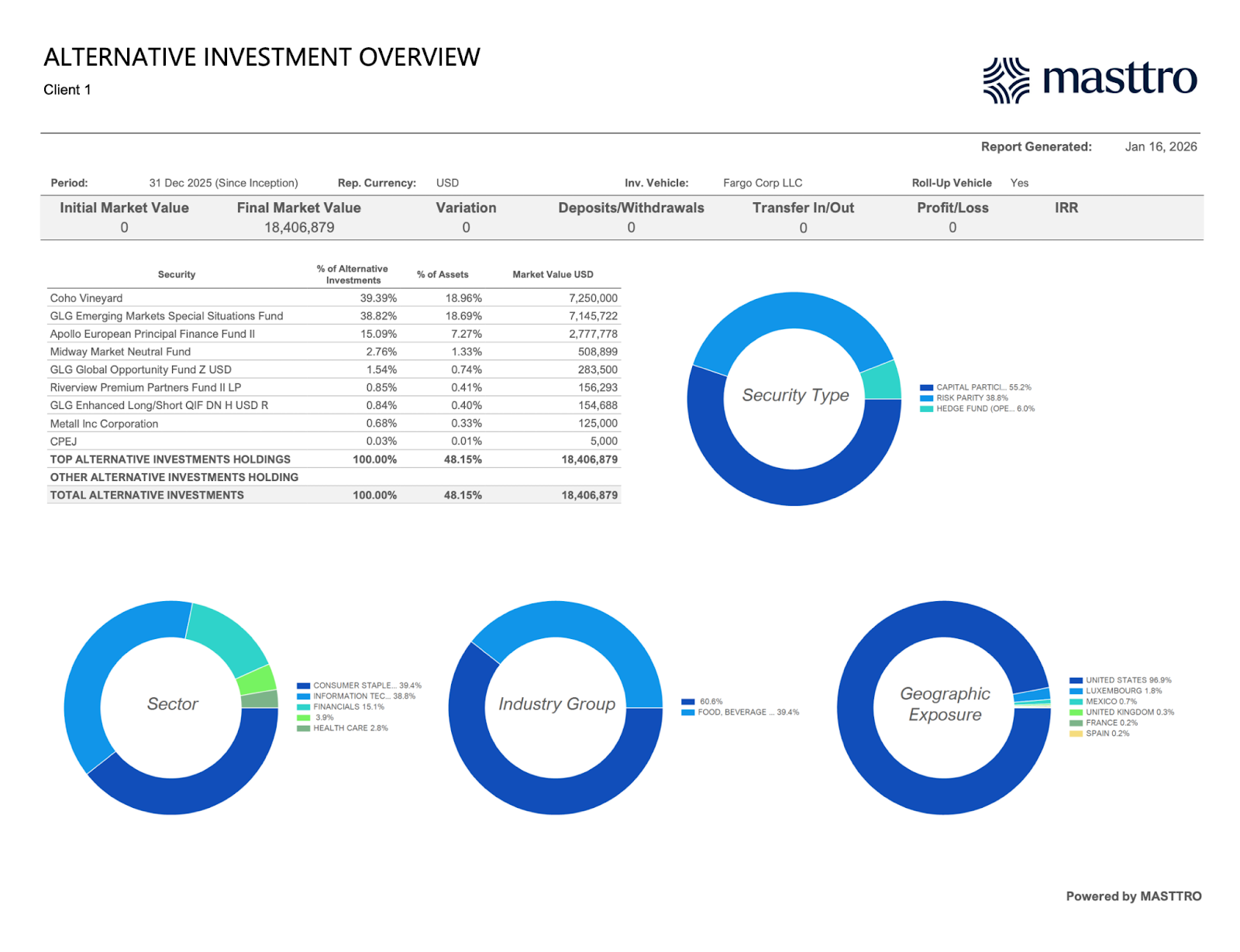
Alternative reporting should open with a single, consolidated view that answers three questions instantly:
- What is the total value of alternative investments?
- How large is this allocation relative to the full portfolio?
- Has capital moved in or out since inception or last period?
2. Security-level transparency without noise
Reporting should list individual holdings with:
- Name of the investment
- Share of alternative investments
- Share of total assets
- Current market value
This allows family office teams and wealth owners to understand concentration risk and exposure without diving into separate fund statements or spreadsheets.
3. Asset type context, not raw tables
The Security Type visualization is critical. It reframes raw holdings into understandable categories such as capital participation, risk parity, or hedge fund exposure. This is how wealth owners think about risk and structure, not how administrators label accounts.
4. Sector, industry, and geography in parallel
Alternative investment reporting should always contextualize exposure across:
- Sector
- Industry group
- Geographic exposure
These views make it possible to identify hidden concentrations across private equity, real estate, or private funds that would otherwise be invisible when looking at investments one by one.
5. Roll-up across entities and vehicles
Reports should clearly indicate when roll-up logic is applied across legal entities. This is essential for family offices using multiple SPVs, holding companies, or investment vehicles. Wealth owners care about total exposure, not entity-level fragmentation.
6. Designed for sharing, not interpretation
Most importantly, this format is built to be shared safely through a secure portal and understood without explanation. Wealth owners do not want to scrub spreadsheets or reconcile PDFs. They want a clear, trusted view of their wealth that supports decisions, conversations, and oversight.
What this replaces
This type of reporting replaces:
- Manual Excel models
- Static quarterly PDFs
- Email-based report distribution
- One-off reconciliations before meetings
What it enables
- Faster decision-making
- Clear governance conversations
- Confident capital allocation
- Reduced operational risk
This is what alternative investment reporting should look like when it is built for family offices rather than adapted from institutional or public-markets tools.
“With Masttro we have the tools to manage assets that are nontraditional, and that’s translated into an opportunity to provide a much broader service than investment management.”

Five Dashboards Every Wealth Owner Needs

Alternative Investments: Core Reporting Coverage
Masttro’s alternative investment reporting spans six primary categories that reflect how family offices actually allocate capital.
1. Alternative Investments Overview Reporting
At the highest level, family offices require a consolidated view of alternative assets across the full portfolio.
Masttro’s Alternative Investment Overview reports provide:
- Exposure by asset class and asset classes
- Allocation across private equity, private credit, real estate, hedge funds, and venture capital
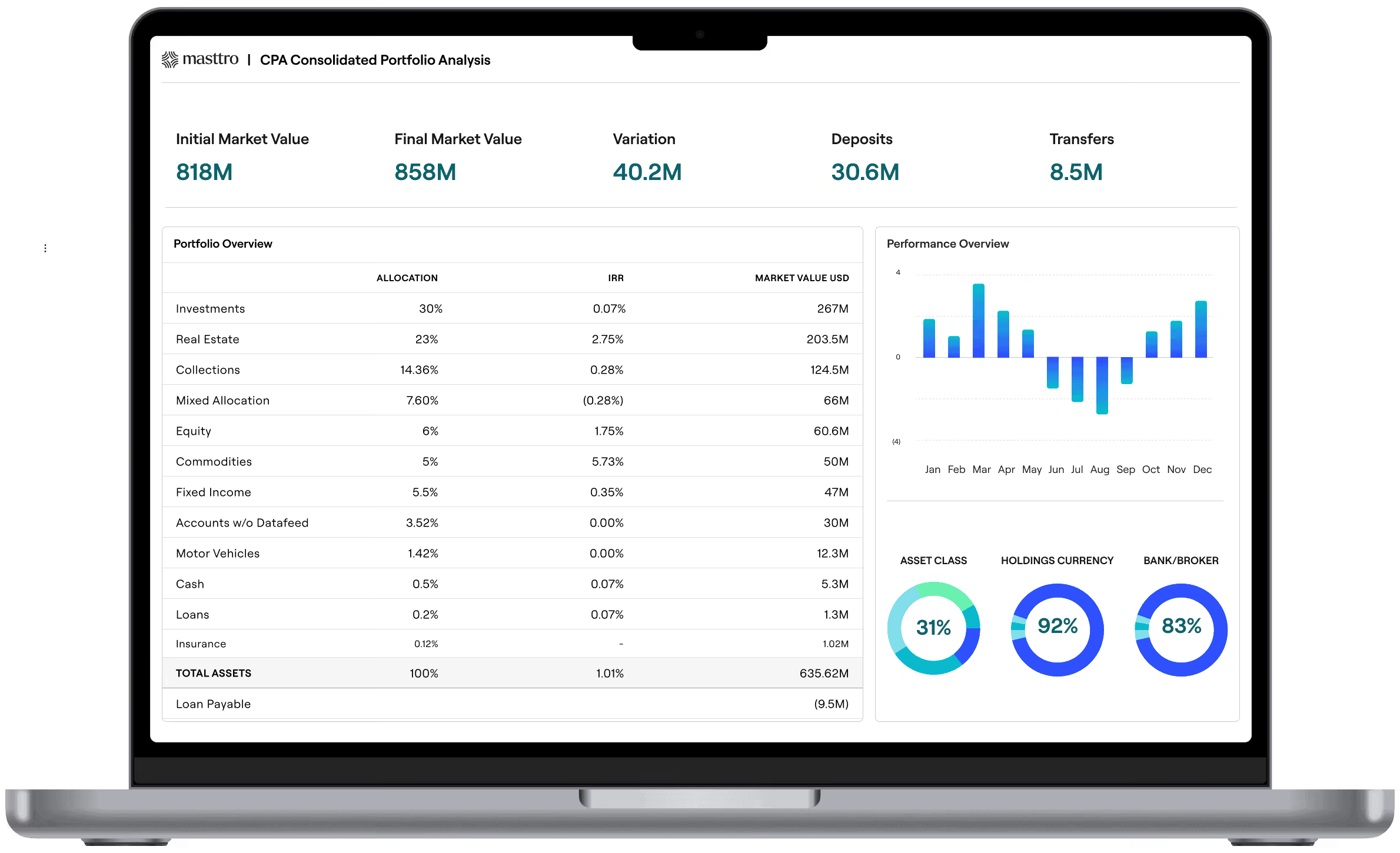
- Portfolio analytics tied to total wealth
- Performance reporting aligned with broader investment management frameworks
These reports anchor family wealth reports and support family governance discussions, board reviews, and external reporting for UHNWI.
2. Capital Participation Reporting
Tracking Capital Calls, Commitments, and Cash Flows
Capital participation structures introduce ongoing capital calls, distributions, and commitment tracking challenges.
Masttro’s Capital Participation reports allow family offices to:
- Monitor committed versus called capital
- Track unfunded commitments across private markets
- Analyze capital calls and distributions over time
- Model future liquidity needs using cash flow modelling
This level of portfolio analysis is critical for asset owners balancing private investments with fixed income, public equities, and tactical tilts across capital markets.
3. Private Fund Reporting
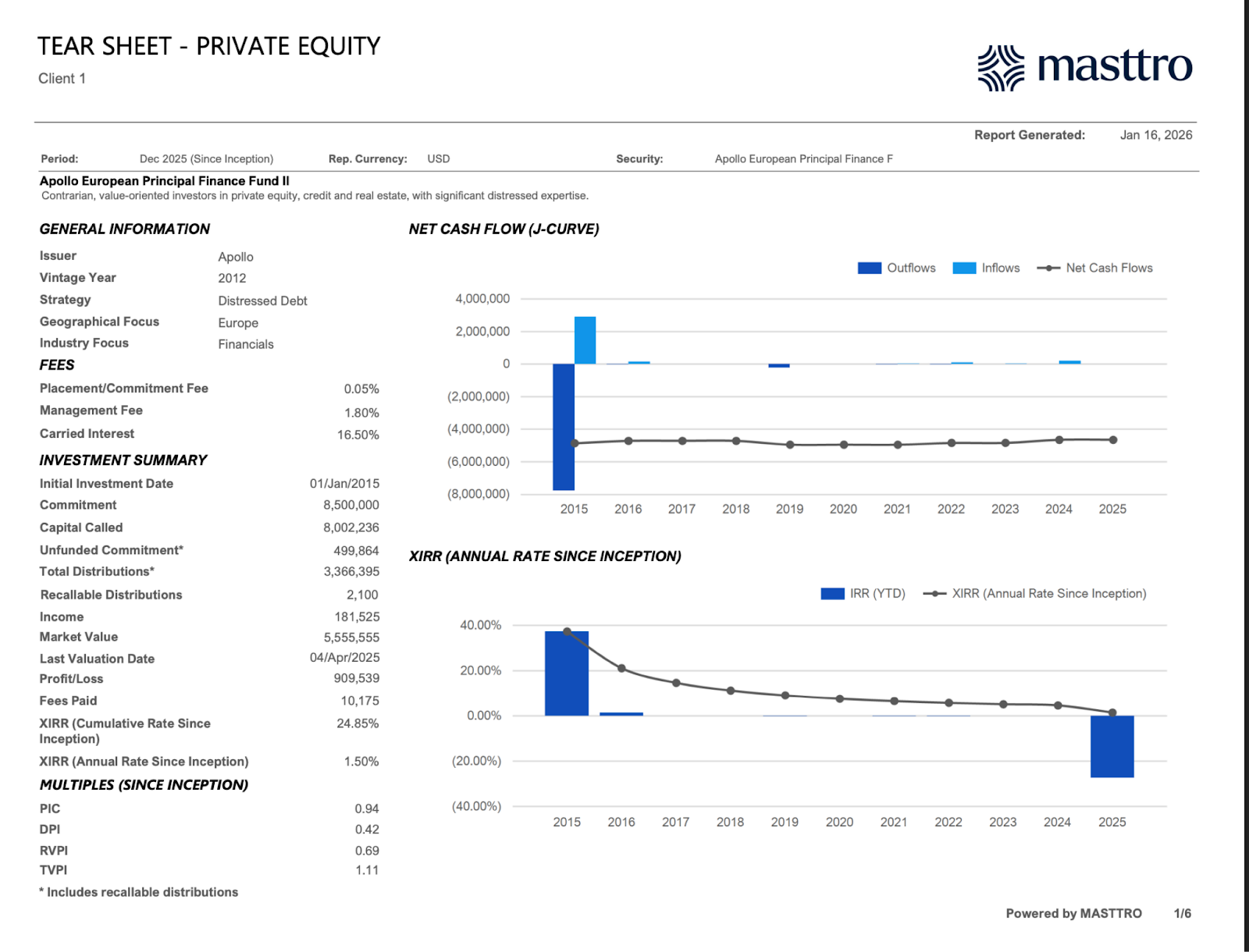
Transparency Across Closed-End and Open-End Structures
Private funds remain central to alternative asset selection for family offices, fund of funds, and Private Credit & Middle-Market Opportunities.
Masttro supports private fund reporting through:
- Private Fund Overview reports
- Detailed Statements for open-end and closed-end funds
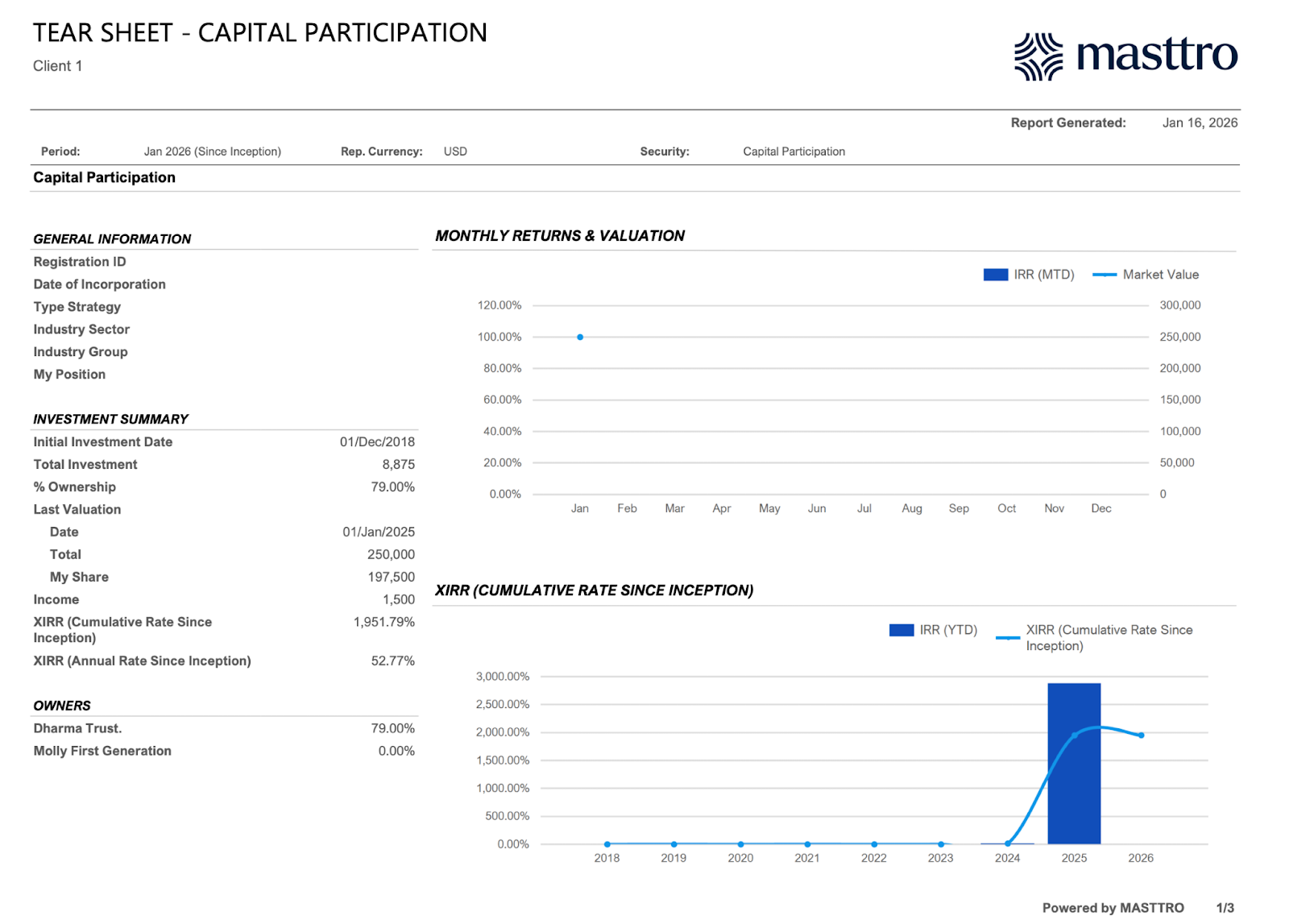
- Tear Sheets designed for investment analysis
- Performance reporting net of management fees and performance fees
These reports support private markets monitoring while enabling cross-comparison against benchmarks such as the S&P 500, European equities, and other market factors.
4. Venture Capital Reporting
Managing Long-Dated, High-Dispersion Assets
Venture capital portfolios are defined by long time horizons, infrequent valuations, and uneven outcomes, making traditional reporting insufficient for ongoing oversight.
Masttro’s venture capital reporting includes:
- Consolidated venture capital statements across all funds and entities
- Direct investment reporting for company-level visibility
- Separate analysis for closed-end and open-end fund structures
- Standardized Tear Sheets highlighting concentration, exposure, and performance trends
These reports give family offices a clear, comparable view of venture capital exposure while supporting ongoing portfolio monitoring across innovation-driven investments.
5. Private Equity Reporting
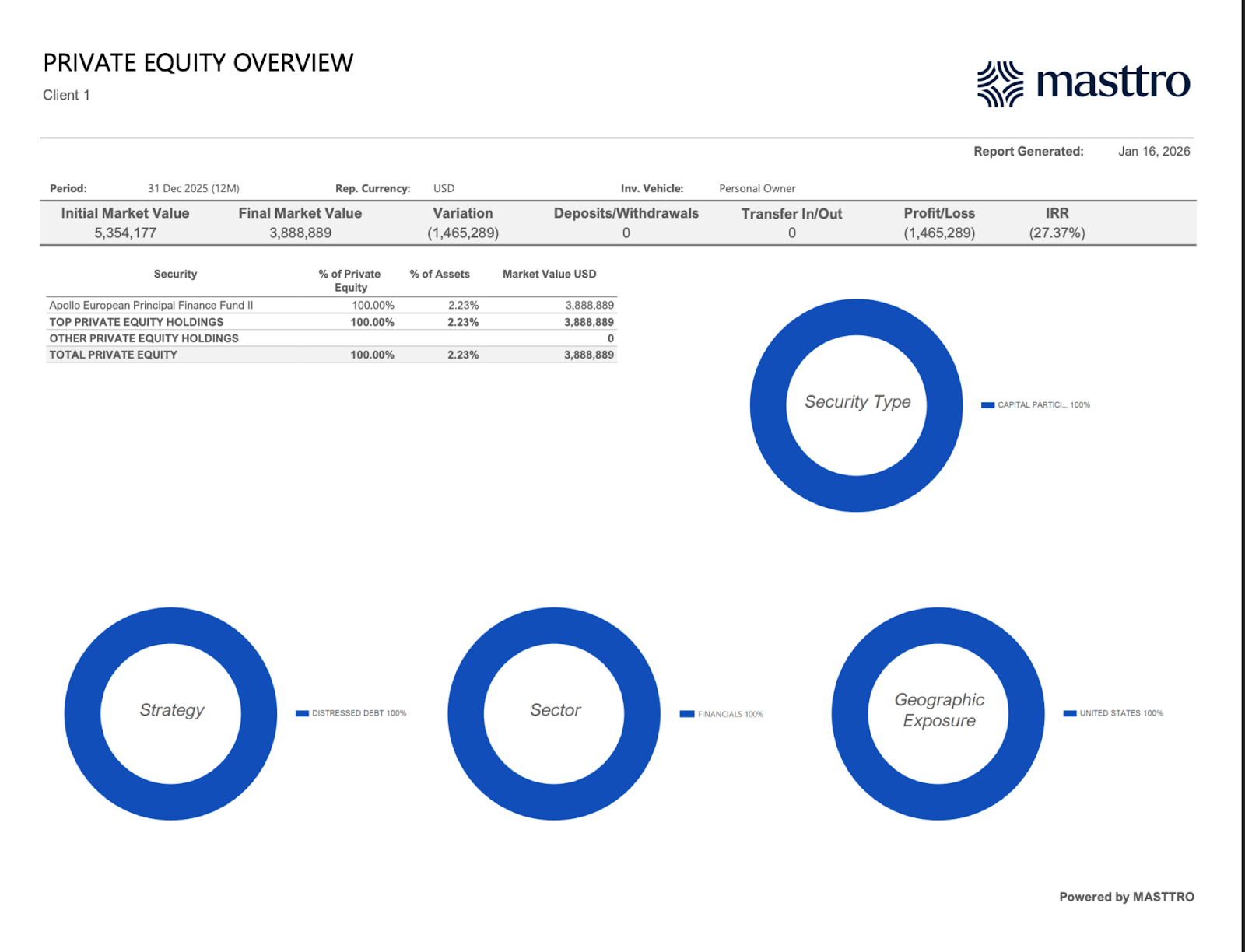
Detailed Visibility Into Complex Ownership Structures
Private funds sit at the center of many family office portfolios, but reporting is often fragmented across administrators, statements, and legal entities.
Masttro’s private fund reporting includes:
- Private fund overview reports showing allocation, value, and exposure
- Detailed statements covering holdings, valuations, and capital activity
- Standardized Tear Sheets designed for quick review and safe sharing
Together, these reports give family offices and wealth owners a clear, consolidated view of private fund exposure, without the need to reconcile spreadsheets or interpret raw fund statements.
6. Real Estate Fund Reporting
Closed-End and Open-End Real Asset Intelligence
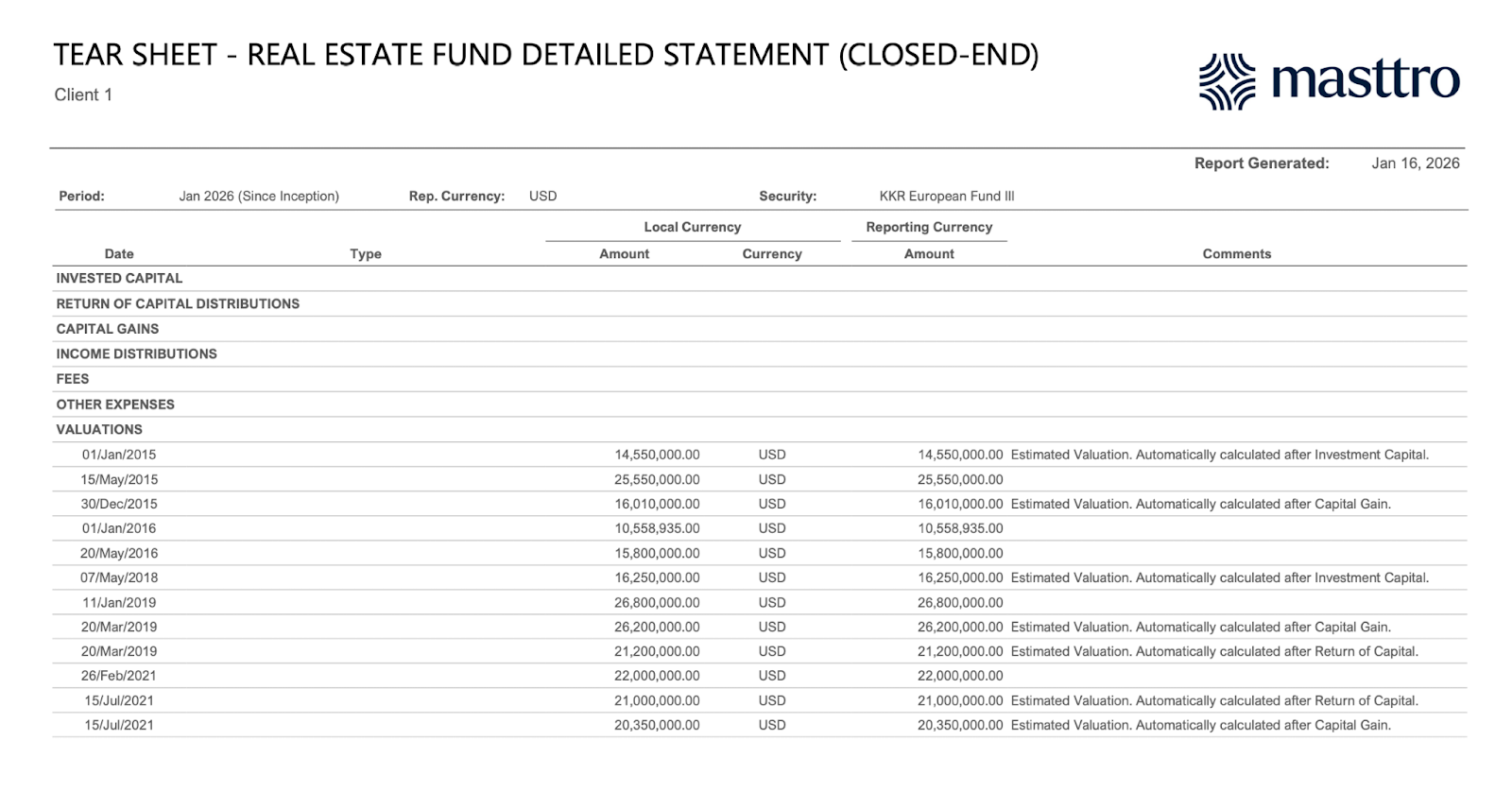
Real estate investments involve long holding periods, varied liquidity profiles, and complex cash flow patterns that require reporting built specifically for private assets.
Masttro’s real estate fund reporting includes:
- Real estate fund overview reports showing allocation, value, and exposure
- Detailed statements for both closed-end and open-end fund structures
- Standardized Tear Sheets highlighting performance, leverage, and cash flow trends
These reports give family offices and wealth owners a clear, consolidated view of real estate exposure across vehicles, without manual reconciliation or fragmented reporting.
7. Hedge Fund Reporting
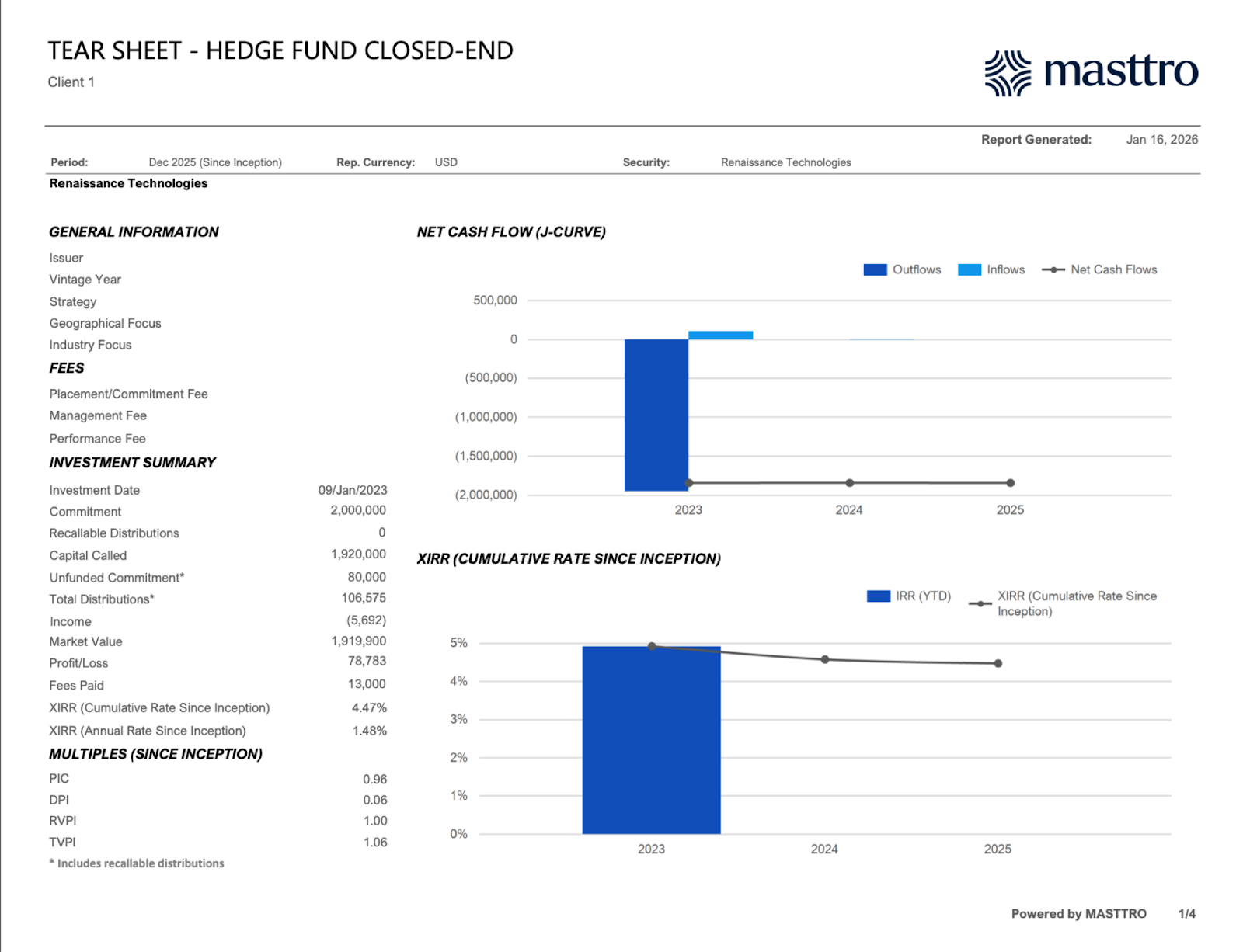
Performance, Risk, and Liquidity Clarity
Hedge funds introduce leverage, derivatives exposure, and dynamic trading strategies.
Masttro’s Hedge Fund reporting includes:
- Consolidated hedge fund statements
- Holdings performance analysis
- Open-end and closed-end reporting
- Tear Sheets aligned with risk management and portfolio analytics
These reports support oversight of OTC derivatives, structured investments, and tactical positioning across changing economic policies and inflationary pressures.
Secure Delivery Through the Client Portal
All alternative investment reports are delivered through Masttro’s Secure Communication Portal (SCP), built specifically for family offices, private clients, and their trusted advisors.
The SCP replaces fragmented email threads, static PDFs, and insecure file-sharing tools with a single, encrypted environment for delivering interactive reports and sharing sensitive financial documents. Reports remain live, current, and accessible, allowing wealth owners and advisors to review the same information without version conflicts or manual follow-ups.
How Masttro’s Secure Communication Portal Supports Family Offices
Encrypted, compliant collaboration
- All data and documents are protected by military-grade security protocols and encryption, enabling private and confidential communication between families, advisors, and external partners.
Interactive, real-time reporting
- Alternative investment reports are delivered as interactive views rather than static files, ensuring wealth owners always access the most current portfolio information.
Elimination of email and PDF chains
- Centralized access removes back-and-forth communication, reducing operational risk, version confusion, and administrative overhead.
Digital-first, mobile-friendly experience
- Reports and documents are easy to access, review, and share across devices, meeting modern client expectations without compromising security.
Clear, organized family communication
- Structured folders and intuitive navigation allow family members to locate reports and documents easily, without relying on intermediaries.
Consistent, professional client experience
- Clear presentation and transparency reinforce trust, helping family offices demonstrate control, rigor, and professionalism.
Scalable reporting distribution
- With over 140 report templates available across all wealth topics, reports can be shared, printed, downloaded, or scheduled without rebuilding workflows.
Why Family Offices Choose Purpose-Built Alternative Asset Reporting Software
Alternative investment reporting is not just about producing statements. It is about enabling better decisions across generations.
Masttro’s investment management platform delivers:
- Consolidated reporting across public and private markets
- Real-time intelligence for portfolio management
- Wealth Intelligence across asset classes
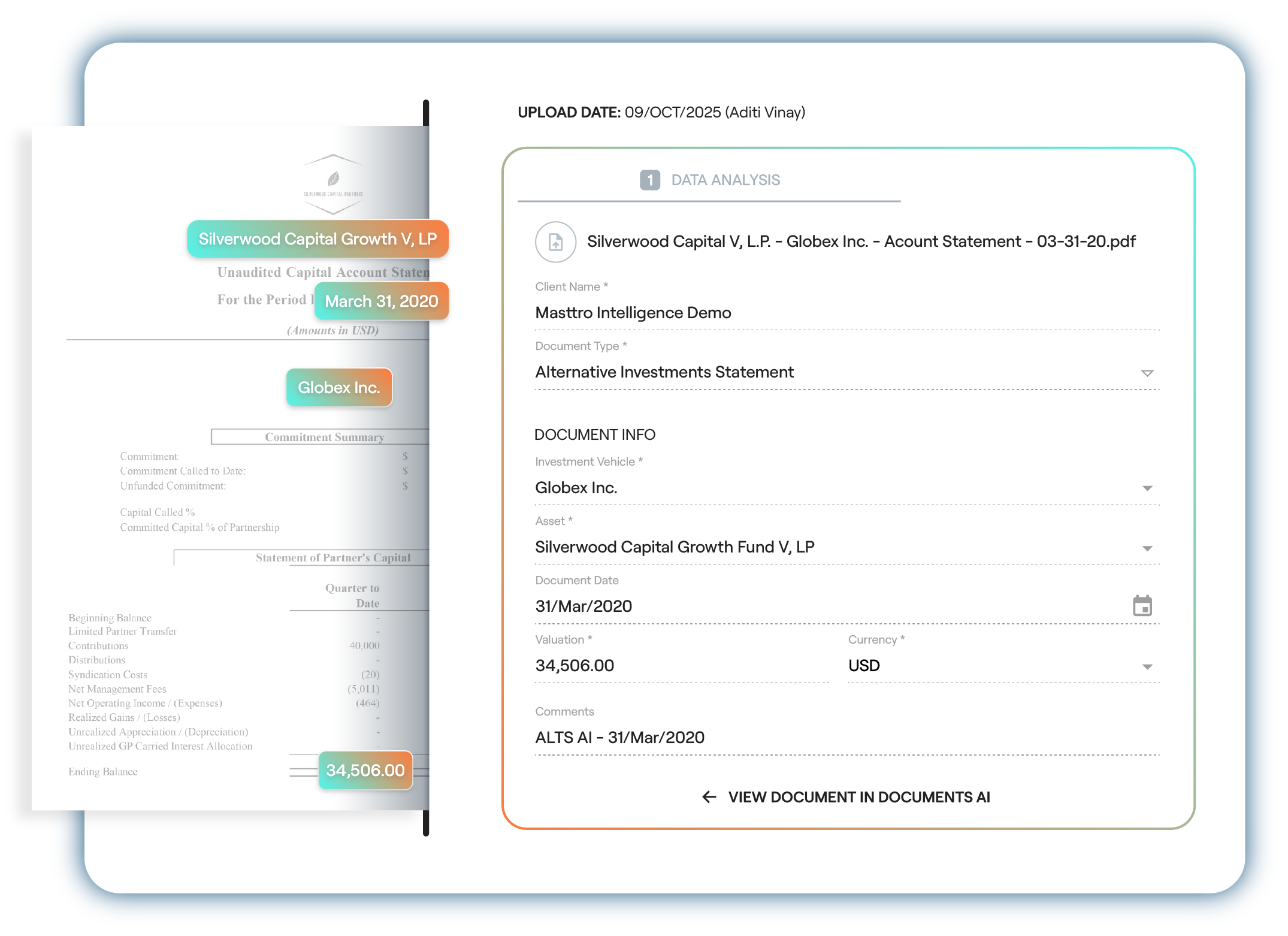
- Private asset reporting that replaces fragmented Excel workflows
For family offices managing complex portfolios, regulatory exposure, and long-term succession planning, alternative investment reporting becomes a strategic advantage rather than an operational burden.
From Reporting to Wealth Intelligence
As alternative assets continue to represent a larger share of family office portfolios, reporting infrastructure must keep pace with the complexity of private markets, regulatory expectations, and evolving investment strategies. Static reports and spreadsheet-based workflows can no longer support the level of visibility and control required to manage long-term, multi-asset portfolios.
Masttro transforms alternative investment reporting into a unified system for portfolio analytics, risk management, and intelligence-driven investing across the entire family balance sheet. Rather than stitching together data from multiple sources, family offices gain a consistent, consolidated view of private assets that supports oversight, governance, and informed decision-making.
For family offices seeking clarity across private equity, venture capital, hedge funds, real estate, private credit, and structured investments, purpose-built reporting is no longer optional. It is foundational.
Explore an interactive demo to experience how alternative investment data, reports, and secure delivery come together in a single platform built for modern family offices.
“We can fully visualize our portfolio and give full transparency to each family member. Additionally, we can now track our performance across alternative investments extremely well and accurately.”
“We went from having no consolidation tool or data feeds to having both capabilities in a single platform - that also happens to track private equity investments perfectly.”

“Finally, the most comprehensive and complete system available to manage all types of assets for a family.”