Offshore single-family office consolidates more than 130 funds onto Masttro
An offshore single-family office with over 45 years of investing history now runs 130+ funds and two legal entities on Masttro. Manual reporting from spreadsheets that used to take several hours per week can now run in 10 seconds, with the assurance that the output is complete and accurate.


The challenge
The family behind this office has been investing actively for almost 50 years. That means they run a complicated book, with 130 to 150 funds across 50 to 60 managers, held through two legal entities and a set of family trusts.
Investments are concentrated in private markets. Private equity alone spans 10 distinct sub-strategies in the office’s own taxonomy. Valuations arrive monthly from some managers and quarterly from others; some are obtained through brokerage portals, some through transfer agent portals, and some as email attachments.
When the current CFO joined the family office in early 2024, he rebuilt the office's single tracking spreadsheet into three linked workbooks. The first held a tab per investment and carried every movement and calculation. The second summarized positions by month, and the third reported performance. The latter two pulled from the first.
This three-book system worked, but that was part of the problem.
"They were pretty robust but involved a lot of manual entry." the CFO said. "Valuations would come in, the spreadsheets would require rolling things forward, entering the new valuation, and picking up redemptions and capital calls."
"Once I'd got it up and running, it was probably a couple of days a week, a lot of it just back checking," he said. "That's the trouble with spreadsheets. They're susceptible to human error. Formulas don’t copy over as intended, links get broken. You've really got to keep your eye on the ball."
The maintenance was only half of it. Before handing the CIO a performance breakdown by asset class, the CFO had to spend time sense-checking the output to ensure it was consistent with the underlying data.
Beyond the time requirement and the error risk, there was limited history to work with. The office always knew what an asset was worth at a given moment, but it was the introduction of the new spreadsheets in early 2024 that allowed the value of an asset to be tracked over time.
"We always knew what the value of the assets were at any point in time, but we only had limited historical values," the CIO said. "So, any analysis would be limited by the historical data captured in the spreadsheets. As time passed this increased and so the analysis we could run became more useful"
The evaluation
The team set about researching aggregation and reporting tools for family offices and produced a list of eight candidates. Comparing capabilities and fit narrowed the field to a handful, and after introductory calls, the office had two finalists in mind.
At that point, the office brought in a consultant from an investment bank whose job is sourcing exactly this kind of provider. His verdict was that the team had run the process correctly and reached the right shortlist.
Despite an eventual pricing concession from the other finalist, the office chose Masttro anyway, for four reasons:
- Everything stayed in-house
Loading private markets data through the other platform would have required a third-party provider. "We did not want to be dealing with external providers and all of a sudden everyone's pointing at each other, because when things aren't working, it's their fault, it's our fault," the CIO said. "We wanted one provider that would help us through the whole process."
- They wanted a partner for the long run
Several newer entrants offered innovative products, but the CIO was wary of potentially repeating this exercise in three years, after the taxonomy was built and the history was loaded. "We did not want to be with someone who three years down the road gets sold to someone else," he said. "We were looking for a long-term partner."
- The platform needed to follow the office’s asset taxonomy
Most systems assume a standard classification, but this office had spent two years building a unique set of categories to support their investing style. A platform that couldn’t adapt to it would have limited utility. "The standard master system says everything's private equity or private credit, but we have 10 different flavors of private equity," the CIO said.
The CFO wanted the same guarantee: "Being able to report stuff how we want to report it, not being shoehorned into how somebody else categorizes things."
- The data sits in Switzerland
Given that the family is private and prizes both security and confidentiality, using Swiss infrastructure set Masttro apart. “Having the data hosted in Switzerland was one of the big selling points for us,” the CIO commented. "We just like our privacy and we want to keep it."
The results
The office went live with Masttro in the first quarter of 2026.
The first thing that changed was who could produce a report, and when. Because the two team members sit four time zones apart, the CFO's day ends in the middle of the CIO’s afternoon. Previously, questions waited until the next morning unless the CFO logged back on after hours.
Today, both team members can build, run, and publish reports. The CFO still owns the data, but the reporting no longer routes solely through him.
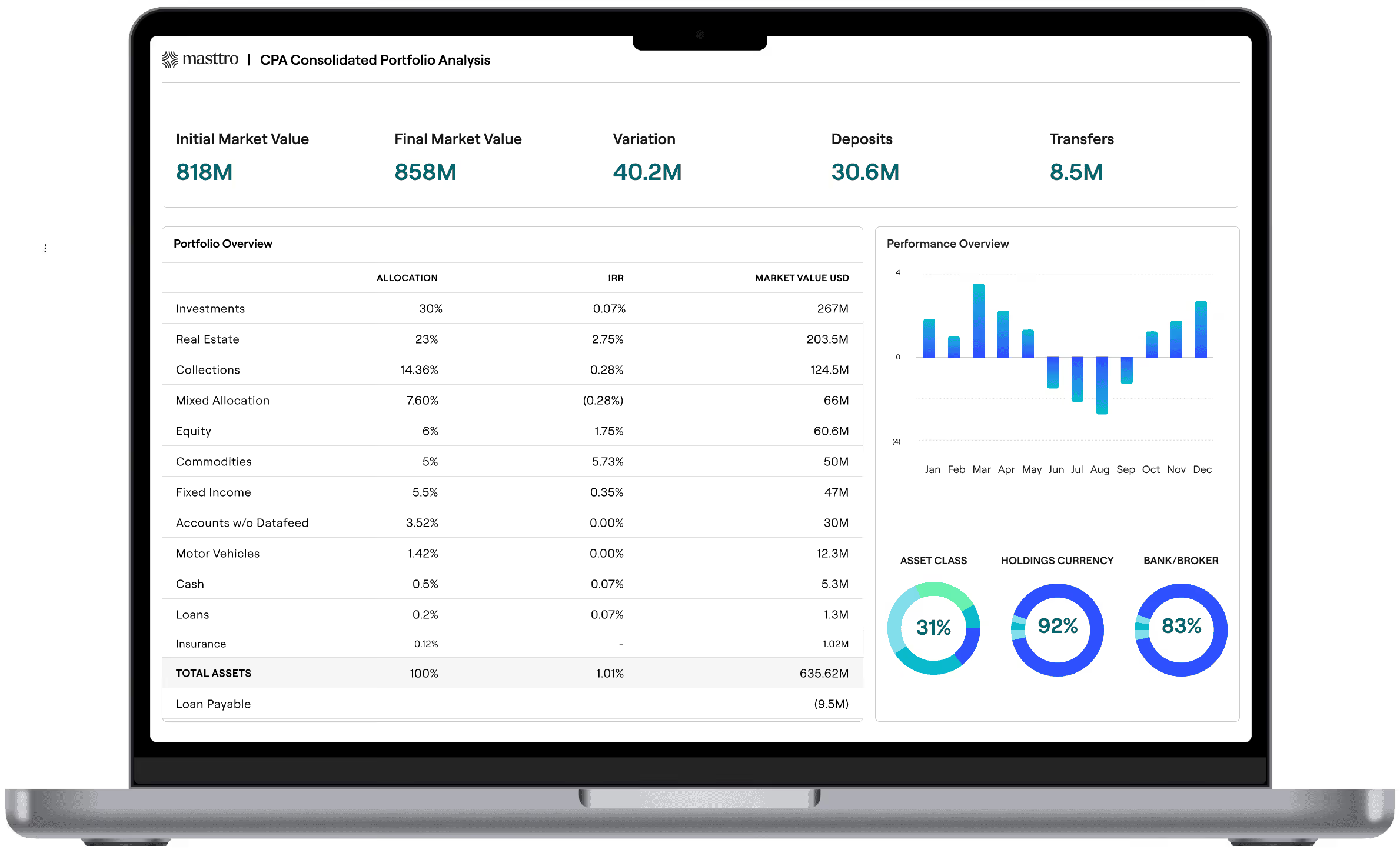
"Now I can hit a button and I get the reports automatically," the CIO said. "It'll run within 10 seconds, where previously it would probably take several hours of work to run and validate those reports for us."
Alternative investment processing is also automated today. Masttro's Alternatives AI reads capital call, distribution, and valuation documents on intake. Having a scalable workflow to handle these documents is of disproportionate importance for this family, given that their book is weighted toward private markets.
For the CFO, Masttro has improved the office’s speed while also boosting confidence across reporting. "You've got one golden source of data," he said. "You know when you press that button that it's pulling from that one golden source. Whereas with the multiple spreadsheets solution there was always that: ‘Have I got it right? Is there a link missing? Has everything been updated correctly?’"
For the CIO, that confidence translates to checking fund-level exposure from the mobile app while he’s traveling or away from his desk. "I can find exactly how much we have invested in every one of our funds when I'm on the road."
What comes next
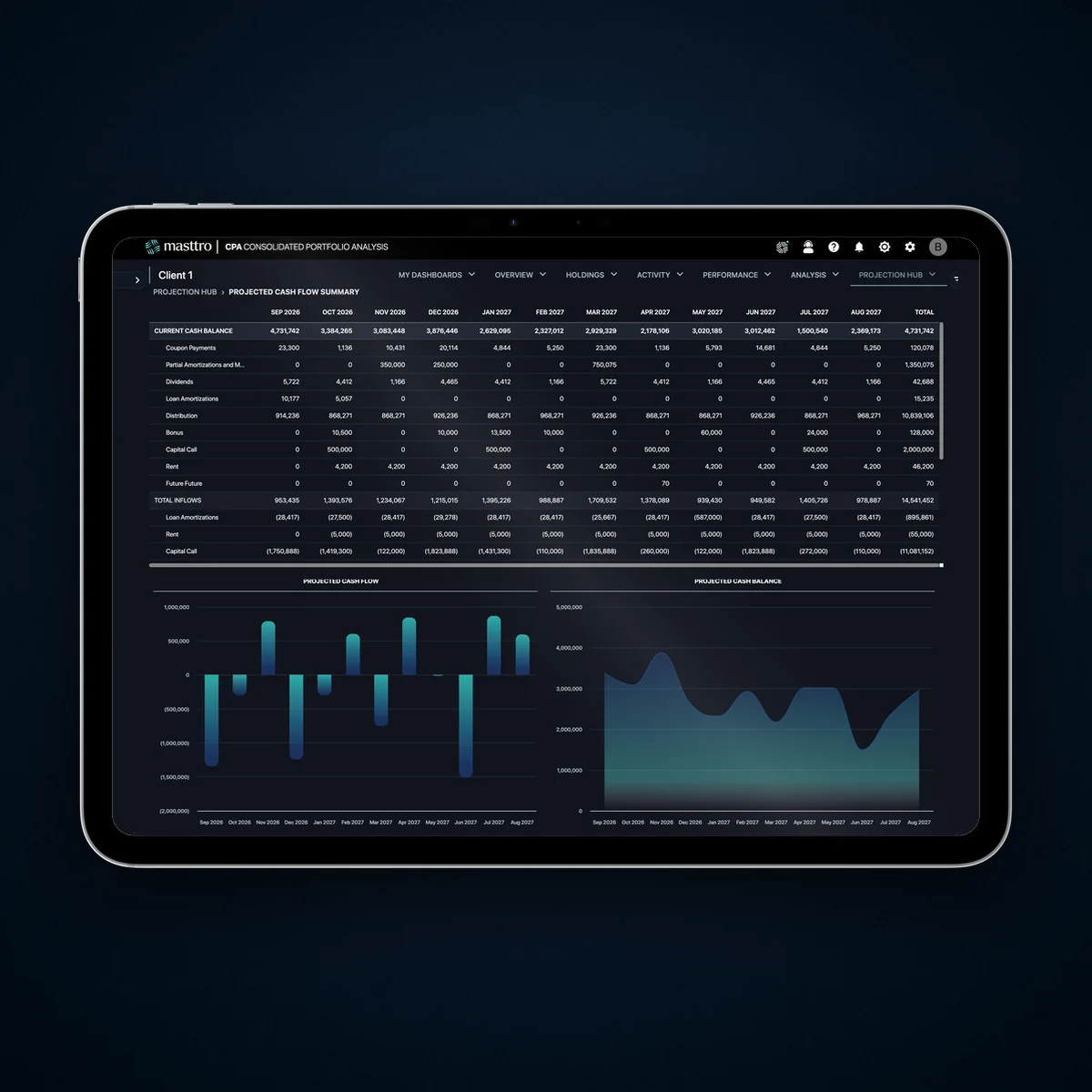
The office is still expanding what it does with Masttro. Using the Global Wealth Map, the CFO maps the family trusts and prepares individual reporting views for family members beyond the patriarch. The next generation is still several years away from holding a meaningful amount of assets, so this mapping is additive rather than mission-critical. Also, with Masttro now up and running for around 6 months, the CIO and CFO are thinking about what additional reporting can be built to support portfolio decision making and improving future fund cashflows projections.
The nearer-term goal is to take advantage of the office’s operational efficiency. With Masttro greatly accelerating reconciliation and reporting, the office can hire a junior person for data entry and move the CFO, an accountant with 30 years experience in investments, closer to the investment process itself.
Meanwhile, the office is also driven by an underlying goal related to governance and key-person risk. "If we get hit by a bus, someone else can walk in and everything is there," the CIO said. "It's turnkey for the next people to take over."
A two-person team running 150 funds across two entities cannot afford to keep institutional knowledge locked away in a spreadsheet. With Masttro, that knowledge is now part of a system.

Schedule an intro
Book a demo to see why over 400 leading family offices in 40+ countries choose Masttro:
700+ custodial connections for a complete view of wealth, with no blind spots.
Automated data and document ingestion that eliminates manual collection and reconciliation.
Built for complexity, with one secure system for assets, entities, and reporting.
Fixed pricing, not AUM-based, so growth does not trigger higher platform costs or hidden fees.