
Key Takeaways

Aleta alternatives at a glance
Six alternatives to Aleta, compared on the office profile each serves, data connectivity, alternatives handling, pricing and where each runs out.
Two things separate this set. Aleta and Asora compete on speed and entry price; Masttro and Addepar compete on depth. And published data connectivity varies by roughly an order of magnitude — the single variable most likely to decide whether a multi-custodian estate reconciles cleanly.
Masttro vs Aleta, head to head
Where the two platforms differ on the criteria that decide a UHNW platform selection.
Speed to go live and speed to trust are not the same thing. The question to put to any vendor quoting six weeks is what, exactly, is live at week six: which custodians are connected, whether alternatives are automated, and what the data-quality commitment is.
Why do family offices look for Aleta alternatives?
Even with a clean interface and fast deployment, family offices look past Aleta for four reasons, all of which surface after the demo rather than during it.
Data connectivity caps at roughly 100 integrations
Aleta’s own published figure is “+100 custodian and bank integrations.” For a single-jurisdiction office banking with a handful of institutions, that may be all you need. For an estate spanning multiple countries, private banks and trustees, it is the constraint that becomes a blocker. Usually as a manual upload workflow nobody agreed to in the demo. Open architecture is only worth having if the data flowing through it is complete and reconciled first. Open pipes filled with unreconciled data move the problem into more tools rather than solving it.
Alternatives are reported, not automated
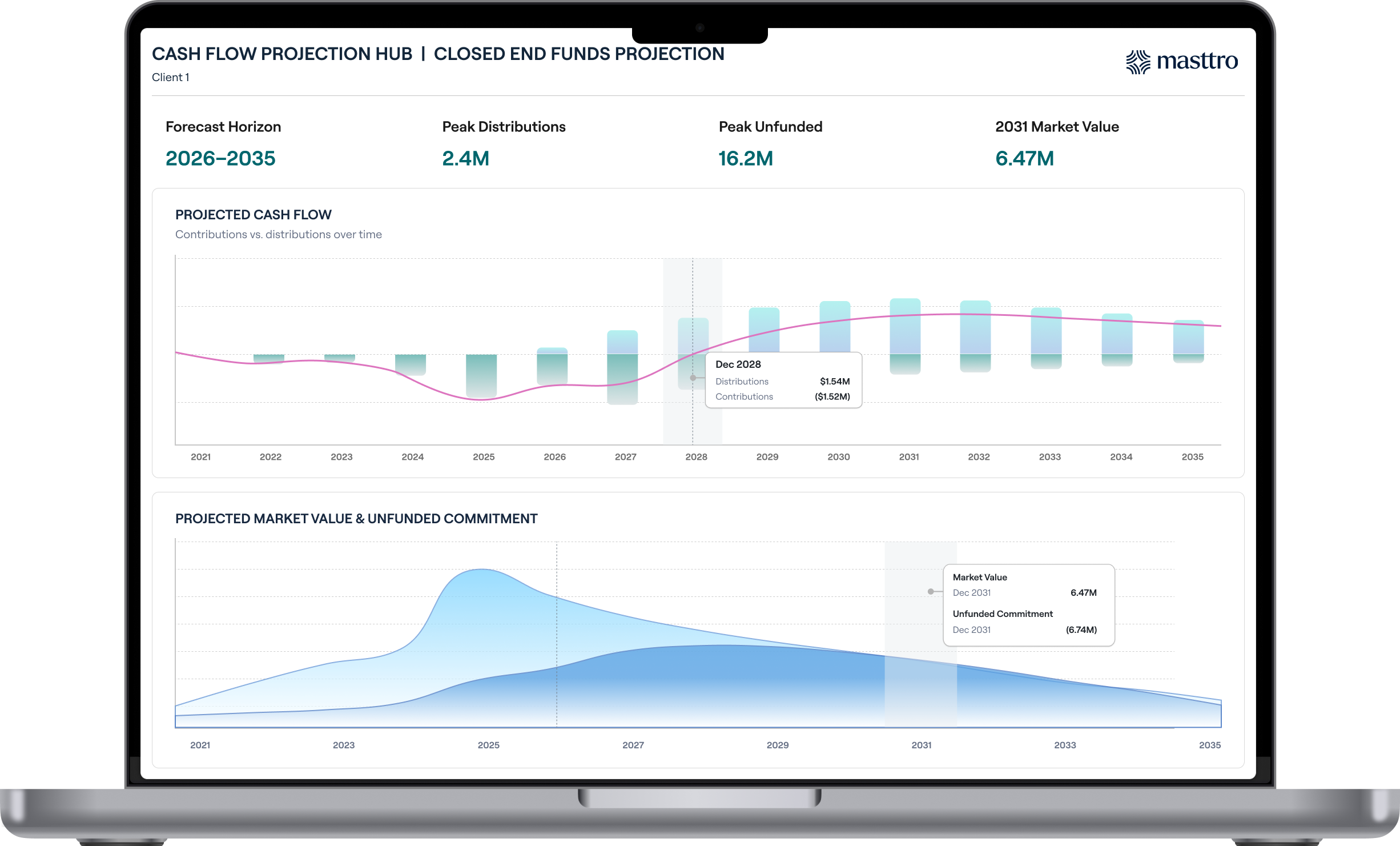
Aleta’s information around private markets describe capital calls, distributions and unfunded commitments. What they do not describe is document ingestion — no OCR, no automated extraction from capital call notices, NAV statements or K-1s — and no look-through analysis, benchmarking, TVPI, DPI or MOIC. For a portfolio where alternatives are a meaningful allocation, that is the difference between a reporting tile and an operating workflow, and it lands as manual hours on the operations team every quarter.
There is no independent validation to check the claims against
Aleta has no user reviews on G2, Capterra or SourceForge — Capterra’s listing reads “Based on 0 user reviews.” It publishes no client count and has named one client publicly. This is not evidence of poor quality; family office software is reviewed publicly far less than mainstream software. It does mean every scale figure Aleta publishes is a vendor claim with nothing independent to corroborate it, and that a prospect cannot easily find a comparable reference.
Aleta positions itself as a layer, not a platform
An independent 2026 category review concludes that Aleta “is designed to be the consolidation and visualization layer, not a replacement for a dedicated investment analytics tool.” A separate independent comparison lists Aleta’s limitation as “no governance or planning layer.” Forbes’ 2025 family office software roundup places Aleta in Data Consolidation & Wealth Reporting — a narrower category than the platforms it competes against. An office buying Aleta should expect to pair it with something else.
How we evaluated these family office platforms
Each platform was assessed on five criteria: breadth and directness of custodian connectivity; depth of alternatives and document automation; handling of multi-entity, multi-currency and multi-jurisdiction structures; security and data-privacy architecture; and pricing predictability over a generational horizon.
Claims are drawn from each vendor’s public product documentation and published pricing, accessed July 2026; corporate filings; third-party review platforms; and independent category reviews, listed in Sources. No platform was benchmarked hands-on, and implementation timelines are as stated by each vendor. Where a vendor publishes no figure, this comparison records the absence rather than estimating one.
The 6 best Aleta alternatives for family offices
Ordered by the complexity of the office each platform serves best, starting with the profile most searchers for this term are in — an office that finds the consolidated reporting idea right, but needs more underneath it.
1. Masttro — best for multi-jurisdiction families with meaningful alternatives exposure
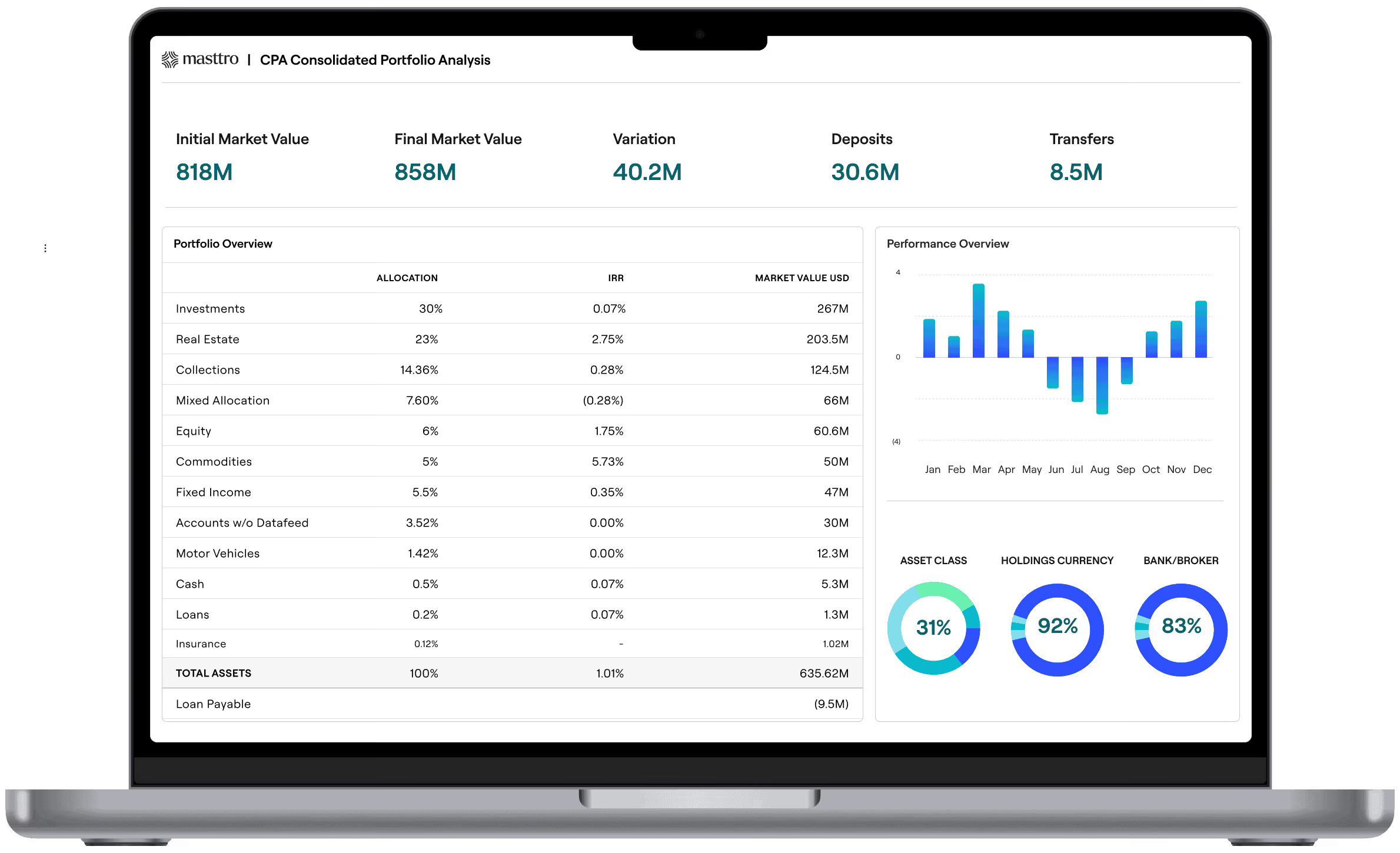
Masttro was built inside a multigenerational family office by its CFO and CTO, and now serves 400+ clients globally and 10,000+ end users, aggregating from 700+ direct custodian feeds across the globe.
What it does well
Every asset class and entity type in one reconciled view — public markets, fixed income, private equity, hedge funds, venture, private credit, real estate, art and lifestyle assets, held through companies, trusts, LLCs and foundations. Alternatives AI processes capital calls, distributions and PE/VC valuations; Documents AI ingests K-1s and NAV statements. Pricing is flat and not based on AUM. Data is Swiss-hosted with client-controlled encryption, so not even Masttro employees can access it. Jefferson River Capital describes the result as “a single source of truth for all of our investments … world class, institutional quality middle office infrastructure.”
Limitations
Masttro is reporting-first and does not include a full double-entry general ledger. Partnerships with supporting accounting software like Truewind allow for more automated integrations with accounting tools like Sage, Quickbooks, and Intuit Enterprise Suite. Pricing is quoted, not published.
Why Masttro instead of Aleta
With seven times the custodian connectivity, alternatives automation that runs as a workflow rather than a reporting tile, and a privacy architecture built for families for whom data exposure is the risk that matters. Aleta gets you live faster. Masttro gets you live with data you can act on.
2. Addepar — best for institutional-grade portfolio analytics
Addepar is the enterprise default for RIAs and large family offices, reporting $9 trillion of assets on the platform. Where Aleta consolidates and visualises, Addepar models.
What it does well
Deep performance and exposure analytics, scenario modelling, and flexible reporting across complex ownership structures.
Limitations
Addepar prices on assets under management, so platform cost rises as the family’s wealth does, and it publishes no pricing page. It carries a steep learning curve, is oriented to a CIO or analyst team rather than a principal, and relies on external partners for alternatives document collection.
Why Masttro instead
Masttro delivers comparable consolidation with native alternatives and document automation rather than bolt-on partners, principal-first usability rather than an analyst interface, and flat pricing that does not reprice you as the portfolio grows.
3. Altoo — best for a Swiss-hosted wealth overview
Altoo offers a clean, wealth-owner-facing consolidated view, Swiss-hosted, and — unusually for this category — openly priced at CHF 15,000 per year for the software licence, excluding banking connections.
What it does well
An interface aimed at the wealth owner rather than the operator, consolidated reporting across accounts, and document handling. Published pricing is rare here.
Limitations
Altoo operates at a smaller scale, publishes no custodian figure, and handles alternatives more lightly than a private-markets-heavy portfolio needs. The quoted licence excludes banking connections, so compare total cost rather than headline price.
Why Masttro instead
Masttro matches the Swiss-grade privacy posture and adds the operating layer underneath it — 700+ direct feeds, alternatives automation, and multi-entity modelling that holds up past a simple overview.
4. Landytech (Sesame) — best for investment data validation at scale
Landytech built its Sesame platform around getting investment data right: aggregation across 500+ custodians, reconciliation, performance analytics and automated bookkeeping.
What it does well
Data validation and reconciliation depth, performance analytics, and a reporting layer built for professional intermediaries as much as for families.
Limitations
Landytech is reporting-led and carries less depth on multi-generational entity structures and lifestyle assets than a family modelling four generations of ownership will need.
Why Masttro instead
Masttro brings comparable data rigour with wider custodian reach, and adds the dynastic layer Landytech does not — visual entity mapping, lifestyle assets alongside portfolios, and reporting designed for the principal rather than the intermediary.
5. Asora — best for small offices that want published pricing
Asora is modern, transparent and quick to stand up, aimed at nimble single and multi-family offices. Published pricing starts at $15,600 per year, plus a one-time implementation fee of 25%.
What it does well
Published pricing tiers, a modern interface, fast onboarding, and asset and pipeline tracking suited to an office running lean.
Limitations
Alternative fund holdings are metered rather than unlimited, sold in packs of twenty, which changes the economics quickly for a private-markets-heavy portfolio. Depth thins as entity structures layer up.
Why Masttro instead
Masttro tracks 300,000+ alternative investments without metering, holds up as entity structures multiply, and prices flat — so the platform you select this year is still the right one after the next generational transition.
How to Build Deeper Relationships with Wealthy Families

How to choose: five questions to ask every vendor
- How many of my custodians do you connect to directly? Ask for the list, not the headline number, and ask what happens to the ones not on it.
- Show me a capital call ingested end to end. Watch the document arrive, get tagged, hit the right entity and reconcile to the bank account. This is where alternatives-heavy portfolios break.
- What is live at week six? If a vendor quotes a six-week go-live, ask which custodians are connected by then, whether alternatives are automated, and what the data-quality commitment is.
- What does this cost in five years if the portfolio doubles, and what is metered? AUM-linked, flat and per-unit models diverge sharply over a generational horizon. Ask what is counted — entities, users, custodians, alternative holdings.
Frequently asked questions
What is the best Aleta alternative for a family office?
Masttro, for any office with multi-jurisdiction, multi-entity complexity or meaningful alternatives exposure. It aggregates from 700+ direct custodian feeds across 40+ countries, automates capital calls and K-1s natively through Alternatives AI and Documents AI, and prices flat rather than on assets under management. For institutional analytics depth, Addepar. For a lighter overview, Altoo.
How many custodians does Aleta connect to?
Aleta’s published figure is “+100 custodian and bank integrations.” For comparison, Landytech publishes 500+ custodians and Masttro operates 700+ direct custodian feeds across 40+ countries, with no screen-scraping and no third-party aggregators.
Does Aleta handle alternative investments?
Aleta’s product pages describe capital calls, distributions and unfunded commitments. They do not describe document ingestion from capital call notices, NAV statements or K-1s, nor look-through analysis, benchmarking, TVPI, DPI or MOIC. Masttro processes those workflows natively and tracks 300,000+ alternative investments on platform.
How much does Aleta cost?
Aleta markets “transparent SaaS from $1,000/month,” but has no pricing page — the figure appears only inside its own competitor-comparison tables. Tier structure, inclusions, entity or custodian limits, setup fees and contract length are not published. One independent comparison records Aleta’s pricing as “not disclosed; demo required.”
How long does Masttro take to implement?
Twelve to fourteen weeks, including custodian connection and alternatives onboarding. Jefferson River Capital, a portfolio with more than two hundred alternative investments, was input and tracking performance in three months or less. Faster go-live claims elsewhere in the category are worth testing against what is actually connected and automated on day one.
Want to see Masttro in Action?
Join a demo call and we'll demonstrate the product and features that fit your exact needs.. Book a demo.