Key Takeaways
Ask three people in your family office to sketch the office’s structure, and you will likely get three different diagrams. The lawyer has the version from the last restructuring, the accountant has the one that matches the tax returns, and the principal has a third one mapped according to interfamily dynamics.
That gap widens with every new trust, LLC or jurisdiction. Deloitte Private estimates there were 8,030 single-family offices worldwide in 2024, and projects 10,720 by 2030 (Deloitte Private, 2024). More offices, all dealing with the same problem: the structure chart is usually the first document to go stale.
A family office’s structure gets easier to map once you split it into three layers: who owns, who decides, and who does the work. This article will describe how to pick an office model, organize the ownership, set up the decision bodies, and keep the whole picture current as your family members and holdings multiply.
What is a family office structure?
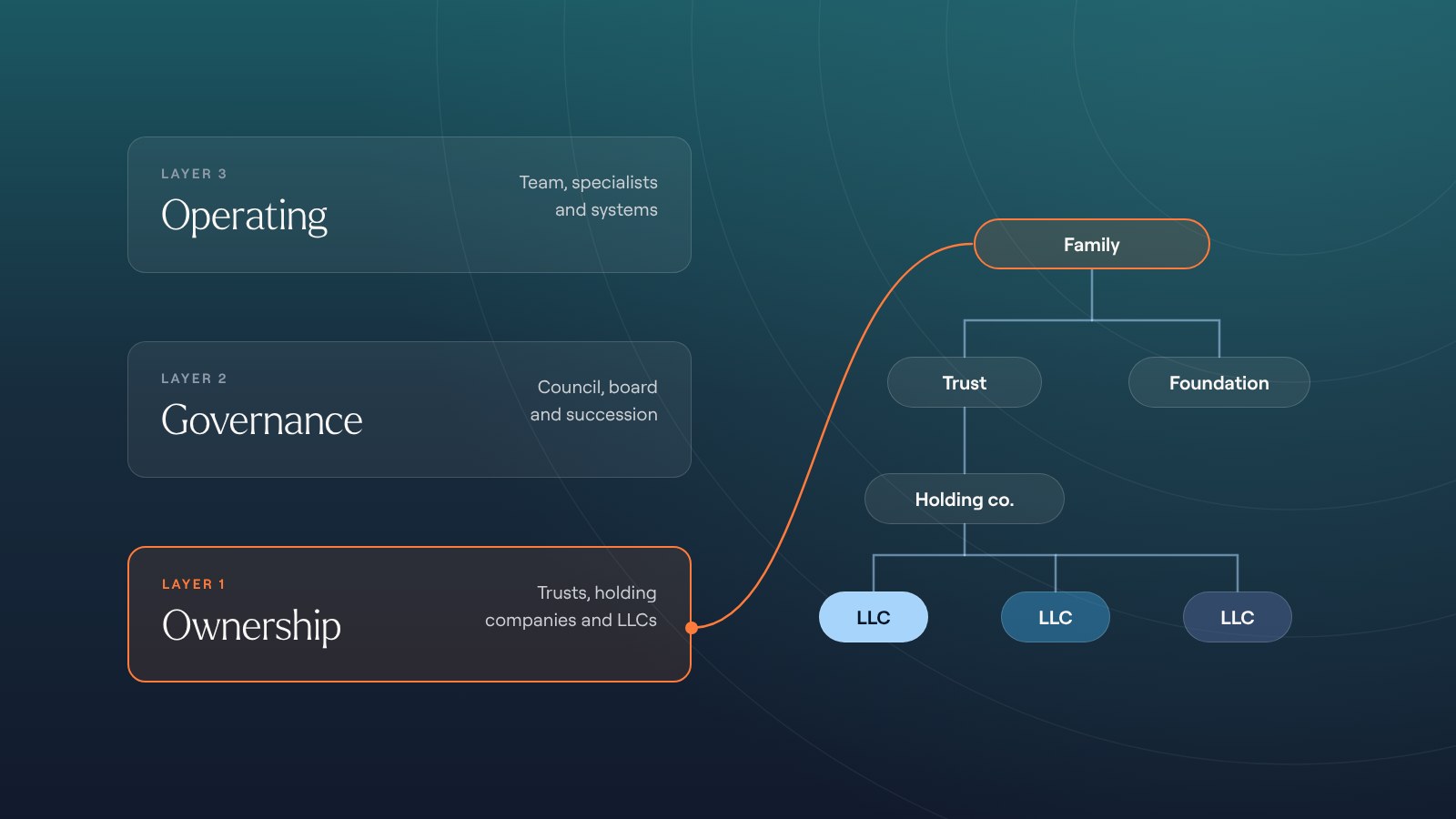
A family office structure is how a family organizes three distinct layers: the wealth it owns, the people who decide what happens to that wealth, and the team that carries those decisions out. Ownership is at the bottom, decisions are in the middle, and operations sit on top.
Each layer answers a different question and has a different owner.
| Layer | What it contains | Who owns the decision |
|---|---|---|
| Ownership | The legal structure: holding companies, LLCs, trusts, foundations and the assets inside them | The principal, with trust, estate and tax counsel |
| Governance | Family council, board, investment committee, family constitution, succession plan | The council and the board |
| Operating | Staff, outside specialists, systems and data | The office’s CEO or COO, answering to the board |
Many family offices are born from a liquidity event, such as the sale of an operating company. Overnight, the family has a large pool of cash, a large tax bill, and no one whose full-time job is to manage either. Lawyers usually set up the ownership structure first: the trusts, holding companies, and entities that hold the assets. The investment and reporting layers are added later.
That order is backwards, because the structure has to work across generations, not only for the person who made the money. If you haven’t formed an office yet, start with how to start a family office.
We’ll take the layers in order, beginning with a choice that shapes all three: what kind of office you want to run.
Which family office model fits your family?
The family office model is a choice about control, cost and how much work the family keeps in-house. The right model depends on the size of the fortune, the number of family branches, and the family’s attitude toward privacy.
Although many family offices run much leaner, the average office employs 12 people (UBS Global Family Office Report 2025).
| Model | Typical wealth | Control | Cost | Best for |
|---|---|---|---|---|
| Single-family office | Ultra-high net-worth individuals whose wealth can carry a dedicated team | Full | Highest fixed cost | One family with a layered, private structure |
| Multi-family office | Below that level | Shared | Lower; management fees, often tied to assets under management | Institutional services without building them |
| Virtual family office | Wide range | High over decisions, lower over execution | Pay specialists as you use them | A lean core with trusted outside firms |
| Embedded family office | Tied to the operating company | Informal | Hidden in company payroll | The early years, while the business still dominates |
There’s no legal minimum to establish a family office. Our guide to family office minimum net worth covers where the thresholds usually fall.
Single-family office
A single-family office answers to one family only. You get full control, full privacy, and a team that knows every holding by name. You also carry the whole cost, regardless of the portfolio’s performance.
Multi-family office
A multi-family office spreads one team and one set of systems across several families. Costs drop, but so does customizability. Many MFOs grew out of a private bank or a wealth management firm, so principals should verify that the advice is conflict-free. Offices on multi-family office software can give each household its own reporting from one platform.
Virtual family office
A virtual family office keeps a small core (sometimes consisting of one trusted advisor) and hires specialists for tax, legal, and investment management. This model suits families who want control without payroll for every function. The catch is coordination, which we cover in virtual family office services.
Embedded family office
An embedded office lives inside the family business. The company’s CFO pays the family’s bills, and company staff track the family’s investments. It feels free, but it’s not.
When the family enterprise and the family’s private wealth share staff, conflicts of interest and blind spots are common. Whose side is the CFO on when the company and the family want different things? Who sees the full picture when personal assets sit in the company’s books? An embedded office is frequently the transitional stage before a more permanent structure can be established.
Whichever model you pick, a more permanent foundation will support it: the structures that actually hold title to the assets.
How should you structure the entities that own the wealth?
The ownership layer determines who is liable if something goes wrong, how each asset is taxed, and who controls what. It’s also the layer families lose sight of first. Each new trust, LLC or foreign holding company adds a box to the chart, and the chart doesn’t stay current unless someone is responsible for it.
Holding companies and LLCs
A family holding company usually sits near the top and consolidates ownership. Beneath it, separate LLCs hold individual assets. The advantage is liability protection. If a tenant sues one property LLC, the claim stops there instead of reaching everything else.
Trusts and private trust companies
Trust structures move ownership out of the principal’s name and into a vehicle with its own terms, for the benefit of each named beneficiary. Families with several large trusts sometimes form private trust companies to act as trustees, which keeps those decisions inside the family. Weighing a trust on its own? See trust vs family office.
Private foundations and philanthropic vehicles
Philanthropy usually gets its own branch of the chart. Private foundations give the family control over grants, at the cost of a greater administrative burden and public filing requirements. A donor-advised fund is lighter and easier to set up, but offers less control.
Cross-jurisdiction structures
Once a family holds companies in two countries, every question doubles. Which country taxes the income? Which currency do you report in? Which trustee answers to which court? Tax planning and tax optimization across borders is intricate work, so consult reputable advisors licensed in each jurisdiction. Meanwhile, invest in shared reporting that makes it possible for everyone to work from the same chart.
An example ownership chart
Below is a simplified, hypothetical structure.
The chart shows the chain of ownership. Note that the plane, yacht, and art collection sit inside their respective LLCs too, right beside the portfolio.
| Level | Vehicle | What it holds |
|---|---|---|
| 1 | Principal and spouse (G1) | Settle the family trust; fund the private foundation directly |
| 2 | Family (dynasty) trust, with a private trust company as trustee | 100% of the holding company |
| 2 | Private foundation, funded by the principal, outside the trust | Grant-making endowment |
| 3 | Holding company | The LLCs below |
| 4 | Investment LLC | Public portfolio and cash |
| 4 | Private markets LLC | Private equity funds and other alternative assets |
| 4 | Real estate LLCs, one per property | Homes, commercial buildings |
| 4 | Aviation and marine LLCs | Aircraft, yacht |
| 4 | Art LLC | The collection |
Even this basic example mixes liquid and illiquid holdings, and adds a second currency the moment a foreign property enters. That’s where spreadsheets start to break. They can’t show layered ownership percentages, and a third currency only adds further complexity.
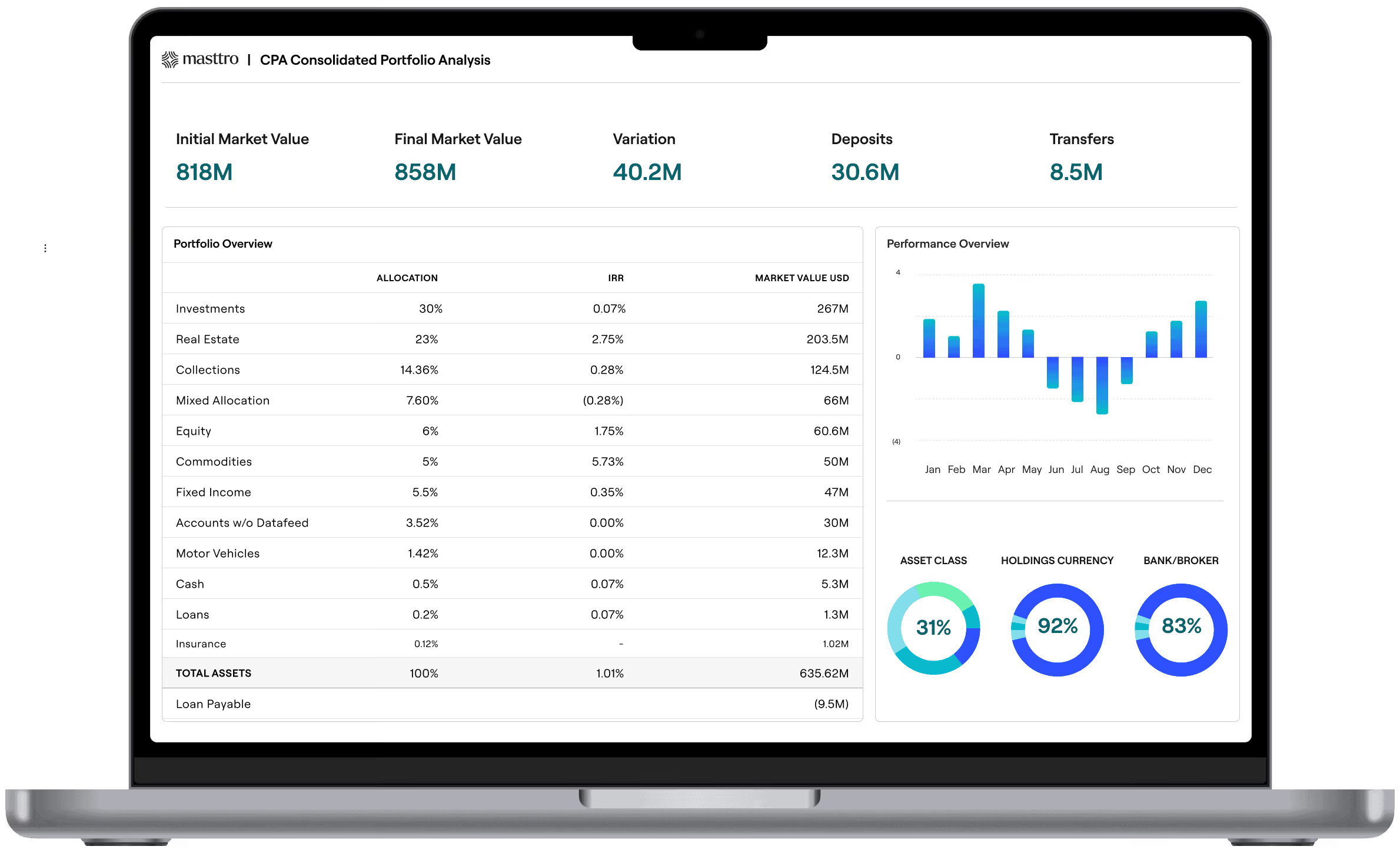
Masttro was built inside a multigenerational family office in 2010 by operators solving exactly this problem: one view of wealth spread across entities, jurisdictions, currencies and asset classes. The Global Wealth Map draws the ownership chart from live data across companies, trusts, LLCs and foundations, while the platform keeps lifestyle assets in the same view as the portfolio.
Jefferson River Capital implemented Masttro across a $1B+ portfolio with 200+ alternative investments in three months or less. See how. Read the case study
How do you build the governance layer?
This layer decides who can make which decisions and how the family settles disagreements. Most offices formalize it: nearly three-quarters of family offices have boards, averaging four members (Deloitte Private, 2024).
Family council and family constitution
A family council speaks for the family, not the family office. It gives each branch and generation a seat, which matters over time as a handful of siblings becomes a consortium of cousins who may barely know each other. A family constitution writes down what’s agreed to: the mission, who counts as family, and how disputes get resolved.
Board and investment committee
The governing board oversees the office: budget, senior hires, and risk. The investment committee sets asset allocation targets and approves managers according to an investment policy. Should family members sit on both board and committee? Some do, but one independent member on each adds objectivity and makes it easier to say no to a relative.
Succession planning
Succession belongs in the structure. However, only 53% of families have a wealth succession plan, up from 47% in 2024 (UBS Global Family Office Report 2025). The rest are relying on memory and goodwill for the largest wealth transfer they will ever make. A real plan names who takes over each role, how future generations are prepared, and who controls each vehicle next.
Before you call this layer done, check that these documents exist and are current:
- Family constitution
- Investment policy statement
- Succession plan, covering roles as well as assets
- Estate planning documents for each principal, matched to the ownership chart
- Board and committee charters
Written governance frameworks last. They are how generational wealth survives a founder stepping back. Once the rules exist, they shape every investment and spending decision. Our guide to family office strategy picks up from there.
But keep in mind, documents don’t run an office. People do.
The operating layer: the team that runs the office
The operating layer is the family office team and the outside firms that carry out the board’s instructions. Most offices stay lean, and budgets show why: personnel, infrastructure and IT accounted for 56% of family office costs in 2024 (UBS Global Family Office Report 2025).
Typical roles in a family office include:
- CEO or principal: sets direction, answers to the board and council.
- Chief investment officer: sets investment strategies, oversees the investment portfolios and owns risk management.
- Chief financial officer: cash, tax, financial planning, outside accountants.
- COO: administrative services, vendors, reporting, cybersecurity.
- Accountants: reconciliation, bill pay, capital calls, K-1s.
Few offices need to hire all five. The real decision is what gets outsourced and what gets built in-house. Many families hand investment management to wealth managers or an outsourced CIO, and send tax and legal to outside firms. Keep in-house whatever requires deep knowledge of the family, and outsource whatever a specialist can execute more easily at volume.
A lean team only works if systems do the repetitive work. Two people can’t reconcile a dozen custodians by hand each month and still answer the principal on the same day. That’s the job that purpose-built family office software exists to do.
A lean team needs the right systems. Get the guide to building a family office tech stack. Download the ebook
For US families, there’s one more constraint, and it is set by Washington, D.C.
US regulation: the SEC family office exclusion
Under the SEC’s family office rule, a qualifying family office is excluded from the Investment Advisers Act definition of an investment adviser, so it doesn’t have to register. The SEC adopted Rule 202(a)(11)(G)-1 on June 22, 2011 (SEC), after the Dodd-Frank Act removed the exemption that many offices had relied on.
The office must meet three conditions:
- It advises only “family clients,” as the rule defines them.
- It is wholly owned by family clients and exclusively controlled by family members or family entities.
- It does not hold itself out to the public as an investment adviser.
If you bring in an unrelated co-owner, or start advising a friend’s family, the exclusion may cease to apply.
This is not legal advice; confirm your position with counsel. Offices with holdings or family outside the US face other regimes too, so cross-border structures need local counsel.
Either way, you can only prove who owns and controls the office if the chart is current on the day that someone asks.
“Masttro allows us to answer all the different questions from the owner’s perspective. What assets do I have? Where do I have them? Who knows about this information and who is in charge of it?”

Five Dashboards Every Wealth Owner Needs

How do you keep the structure visible as it grows?
A structure chart is only useful if it’s up to date. Every new company, account and jurisdiction has to land in the right place on the day it’s created, otherwise the chart becomes historical.
“Visible” means you can answer four questions on any day: who owns this asset, through which vehicle, in which currency, and what it’s worth today.
Consolidated reporting across the whole family structure makes that possible for every asset. The alternative is principals receiving a quarterly PDF that’s stale on arrival, and the COO spending the week before each board meeting rebuilding the chart from statements.
So, stop treating the chart as a document and elevate it to a source of truth. Feed it from live custodian data and put it on the investment dashboards that the family already uses. Jefferson River Capital’s CIO put it plainly:
“Visually, from a user interface perspective, this is by far the easiest platform to add assets and to see our family mapping.” Daniel Forman, CIO, Jefferson River Capital
That’s the Global Wealth Map, fed by Masttro’s data aggregation from 750+ custodian feeds across 40+ countries, on a Swiss private cloud where not even Masttro employees can access your data.
See how one live map can show every entity, trust and asset a family owns, across jurisdictions and currencies. Explore the Global Wealth Map
Frequently Asked Questions
How much wealth do you need to set up a single-family office?
There’s no legal minimum. The test is whether the fortune can carry a dedicated team year after year; family offices employ 12 people on average (UBS, 2025). Below that point, a multi-family or virtual office usually costs less.
How much of a family office budget goes to staff and systems?
Most of it. Personnel, infrastructure and IT were 56% of family office costs in 2024 (UBS, 2025).
Should a family office be an LLC or a trust?
Usually both, because they do different jobs. The office itself is often an LLC that employs staff and signs contracts. Trusts hold the assets for the beneficiaries. Your trust and tax counsel should set the mix.
Can a family office serve more than one family and stay exempt from SEC registration?
Generally, no. Under the SEC rule, family members are the descendants of one common ancestor who is no more than ten generations removed from the family’s youngest generation, plus their spouses. Certain key employees and family trusts can also be clients. An office advising unrelated families usually must register or find another exemption.
How many people does a family office need?
The average is 12 (UBS, 2025), but many run with a handful of staff and outsource investments, tax and legal.
How do family offices handle entities in several countries?
Local counsel in each jurisdiction, and one consolidated view across all of them. The legal work stays local; the picture of who owns what, in which currency, lives in one place.
Can Masttro map our family’s entities and ownership structure?
Yes. The Global Wealth Map shows companies, trusts, LLCs and foundations in one live view. The wider Masttro platform keeps real estate, art, aircraft and yachts beside the portfolio, with data from 750+ custodians across 40+ countries.
“The biggest value for us has been gaining a complete and organized view of our entire patrimonial structure. Today, we have a much clearer map of what we own, where it is held, and how the different entities and investments are connected.”
“Masttro allows us to consolidate all custodians and set up the entire legal structure to offer our clients a true holistic vision of their assets.”

“Game changer for portfolio performance and org chart viewing.”