Key Takeaways
The most common Masttro alternatives are Addepar, Aleta, FundCount, Asora and Eton Solutions. They differ more than their marketing suggests: Addepar is an enterprise data platform, FundCount and Eton are accounting-led, Aleta and Asora sell speed of onboarding, and SS&C Black Diamond serves advisors rather than family offices. Masttro is the reporting-first choice for family offices and wealth owners with alternative investments, many entities and assets in several countries.
Masttro publishes this page. We wrote it because most pages about Masttro alternatives are written by competitors. Every competitor fact below comes from that vendor's own website or press releases as of October 2026, and we say where Masttro falls short as well as where it leads, so wealth owners and their advisors can make the financial decisions this choice involves with the full picture.
Why do family offices look for Masttro alternatives?
Buyers who compare wealth tech platforms usually raise the same four questions about Masttro. Here are straight answers.
"Masttro does not have a general ledger." True. Masttro is reporting-first. Its Investment Sub-Ledger bridges reporting and accounting and exports reconciled entries to your general ledger. Masttro is designed to sit beside your ledger, not replace it, giving you consolidated reporting connected to the ledger your CPA already trusts.
"Implementation takes too long." It depends on complexity. Jefferson River Capital, a $1B+ portfolio, loaded 200+ alternative investments and began tracking performance in three months or less. Platforms quoting a few weeks are usually quoting simpler structures.
"Pricing is not published." Masttro does not publish a price list. Its pricing is not based on assets under management, so cost does not rise as the family's wealth grows. Stonebridge Family Office chose Masttro because other solutions "would've been at least double the cost."
"Is my data locked in?" No. Masttro offers API endpoints for downstream data management systems, and the Investment Sub-Ledger supports exports. Whichever vendor you choose, get data ownership terms in writing.
How do the main Masttro alternatives compare?
| Platform | Positioning, in its own words | Data connections (vendor's figure) | Accounting approach | Published pricing |
|---|---|---|---|---|
| Masttro | "Family office software for every asset, entity, and generation" | 750+ direct custodian feeds, 40+ countries | Investment Sub-Ledger feeding your GL | Not published; not based on AUM |
| Addepar | "A global data and AI platform" | "Hundreds of global custodians, banks and administrators" | Integrates with general ledgers | Not published |
| Aleta | "Open by design. Agent-ready." | 100+ custodian and bank integrations | Investment ledger; feeds third-party GLs | Not published; not based on AUM |
| FundCount | "Unified accounting & investment software" | 50+ native connectors plus RPA | Integrated real-time general ledger | SFO from $35,899 a year, plus fees |
| Asora | "Software for the modern family office" | 200+ custodians | Book-cost accounting module | Tiered by family net worth |
| Eton Solutions | "The Only Integrated, Secure WealthAI Solution You Need" | 1,500+ banks and custodians, directly or through partner aggregators | Integrated ERP (AtlasFive) | Not published |
| SS&C Black Diamond | Advisor portfolio management and client reporting | Not published | Not a general ledger | Not published |
Masttro
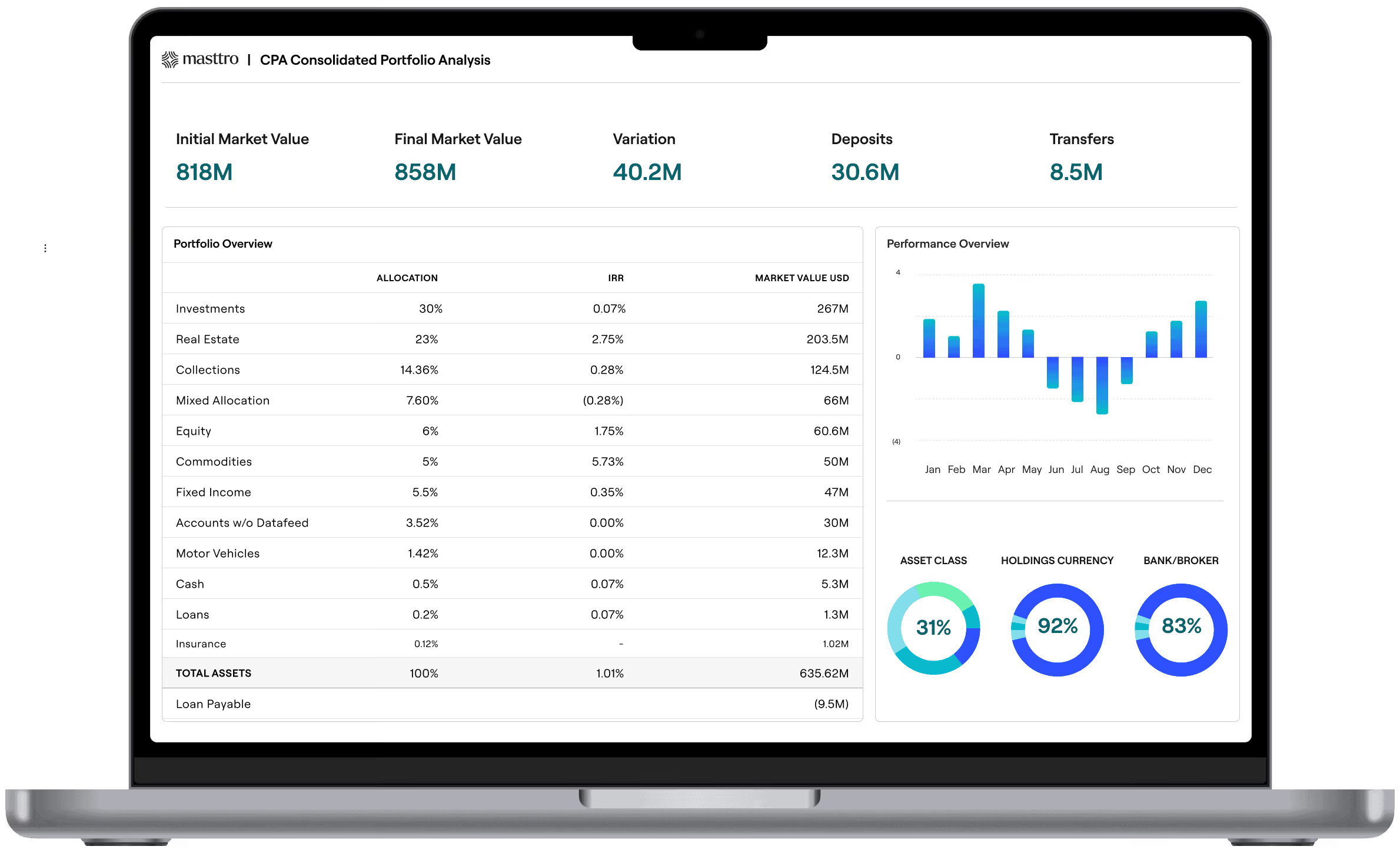
Masttro was built inside a multigenerational family office and now serves 400+ family offices, and more than 10,000 people use the platform. Its data aggregation connects 750+ custodians, private banks and other financial institutions in 40+ countries through direct custodian feeds and places liquid and illiquid assets in one consolidated view, from public equities and private credit to real estate, art and aircraft. Native artificial intelligence, Alternatives AI and Documents AI, handles document management for capital calls, distributions, NAV statements and K-1s, and Masttro tracks 300,000+ alternative investments. Consolidated reporting runs through Consolidated Portfolio Analysis, with portfolio analytics and performance metrics across asset classes. The Global Wealth Map shows every entity, net worth and ownership percentage across generations, and private markets forecasting projects capital calls and cash needs. Data is hosted in a Swiss private cloud with role-based access control and multi-factor authentication, Masttro is ISO/IEC 27001:2022 certified, and not even Masttro employees can access client data.
"Visually, from a user interface perspective, this is by far the easiest platform to add assets and to see our family mapping," said Daniel Forman, CIO of Jefferson River Capital.
Where it falls short: no full double-entry general ledger, and no published price list.
Addepar
Addepar reports more than 1,500 client firms and nearly $10 trillion on its platform across 60 countries, and describes itself as "a global data and AI platform." It launched Addison, a native AI experience, in March 2026 and describes integrating "directly with general ledgers."
Where it falls short: Addepar serves large RIAs, private banks and asset management firms as well as family offices, so family office use often depends on configuration and implementation partners. Pricing is not published.
Why Masttro instead: a principal-first design, real estate and lifestyle assets mapped with portfolios in one view, and native document AI for alternatives. See Masttro vs Addepar.
Secure Visibility for Modern Family Offices

Aleta
Aleta describes itself as "Open by design. Agent-ready." It says its pricing is not based on assets under management and that most family offices are up and running in weeks. It reports 100+ custodian connections and bank integrations, SOC 2 Type II certification, and open APIs with support for AI assistants. It offers a private-markets forecasting tool and is headquartered in New York.
Where it falls short: a network of 100+ integrations, against Masttro's 750+ direct custodian feeds, limits data aggregation when a family banks with private banks in several countries.
Why Masttro instead: multi-jurisdiction depth, 300,000+ alternative investments tracked, and a privacy model where vendor staff cannot see client data. See Masttro vs Aleta.
FundCount
FundCount calls itself "unified accounting & investment software" and says "every capability posts to the same real-time general ledger." It publishes starting prices of $35,899 a year for a single-family office and $26,950 for a multi-family office, plus implementation and hosting fees, and lists 50+ native connectors plus managed RPA.
Where it falls short: it is built around multi-entity accounting, with narrower principal-facing portfolio analytics and fewer direct custodian connections.
Why Masttro instead: 750+ direct custodian feeds, a Global Wealth Map built for families, and native AI for alternatives. See Masttro vs FundCount.
Asora
Asora calls itself "Software for the modern family office" and prices by family net worth. A $50M–$100M family pays $15,600 a year plus $3,900 for onboarding. Private-fund holdings are added through a paid pack of $3,600 a year per 20 holdings. Asora is ISO 27001 certified and quotes go-live in four weeks or less.
Where it falls short: private investments arrive as a priced add-on, so cost and dependency grow with the private portfolio.
Why Masttro instead: native Alternatives AI for private funds with no per-holding packs, and entity mapping built for multigenerational structures. See Masttro vs Asora.
Eton Solutions
Eton Solutions describes AtlasFive as "The Only Integrated, Secure WealthAI Solution You Need" and an ERP for investment operations. It reports more than 1,300 families on the platform, EtonAI processing for 250+ document types, and ISO 42001, ISO 27001 and ISO 27701 certifications.
Where it falls short: an ERP rollout changes accounting, bill pay and workflow at once, so implementation scope is broad. Pricing is not published.
Why Masttro instead: a bounded implementation focused on consolidated reporting and alternative investments, connected to the general ledger your office already uses.
Black Diamond
SS&C Black Diamond reports one million active users and more than $4.6 trillion in assets under management. It is built for registered investment advisors and wealth management firms who need portfolio management, performance reporting and client reporting across many households.
Where it falls short: Black Diamond is designed for advisors serving many clients, not for a family office reporting on trusts, operating companies, private funds and lifestyle assets for one family.
Why Masttro instead: a platform designed around how wealth owners hold assets, with look-through ownership, private investments and passion assets in one net worth view.
What other platforms appear on Masttro alternatives lists?
Review sites and competitor blogs add more names. Some fit family office use cases; others are wealth management technology for a different buyer.
- SEI Archway (the Archway Platform): family office management software built around multi-entity accounting and a general ledger.
- Envestnet | Tamarac: RIA software for rebalancing, performance reporting and client reporting. Envestnet | Tamarac fits advisors managing many households, not a single family's entity structure.
- Asset Vantage: an integrated general ledger with analytics; Asset Vantage publishes pricing from $30,000 a year for a single-family office and states "No hidden fees. No AUM-based pricing."
- Landytech Sesame: Landytech's aggregation and reporting platform, citing 500+ custodian feeds.
- Retirement and research tools: some review-site lists include workplace retirement apps and investment research terminals. These are not family office management software and do not consolidate entities or private funds.
Which platforms do different firms compare?
The right comparison depends on who you are. Single-family offices usually weigh Masttro against Aleta, Asora and Addepar. Multi-family offices and private banks weigh it against Addepar and Black Diamond, with client-ready reports under their own brand as the deciding feature. Masttro serves all three groups, and private banks and other financial institutions use its white-label platform to deliver client-ready reports to their UHNW clients.
Whatever the firm type, look past the feature list to three things: data aggregation coverage in every country where the family banks, how private funds are processed, and access control over who can see the family's data, including the vendor's own staff. Single-family offices also weigh user experience for the principal; multi-family offices weigh client reporting at scale.
How should you test Masttro against an alternative?
Use your own data, not a demo file. Ask each vendor to:
- Process one of your recent capital calls from the notice to the bank match.
- Show whether private-fund values come from document AI or from PDF statement import and manual marks.
- Map one trust that owns part of a holding company and show the look-through exposure.
- Report one non-USD account in its local and base currency.
- Export a month of investment activity to your general ledger.
- Put in writing who at the vendor can access your data, and confirm data ownership and access control terms.
- Introduce a reference client with similar complexity, live for at least 12 months.
Frequently asked questions
What are the best Masttro alternatives?
The platforms family offices most often compare with Masttro are Addepar, Aleta, FundCount, Asora and Eton Solutions; advisors and private banks also compare it with SS&C Black Diamond. Addepar is an enterprise data platform for wealth management firms, FundCount and Eton are accounting-led, and Aleta and Asora focus on speed of onboarding.
Who are Masttro's competitors?
Masttro's main competitors in family office software are Addepar, Eton Solutions, Aleta, Asora, FundCount, Asseta, Asset Vantage, Landytech, SEI Archway and, for advisors, Black Diamond and Envestnet | Tamarac. Several publish their own comparison pages about Masttro.
How much does Masttro cost?
Masttro does not publish a price list. Pricing is scoped to the platform and the family's needs and is not based on assets under management, so it does not rise as wealth grows.
Is Masttro better than Addepar?
For family offices and wealth owners who want principal-first design, liquid and illiquid assets in the same net worth view, and native artificial intelligence for alternatives, Masttro is the stronger fit. Addepar serves a wider range of firms, including large RIAs.
Does Masttro have a general ledger?
No. Masttro is reporting-first. Its Investment Sub-Ledger bridges reporting and accounting and exports to your existing general ledger.
How long does Masttro take to implement?
It depends on complexity. Jefferson River Capital, with a $1B+ portfolio, loaded 200+ alternative investments and began tracking performance in three months or less.
Can I export my data from Masttro?
Yes. Masttro offers API endpoints for downstream systems, and the Investment Sub-Ledger supports exports. Confirm data ownership terms in the contract with any vendor.
Where is Masttro's data hosted?
In a Tier 4 data center in Switzerland on dedicated infrastructure. Masttro is ISO/IEC 27001:2022 certified, and not even Masttro employees can access client data.
About this comparison
Masttro publishes this page. Competitor facts come from each vendor's own website and press releases, checked in October 2026, and are quoted in each vendor's own words where possible. We do not link to competitor websites. Masttro facts come from masttro.com and published client results. If a figure has changed, contact us and we will correct it. Last reviewed: October 10, 2026.
Sources
- Vendor websites and press releases for Addepar, Aleta, FundCount, Asora, Eton Solutions, SS&C Black Diamond, SEI Archway, Envestnet | Tamarac, Asset Vantage and Landytech, checked October 2026.
- Masttro, data security: ISO/IEC 27001:2022 certification and Swiss hosting.
- Masttro client results: Jefferson River Capital, Stonebridge Family Office and Laureate Wealth Management, as published by Masttro.
Next steps
See every head-to-head on our comparison hub, or schedule an intro to test Masttro on your own capital calls.
Related guides: best family office software, family office reporting software and family office accounting software.
“Finally, the most comprehensive and complete system available to manage all types of assets for a family.”

“Visually, from a user interface perspective, this is by far the easiest platform to add assets and to see our family mapping.”

“With Masttro we have the tools to manage assets that are nontraditional, and that’s translated into an opportunity to provide a much broader service than investment management.”