Key Takeaways
Family office accounting software records every transaction across a family's entities in a general ledger, consolidates those entities into financial statements, and connects investment activity such as capital calls, distributions and K-1s to the books. The right setup for 2026 depends on one question: should one system do both accounting and investment reporting, or should a reporting platform feed a dedicated ledger?
The stakes are rising for family offices of every size. A $1B+ family office spent an average of $6.6 million a year to operate in 2026, up from $6.1 million in 2024, according to J.P. Morgan Private Bank's 2026 Global Family Office Report. Reconciliation between systems is one driver of that cost.
Last reviewed October 10, 2026. Statistics are linked to their original sources, listed at the end.
What is family office accounting software?
Family office accounting software is a system that keeps the books for every entity a family owns, from operating companies and trusts to foundations, LLCs and investment partnerships. Unlike small-business accounting, it has to consolidate dozens of legal entities across the multi-entity structures family offices use, handle several currencies, and absorb a steady flow of documents on private investments from private equity, venture capital, private credit and real estate funds.
A complete family office accounting setup covers:
- General ledger for each legal entity, with a shared chart of accounts.
- Multi-entity consolidation into consolidated financial statements that follow the family's ownership structures.
- Intercompany transactions and eliminations between related entities.
- Partnership accounting for capital accounts, allocations and waterfalls.
- Investment accounting and investment tracking for cost basis, income, realized and unrealized gains across all asset classes, including private equity and digital assets.
- Alternative investments activity such as capital calls, distributions, NAV statements and K-1s.
- Cash management and bill pay across bank accounts and entities, the day-to-day financial management of the office.
- Audit trails that show who posted what, and when, backed by data security controls on who can see each entity.
- Tax support that hands your CPA firm clean, documented portfolio data.
Why do QuickBooks and small-business ledgers break in a family office?
Small-business ledgers work for one company in one currency. Family offices break them in specific, predictable places:
- The third entity. Each new trust or holding company becomes a separate file, and consolidation becomes a spreadsheet exercise.
- Intercompany activity. Loans and transfers between related entities need matching entries and eliminations that small-business tools do not automate.
- A second currency. FX revaluation across entities in different base currencies is manual and error-prone.
- Private funds. Capital calls, distributions and K-1s arrive as PDFs. Someone keys them in, and errors surface at year-end.
- Ownership percentages. When a trust owns 40% of a partnership, the ledger cannot show the family's look-through exposure.
That is why accountants supporting family offices move to purpose-built family office software or to mid-market accounting systems such as Sage Intacct combined with investment software.
What are the three family office accounting setups?
| Setup | How it works | Examples | Built for | Trade-off |
|---|---|---|---|---|
| All-in-one ERP software | One platform for ledger, operations, bill pay and reporting | Eton AtlasFive | Large, operations-heavy family offices | Long implementations and broad change management |
| Accounting-first suite | A general ledger at the core, with investment and reporting modules added | FundCount, Asseta, Asset Vantage | Family offices where the controller owns the system | Principal-facing reporting and custodian coverage tend to be narrower |
| Reporting platform plus ledger | A reporting platform consolidates investments and feeds a general ledger | Masttro plus the office's existing general ledger | Single- and multi-family offices with alternatives, many entities and several jurisdictions | Two systems to manage, joined by a sub-ledger or integration |
Whatever the setup, accounting and portfolio reporting must agree. The ledger produces financial statements and financial reporting for each entity; the reporting platform produces consolidated reporting on multi-asset portfolios, private assets and performance analytics. When the two disagree, the family loses trust in both.
No setup is right for all family offices. A family with forty entities, three currencies and two hundred private funds usually gets better results from a reporting platform that owns the portfolio data and feeds clean entries to the ledger.
How does Masttro fit into family office accounting?
Masttro is a reporting-first platform. It does not include a full double-entry general ledger, and we say so plainly because it decides how you design your setup.
What Masttro does is own the investment side of the books:
- Data aggregation: 750+ direct custodian feeds in 40+ countries bring in positions and transactions every day, so data aggregation replaces manual statement uploads. See data aggregation.
- Alternatives: Alternatives AI and Documents AI read capital calls, distributions, NAV statements and K-1s for alternative assets and private investments, then reconcile them to bank activity.
- Structure: the Global Wealth Map records ownership structures, every entity and every ownership percentage, so reports follow how the family actually holds wealth, from investment portfolios to real estate.
- Investment Sub-Ledger: keeps investment-level detail and exports entries to your general ledger, so the controller books summarized, reconciled activity instead of rekeying documents.
- Cash: the cash management registry tracks liquidity across accounts and entities.
- Reporting and controls: customizable dashboards, performance analytics across multi-asset portfolios, role-based data security, and compliance tools that flag concentration limits and AML or KYC alerts.
"With Doc AI, we're able to tag [capital calls and distributions] appropriately, get the date in, get the amount right, and map it and reconcile it to our bank accounts accurately," said Mitchell at Jefferson River Capital, which tracks 200+ alternative investments on Masttro.
“Masttro is a tool that allows you to organize complex structures and give you space to grow.”

Alternatives Reporting: From Below the Line to All of the Above

What does a month-end close look like with a reporting platform and a ledger?
Here is how the work divides in a typical Masttro setup, with automated workflows from the first custodian file to the principal's report:
- Daily: direct custodian feeds update positions, transactions and cash across every account and country.
- As documents arrive: Documents AI reads capital call notices, distribution notices and NAV statements, and matches each one to the bank movement.
- Week one of the close: the operations team reviews exceptions only, such as a distribution that has not yet hit the bank.
- Posting: the Investment Sub-Ledger exports summarized, reconciled investment entries to the general ledger.
- Controller review: the controller posts operating activity, intercompany transactions and accruals in the ledger and closes the books.
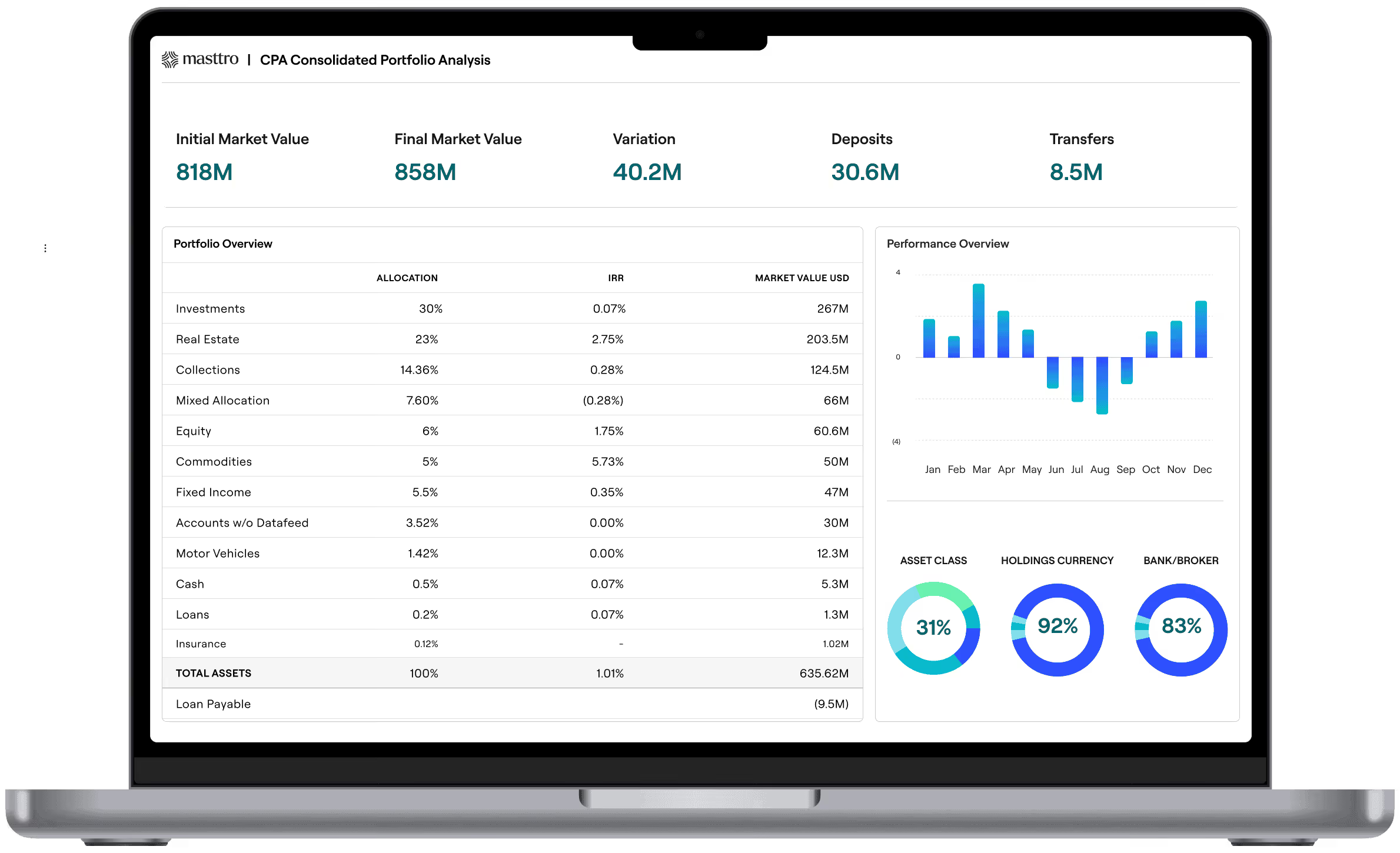
- Reporting: the principal and other family members see consolidated reporting on net worth, performance, cash and private-fund activity in Masttro and on mobile, while the ledger produces financial statements for the CPA firm.
The point of the split is that nobody rekeys a capital call. The investment record and the ledger agree because one feeds the other.
Which reports should family office accounting produce?
- Entity financial statements: balance sheet, income statement and cash flow for each legal entity.
- Consolidated net worth: every entity rolled up by ownership percentage, in the family's base currency.
- Capital account statements: commitments, contributions, distributions and remaining unfunded commitments by fund.
- K-1 tracker: which K-1s have arrived, which are late, and what each reports. Calendar-year partnerships file by March 15 under the IRS Form 1065 instructions, and many extend, so K-1s often arrive months later.
- Cash and liquidity: balances and upcoming capital calls by entity, so no call is missed.
- Performance: returns by asset class, manager and entity, with IRR for private assets such as private equity, venture and real estate funds.
Stonebridge Family Office cut its monthly reporting time from 8–10 hours to a matter of hours after moving consolidation and private-equity tracking into Masttro.
When should you choose a reporting platform plus a ledger?
Choose this model when three or more of the conditions below are true. Alternatives alone make the case for many families: they averaged 35.5% of single-family office portfolios in 2026, per J.P. Morgan. Family offices that hold assets through many legal entities and ownership structures, bank in several countries, and want a better user experience than monthly financial statements alone usually meet the rest.
What should you ask family office accounting software vendors?
| Question | Why it matters |
|---|---|
| Can you post one of our real capital calls, from notice to ledger entry? | Separates automation from manual data entry |
| How are intercompany transactions and eliminations handled across entities? | Consolidation is where spreadsheets fail first |
| Which custodians connect directly, and in which countries? | Every manual feed adds reconciliation work |
| What audit trails exist for every entry and change? | Your auditors and family council will ask |
| How do you export to our GL or CPA firm? | Prevents lock-in and keeps tax preparation clean |
| How long did implementation take for family offices with our complexity? | ERP software rollouts can run far longer than reporting platforms |
| What is the pricing model, and how does it change as assets or entities grow? | AUM-linked pricing rises with the family's success |
How long does implementation take?
It depends on entity count, custodians and private funds. Accounting-first suites and ERPs migrate historical ledgers and workflows, which extends timelines. Reporting platforms move faster because they use custodian integrations and data aggregation and connect to existing ledgers. Jefferson River Capital, a $1B+ portfolio, loaded 200+ alternative investments into Masttro and began tracking performance in three months or less.
What will change in family office accounting in 2027?
Document AI becomes table stakes. Vendors serving family offices and asset managers now read capital calls and K-1s automatically. Ask for accuracy rates and how exceptions are handled, not whether the feature exists.
AI assistants need clean books. More platforms connect to AI assistants such as ChatGPT and Claude for real-time financial insights. An assistant is only as accurate as the reconciled portfolio data underneath it.
Consolidation pressure grows. The average family office already handles data from more than a dozen systems, many of them cloud-based platforms, according to Simple's 2025 Family Office Software and Technology Report. Each connection between systems is a place where numbers can disagree.
Frequently asked questions
What is family office accounting?
Family office accounting is bookkeeping, consolidation and financial reporting across all of a family's entities, including trusts, partnerships, operating companies and investment vehicles, plus the investment accounting for private funds and public portfolios. It is the financial management backbone of UHNW wealth management, and it gives family members one trusted set of numbers.
What is the best family office accounting software?
It depends on your setup. Family offices with heavy alternative investment exposure, many entities and assets in several countries get the most from a reporting platform such as Masttro connected to a general ledger, because the investment data is captured once and reconciled before it reaches the books.
What do accountants use instead of QuickBooks for family offices?
Accountants supporting family offices typically move to multi-entity ledgers such as Sage Intacct, NetSuite or Microsoft Dynamics 365 Business Central (Sage Intacct and Microsoft Dynamics 365 Business Central both handle multi-entity consolidation), or to purpose-built family office platforms, because QuickBooks struggles with consolidation, intercompany activity and multiple currencies.
Does Masttro have a general ledger?
No. Masttro is reporting-first. Its Investment Sub-Ledger bridges reporting and accounting and exports entries to your existing general ledger.
Do I need to replace my accounting system to use Masttro?
No. Masttro sits beside your accounting system rather than replacing it. It owns investment data, investment tracking and alternatives processing, and feeds summarized, reconciled entries to the ledger you already run.
How does family office software handle capital calls?
Purpose-built platforms read the capital call notice, capture the amount and due date, match the payment to the bank account, and update the investment record. Masttro does this with Documents AI and Alternatives AI.
Can family office accounting software handle multiple currencies?
Purpose-built platforms can. Ask each vendor to show consolidation across at least two base currencies, with FX effects separated from investment returns across all asset classes.
How much does family office accounting software cost?
Published prices for accounting-first suites start around $26,950 to $35,899 a year before implementation and hosting fees. ERP software and enterprise wealth management platforms usually quote privately; Asset Vantage publishes pricing tiered by entity count. Masttro's pricing is not based on assets under management.
About this guide
Masttro's team wrote this guide for family office controllers, COOs and the CPA firms that support them. The month-end close and capital call flow describe how Masttro clients split work between Masttro and their general ledger. Masttro is reporting-first and has no general ledger of its own, which is why this guide treats the ledger as a separate system you keep.
Sources
- J.P. Morgan Private Bank, 2026 Global Family Office Report: operating costs and asset allocation.
- Internal Revenue Service, Instructions for Form 1065: partnership filing deadlines.
- Simple, 2025 Family Office Software and Technology Report: number of systems per office.
- Vendor websites for Eton Solutions, FundCount, Asseta and Asset Vantage, checked October 2026.
- Masttro client results: Jefferson River Capital, Stonebridge Family Office and Henco, as published by Masttro.
Next steps
Read our comparison of the best family office software, download the Family Office Upgrade Playbook, or schedule an intro to see a capital call flow from notice to ledger.
Related guides: family office reporting software, portfolio reporting software and Masttro alternatives.
“Game changer for portfolio performance and org chart viewing.”
“Friendly environment and easy to use, very intuitive.”
“I appreciate the ease of use and the pre-produced library of reports that Masttro provides. It has significantly streamlined our processes, allowing us to produce reports in minutes that would have taken hours before.”