Key Takeaways
The best family office software for 2027 is the platform that consolidates every custodian, legal entity, currency and private investment into one reconciled record of portfolio data, then automates the operational work around it. For most single- and multi-family offices with meaningful alternatives, that means a reporting-first platform with native document AI, such as Masttro, connected to the general ledger they already use.
The choice matters more each year for UHNW wealth management. Alternatives such as private equity averaged 35.5% of single-family office portfolios in 2026, and a $1B+ family office now spends $6.6 million a year to operate, up from $6.1 million in 2024, according to J.P. Morgan Private Bank's 2026 Global Family Office Report. Software that removes manual reconciliation is one of the few levers on that cost.
This guide compares nine platforms on the criteria family office operators use in real evaluations: data aggregation, alternative assets, ownership structures, accounting, security and pricing model. Masttro publishes this page, so we say where Masttro falls short as well as where it leads, and every competitor fact comes from that vendor's own website or press releases as of October 2026.
How did we compare these platforms?
We scored each platform on seven questions an SFO principal or COO asks before signing:
- Data: How many custodian integrations are direct, and in how many countries?
- Alternatives: Does the platform read capital calls, distributions, NAV statements and K-1s for private assets and private equity funds automatically?
- Structure: Can it map ownership structures, including trusts, foundations, LLCs and partial ownership, across generations?
- Accounting: Does it include a general ledger, a sub-ledger, or an integration to the accounting systems you already run?
- Security: Where is data hosted, which security protocols apply, who at the vendor can see it, and are there audit trails?
- Implementation: How long until reports are reliable, not just live?
- Pricing: Is it published, and does it rise with assets?
How do the best family office software platforms compare?
| Platform | Built for | Data connections (vendor's figure) | Accounting approach | Published pricing |
|---|---|---|---|---|
| Masttro | SFOs and MFOs with alternatives, multiple entities and jurisdictions | 750+ direct custodian feeds, 40+ countries | Investment Sub-Ledger that exports to your GL | Not published; not based on AUM |
| Addepar | Large RIAs, enterprises and family offices | "Hundreds of global custodians, banks and administrators" | Integrates with general ledgers | Not published |
| Eton Solutions | Large, operations-heavy family offices | 1,500+ banks and custodians, directly or through partner aggregators | Integrated ERP (AtlasFive) | Not published |
| FundCount | Offices that want accounting and investment data in one ledger | 50+ native connectors plus PDF, FTP, API and managed RPA | Integrated real-time general ledger | SFO from $35,899 a year, plus fees |
| Aleta | Smaller, faster-moving offices | 100+ custodian and bank integrations | Investment ledger; feeds third-party GLs | Not published; not based on AUM |
| Asora | Early-stage SFOs | 200+ custodians | Book-cost accounting module | Tiered by net worth; $15,600 a year for $50M–$100M families |
| Asseta | Offices that want GL, banking and bill pay | 15,000+ financial institutions | General ledger at the core | Not published |
| Landytech | Asset owners and asset managers needing aggregation | 500+ custodian feeds | General ledger generated from portfolio activity | Not published |
| Asset Vantage | Mid-market offices that want an integrated GL with analytics | T+1/T+2 feeds; count not published | Integrated general ledger | Published in INR and USD, tiered by entity count (SFO from $30,000 a year) |
1. Masttro
Built for: single- and multi-family offices with alternatives, multi-entity structures and assets in more than one country.
Masttro was built inside a multigenerational family office and now serves 400+ family offices. It aggregates data from 750+ custodians in 40+ countries through direct data aggregation feeds, not screen scraping, and places all asset classes in one net worth view: liquid portfolios, private equity, hedge funds, venture capital, private credit, real estate, crypto and passion assets such as art and aircraft.
What stands out
- Global Wealth Map: ownership mapping for every entity, trust and ownership percentage across generations, so family members see the whole structure.
- Alternatives AI and Documents AI: AI-powered processing that reads capital calls, distributions, NAV statements and K-1s and reconciles them to bank activity. Masttro tracks 300,000+ alternative investments.
- Masttro Intelligence: natural-language questions across live portfolio and document data.
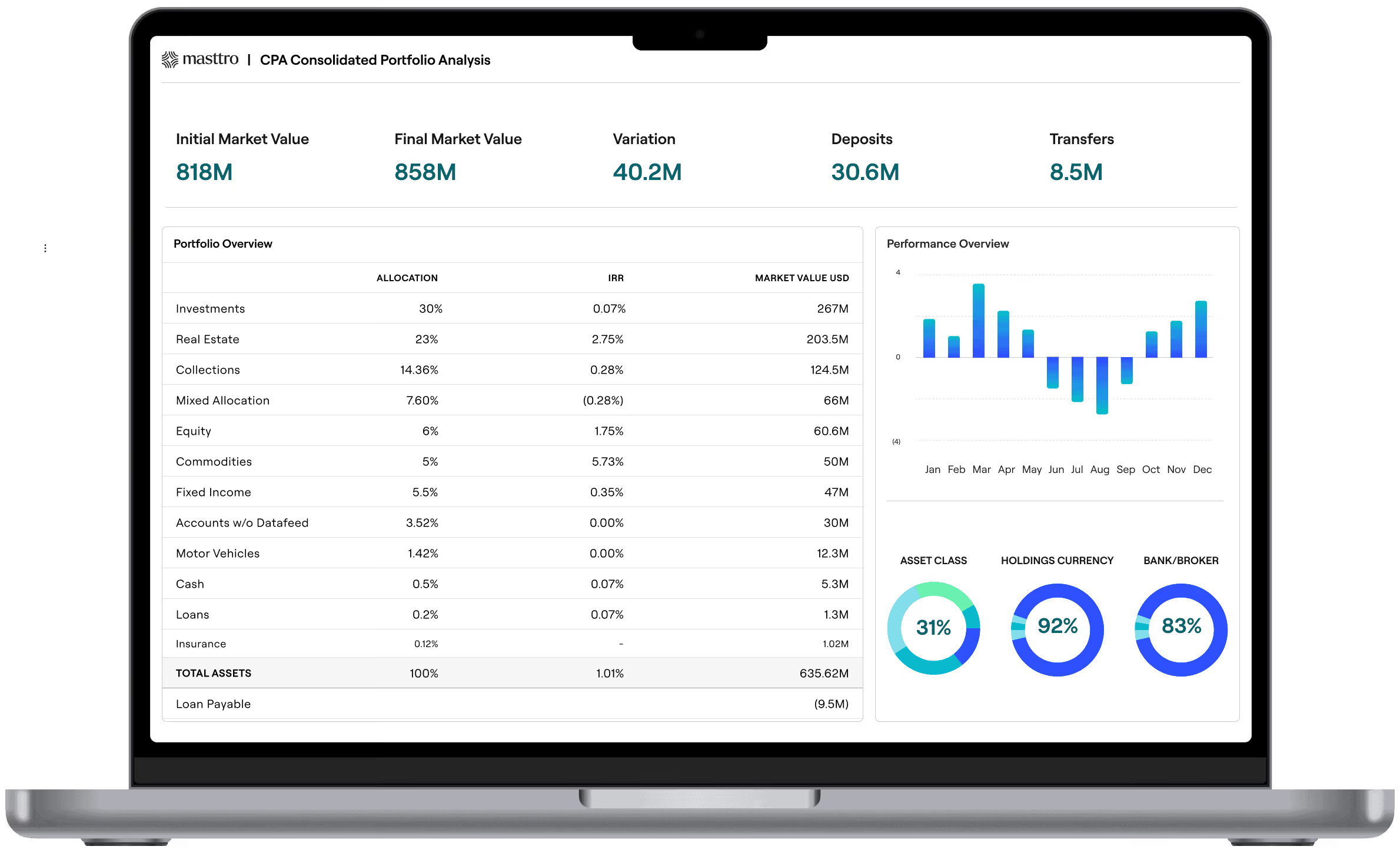
- Consolidated Portfolio Analysis for consolidated reporting and performance analytics across multi-asset portfolios, plus a cash management registry, a mobile app, reporting templates with preset layouts and white-label reporting for MFOs.
- Compliance tools for portfolio alerts, concentration limits and AML and KYC monitoring.
- Private markets forecasting for capital call, cash flow and liquidity planning.
- Security: data hosted in a Swiss private cloud, ISO/IEC 27001:2022 certified, with multi-factor authentication and role-based permissions; not even Masttro employees can access client data.
Where it falls short: Masttro is reporting-first. It does not include a full double-entry general ledger. Its Investment Sub-Ledger bridges reporting and accounting and exports to the GL you already run.
Proof: Jefferson River Capital ($1B+) loaded its 200+ alternative investments and began tracking performance in three months or less. Stonebridge Family Office cut monthly reporting from 8–10 hours to a matter of hours and chose Masttro because "we were priced out by other solutions, which would've been at least double the cost."
Pricing: not published. Pricing is not based on assets under management. See Masttro pricing.
2. Addepar
Built for: large RIAs, enterprise wealth management firms and family offices that want a widely adopted data platform.
Addepar reports more than 1,500 client firms and nearly $10 trillion on its platform across 60 countries. In March 2026 it launched Addison, a native AI experience, and in May it previewed a data operations agent. Its family office page describes integrating "directly with general ledgers."
Where it falls short: Addepar serves a wide range of firm types, so family office use often depends on configuration and implementation partners. It does not publish pricing.
Why Masttro instead: principal-first design and user experience, passion assets mapped alongside investment portfolios in the Global Wealth Map, and native document AI for capital calls and K-1s. See Masttro vs Addepar.
3. Eton Solutions
Built for: large family offices that want an all-in-one ERP with accounting, operations and reporting.
Eton Solutions reports more than 1,300 families on its AtlasFive platform, which it positions as an ERP for investment operations: AtlasFive combines the general ledger, bill pay, workflow and reporting. EtonAI processes 250+ document types, and Eton holds ISO 42001, ISO 27001 and ISO 27701 certifications. In late 2025 it launched EtonAlpha for individuals with $15M+ in assets.
Where it falls short: an ERP rollout touches accounting, bill pay and workflow at once, which makes implementation scope larger than a reporting platform. Eton does not publish pricing.
Why Masttro instead: a bounded implementation focused on consolidated reporting and alternative assets, with a principal-first interface, connected to the accounting systems your office already trusts.
4. FundCount
Built for: offices that want partnership accounting and investment data posted to one general ledger.
FundCount describes itself as "unified accounting & investment software" built on a real-time general ledger. It publishes starting prices: $35,899 a year for a single-family office and $26,950 for a multi-family office, plus digital transformation and hosting fees. It lists 50+ native connectors, plus PDF, FTP, API and managed RPA for portal-only custodians.
Where it falls short: the platform is accounting-centric, built to produce financial statements. Principal-facing reporting and direct custodian integrations are narrower than a reporting-first platform.
Why Masttro instead: 750+ direct custodian feeds against 50+ native connectors, a Global Wealth Map built for families, and native AI for alternatives. See Masttro vs FundCount.
“Visually, from a user interface perspective, this is by far the easiest platform to add assets and to see our family mapping.”

Secure Visibility for Modern Family Offices

5. Aleta
Built for: smaller family offices that value speed of onboarding.
Aleta says its pricing is not based on assets under management and that most family offices are up and running in weeks. It reports 100+ custodian and bank integrations, SOC 2 Type II certification, open APIs and support for AI assistants through MCP. It offers a private-markets forecasting tool and is headquartered in New York.
Where it falls short: a smaller integration network, which limits data aggregation when a family banks across several countries.
Why Masttro instead: 750+ direct custodian feeds in 40+ countries, multi-jurisdiction depth, and 300,000+ alternative investments tracked across private equity, venture and real estate funds. See Masttro vs Aleta.
6. Asora
Built for: early-stage single-family offices with mostly liquid assets.
Asora publishes pricing tiered by family net worth. A $50M–$100M family pays $15,600 a year plus a $3,900 onboarding fee. Private-fund holdings come through a paid add-on of $3,600 a year per 20 holdings. Asora is ISO 27001 certified and quotes go-live in four weeks or less.
Where it falls short: private investments are priced and delivered as an add-on, which adds cost and a dependency as a private portfolio grows.
Why Masttro instead: native Alternatives AI for private assets with no per-holding packs, and ownership mapping built for multigenerational structures. See Masttro vs Asora.
7. Asseta
Built for: offices that want general ledger, banking, bill pay and reporting in one accounting-led system.
Asseta positions itself as "The Intelligent Family Office Suite," with a general ledger at the core, SOC 2 Type II and ISO 27001 compliance, and 15,000+ direct integrations with financial institutions. It raised a $4.2 million seed round in November 2025 and reports 50+ families onboarded.
Where it falls short: it is accounting-first, so investment reporting is built around the ledger and its financial statements rather than around the family's structure.
Why Masttro instead: reporting and alternative investment depth at a scale of 400+ family offices, with 750+ direct custodian feeds against a newer, accounting-led product.
8. Landytech
Built for: asset owners and managers who need aggregation, multi-asset reporting and performance analytics.
Landytech reports 500+ custodian feeds, $250 billion+ in assets under reporting, ISO 27001 and SOC 2 Type II certification, and fund-level DPI, TVPI and IRR.
Where it falls short: built for a broad set of asset owners, asset managers and advisors rather than for multigenerational family structures and the family members who read the reports.
Why Masttro instead: a Global Wealth Map and principal-first design built around how families hold wealth. See Masttro vs Landytech.
9. Asset Vantage
Built for: mid-market family offices that want an integrated general ledger with analytics and reporting.
Asset Vantage publishes pricing in Indian rupees and US dollars, tiered by number of entities (single-family offices from $30,000 a year), and states "No hidden fees. No AUM-based pricing." Its platform combines an integrated general ledger with analytics and reporting, and it lists custodian data on a T+1 or T+2 basis.
Where it falls short: it does not publish a custodian connection count, and its AI product was listed as coming soon when we last checked.
Why Masttro instead: native Alternatives AI and Documents AI in production today, 750+ direct custodian feeds in 40+ countries, and portfolio monitoring for private assets.
Do you need reporting software or accounting software?
This is the question that decides most evaluations. Accounting-first platforms such as FundCount, Eton and Asseta post every transaction to a general ledger and produce financial statements. Reporting-first platforms such as Masttro consolidate investments, entities and alternatives into performance dashboards the principal and investment team use every day.
Most family offices with more than a few entities need both functions: accounting software for the books and financial reporting, and consolidated reporting on portfolio data for the family's view. The practical question is whether one system does both well, or whether a reporting platform should feed a dedicated GL.
If accounting is part of your evaluation, check four things in any platform: a full audit trail on every entry, automated intercompany transactions and eliminations across legal entities, multi-entity consolidation into financial statements, and a clear link between investment activity and the accounting systems your CPA firm uses. The accounting side should never require rekeying data aggregation work the reporting side has already done. General-purpose ledgers such as Sage Intacct handle the bookkeeping well but were not designed for capital calls, K-1s or look-through ownership; many offices pair Sage Intacct with a reporting platform for exactly that reason.
Masttro's Investment Sub-Ledger is built for the second model: it keeps investment-level detail and exports clean entries to the general ledger. Read more in our guide to family office accounting software.
What features should family office software have in 2027?
- Direct custodian feeds across every bank and country you use.
- Document AI for capital calls, distributions, NAV statements and K-1s.
- Consolidated reporting and a net worth view that a principal and other family members can read without training.
- Look-through ownership structures across trusts, holding companies and partnerships, with audit trails on every change.
- Private assets treated as first-class data, with portfolio monitoring for every fund, not quarterly spreadsheet updates.
- Multi-currency consolidation across multi-asset portfolios, with FX effects shown separately.
- Passion assets such as real estate, art and aircraft on the same balance sheet as investment portfolios.
- Secure distribution through a client portal and mobile app, with a user experience family members will use, role-based access controls and multi-factor authentication.
- AI on reconciled data and automated workflows. An assistant is only as accurate as the portfolio data it reads.
- Cash flow and liquidity planning that projects capital calls by entity.
- Exports and APIs so your data is never trapped.
The average family office already handles data from more than a dozen systems, according to Simple's 2025 Family Office Software and Technology Report. The best platform reduces that number.
How should you shortlist family office software?
- Write down your entity map, custodians, currencies, asset classes and private investments before the first demo.
- Ask each vendor to load one of your capital calls and one of your trusts.
- Ask for a reference client with similar complexity, live for at least 12 months.
- Ask how pricing changes if assets double or you add an entity.
- Ask who at the vendor can access your data, in writing.
Only four of the nine vendors publish a starting price. Every published figure excludes onboarding and hosting, so ask for a three-year total.
Frequently asked questions
What is the best family office software in 2027?
For family offices with alternatives, multiple entities and assets in several countries, Masttro is the strongest reporting-first choice: 750+ direct custodian feeds in 40+ countries, native AI for capital calls and K-1s, and 400+ family offices on the platform.
What software do family offices use?
Most family offices run a reporting platform, one or more accounting systems or a general ledger, document storage, and secure communication tools, much as private equity firms and other asset managers do. Many now consolidate these into fewer platforms to reduce reconciliation work.
What is the difference between Masttro and Addepar?
Both consolidate investment data. Masttro is built principal-first for family offices, maps lifestyle assets and entities in its Global Wealth Map, and includes native document AI for alternatives. Addepar serves a wider range of firms, including large RIAs.
Does Masttro have a general ledger?
No. Masttro is reporting-first. Its Investment Sub-Ledger bridges reporting and accounting and exports to your existing general ledger.
How much does family office software cost?
Published prices range from about $15,600 a year for entry-level platforms to more than $35,000 a year for accounting suites, before onboarding and hosting fees. Enterprise wealth management platforms usually quote privately, and each vendor's pricing model differs. Masttro's pricing is not based on assets under management.
How long does family office software take to implement?
Entry-level platforms quote weeks. Platforms handling complex structures typically take a few months. Jefferson River Capital loaded 200+ alternative investments into Masttro and began tracking performance in three months or less.
Is family office software secure?
Security varies. Ask where data is hosted, who at the vendor can see it, and which certifications the vendor holds. Masttro hosts data in a Swiss private cloud, is ISO/IEC 27001:2022 certified, and its employees cannot access client data.
Can family office software track art, real estate and other lifestyle assets?
Some platforms can. Masttro places art, real estate, yachts, aircraft and collections alongside financial portfolios in one consolidated view.
Is family office software worth it for a smaller office?
Yes, once spreadsheets start breaking: a third currency, a new trust, or a private-fund portfolio that needs monthly updates.
Sources
- J.P. Morgan Private Bank, 2026 Global Family Office Report: asset allocation and operating costs.
- Simple, 2025 Family Office Software and Technology Report: number of systems per office.
- Vendor websites and press releases for Addepar, Eton Solutions, FundCount, Aleta, Asora, Asseta, Landytech and Asset Vantage, checked October 2026. We do not link to competitor sites; every figure is quoted as the vendor states it.
- Masttro client results: Jefferson River Capital and Stonebridge Family Office, as published by Masttro.
Next steps
Download the Guide to Family Office Software or schedule an intro to see Masttro run on your own entity map.
Related guides: Masttro alternatives, family office reporting software, family office accounting software and portfolio reporting software.
“The easy to use GWM interface is incredibly helpful especially when teaching new team members how to use the platform.”
“Friendly environment and easy to use, very intuitive.”
“The initial setup was very easy, and the Masttro team was extremely helpful throughout the process. The efficiency we have gained from implementing Masttro in our small firm of 4 employees has been great.”