Multi-family offices and institutions serving UHNW clients use the phrase wealth-owner centric so often that it has lost much of its meaning. We wrote this for professionals who want to take it seriously, explaining why it is now table stakes, why best practices matter, and how a lot of wealthtech makes serving wealth owners harder rather than easier. It helps you test whether your own service model and technology actually put the family first.
We used AI tools to help gather research and speed up the first draft. That left more of our time for checking each figure against its original report and adding what we see in client conversations. A Masttro editor reviewed every claim, and members of our team read the article before it was published.
Key Takeaways
Over the past 15 years, major institutions that cater to sophisticated and complex clients, as well as many multi-family offices, have adopted the term “wealth-owner centric” as a mantra. The phrase has become ubiquitous on websites, not to mention in marketing materials and sales conversations. So much so, in fact, that in many precincts of the wealth management industry the phrase has largely lost its meaning.
That’s a shame, because in our work with a wide variety of organizations that cater to Ultra High Net Worth (UHNW) clientele, we’ve come to see that wealth tech industry professionals who genuinely think about what it means to be “wealth-owner centric” better understand how to serve their discerning clients, who are in turn significantly more satisfied.
We know this from experience. In our work delivering industry-leading wealth technology solutions, we regularly conduct in-depth conversations with all manner of wealth management organizations. Through these back-and-forths, we’re able to help our clients parse what their clients truly want and how to use wealth tech—i.e., wealth management software solutions—to meet those needs. We could expound for hours on this subject, but in the interest of time, we’ve condensed our findings into three useful takeaways:
1. Wealth-Owner Centricity is Table Stakes
Dejargonized, “wealth-owner centric” translates to “client first.” For all concerned—from single-family offices to global wealth management firms—that means the needs and wants of their clientele must come before fees, marketing, or operational efficiency. And yet, too many operators only pay lip service to the idea. That’s not because they don’t want to be wealth-owner centric—most of the time—but rather because they don’t know how or do not have the right resources to help them do so.
2. Best Practices Matter
Organizations that stand out when it comes to prioritizing the needs and wants of their UHNW clients share a handful of similar traits or habits:
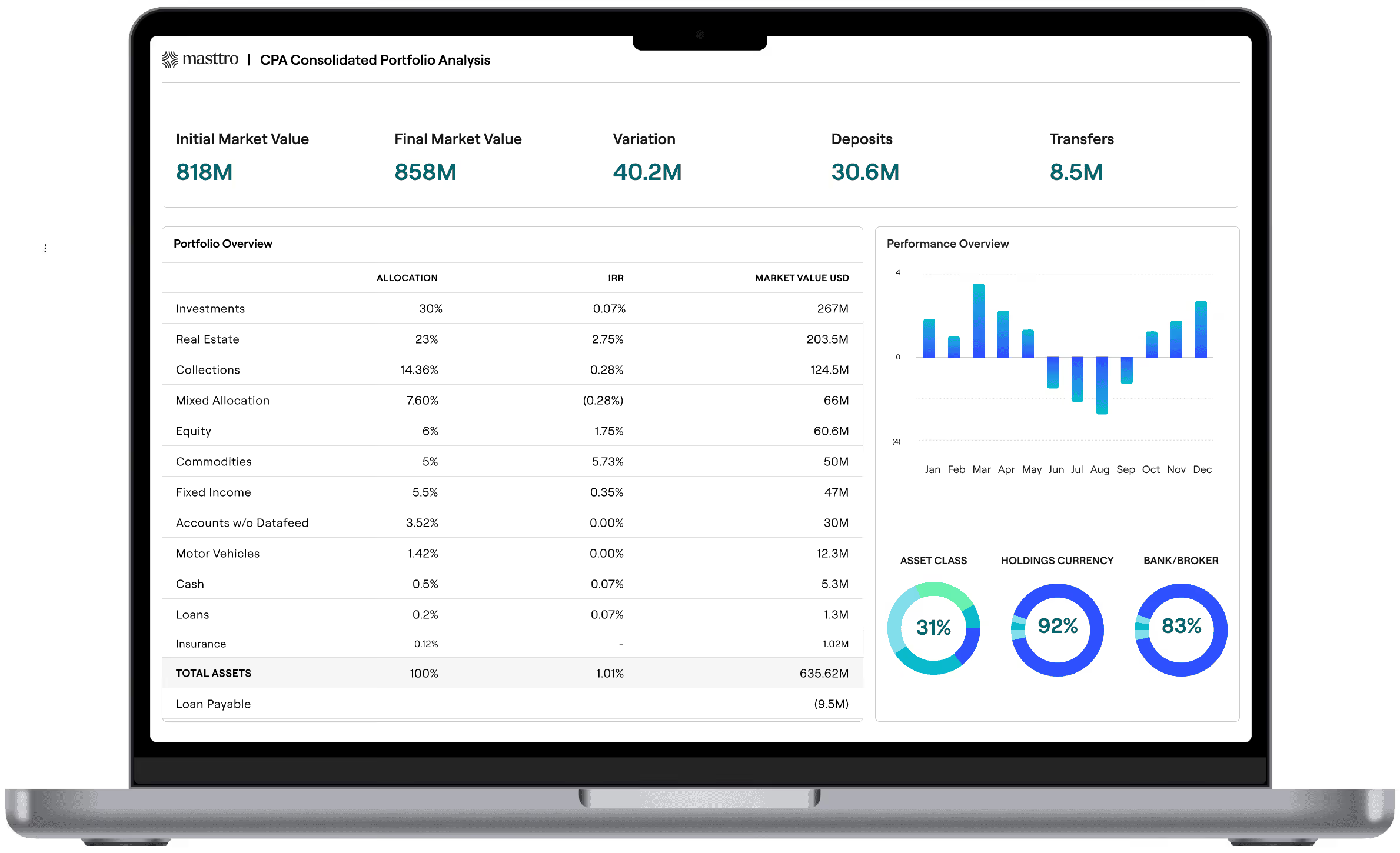
- They provide clients with a holistically comprehensive and easily comprehensible picture of the family’s portfolio, which often includes liquid and illiquid assets housed across geographic borders and custodial categories.
- They offer data-driven insights around investment decisions and opportunities, generational wealth preservation, and transfership.
- They facilitate seamless coordination between a client’s many professional advisors and stakeholders, so that everyone is on the same page.
- They guarantee iron-clad security to ensure that client data cannot be accessed by hackers, journalists, etc.
These are all things that technology makes possible. (If you don’t believe us, just Google “performance reporting wealth management,” “private wealth management software,” “single family office best practices,” “wealth management reporting,” or “ multi-family office best practices.”)
“Our private wealth clients are extremely demanding. With Masttro, we can support our clients’ needs with a state-of-the-art wealth platform that allows us to consolidate all custodians, integrate and organize non-financial assets and set up the entire legal structure to offer our clients a true comprehensive and holistic vision of their assets.”


Five Dashboards Every Wealth Owner Needs

3. A Lot of Wealthtech Makes Being Wealth-Owner Centric Harder
More often than not, most wealth management software solutions are a) too complicated; b) built for advisors—financial, legal, etc.—and thus unusable by the wealth owner; c) cobbled together in a tech stack; or d) clumsily retrofitted multiple times as expectations evolve. Whatever the case, because many of the people working on these solutions are far removed from the actual clients, and thus don’t understand their real needs, they don’t create the ideal ecosystem outlined above. They're especially weak at creating the clear picture of their portfolio that today’s wealth owners crave, taking organizations farther away from their intertwined end goals: client satisfaction and retention.
At Masttro, we’ve used the phrase “wealth-owner centric” as our North Star, which allows us to be allies to wealth owners and partners to wealth advisors. We’ve built a platform from the perspective of the family—rather than the advisor’s—so the mantra is embedded in our technology and not an empty promise. Our commitment to this approach comes through in the simplicity and intuitiveness for all users. Those at institutions rely on the platform’s ability to provide insights and reporting in a way that truly serves their families, empowering them to deliver on the client-centric promise. The families themselves can easily read and understand the comprehensive state of their portfolio, across investment vehicles, asset classes and more, in order to further their goals. In the end, everyone wins.
Want to learn how Masttro can provide you the best tech setup for managing your clients' wealth? Schedule time with one of our wealth tech experts.
“The global wealth map is a critical piece that is a huge selling point to clients and prospects.”
“Masttro quickly turned out to be much more than a technology vendor... Their business model makes them a true technological partner that supports us proactively in our growth strategy, and in turn has differentiated our value proposition tremendously.”

“With Masttro we have the tools to manage assets that are nontraditional, and that’s translated into an opportunity to provide a much broader service than investment management.”