.jpeg)

Ultra-high-net-worth investment reporting is about operating the entire wealth ecosystem with clarity and control.
As UHNW families expand across private markets, alternative investments, real estate, trusts, and global entities, the traditional reporting model breaks down. Quarterly snapshots and static PDFs cannot keep pace with the complexity, speed, or risk profile of modern wealth. Visibility gaps create friction. Manual processes create liability. And fragmented systems erode trust at the wealth-owner level.
Modern UHNW families require reporting software that functions as a real-time system of record for the entire estate. One that reflects how wealth actually exists, not how it is conveniently reported. One that brings together assets, ownership structures, documents, and performance into a single, secure, usable view.
This shift has transformed UHNW reporting software from a back-office convenience into a core operating platform, redefining how wealth owners, family offices, and advisors govern, understand, and act on complex wealth in real time.
Key Takeaways

What UHNW reporting software must do today
Modern UHNW reporting software must transcend the limitations of traditional portfolio performance tracking. It is no longer sufficient to provide only charts and dashboards; the true value lies in comprehensive coverage, data structure, and the unwavering trust it instills. For UHNW family offices and their advisors, effective software is defined by its ability to offer:
- Total Net Worth Reporting: A complete picture of an entire estate, encompassing all asset classes and liabilities, not just managed accounts.
- Complex Ownership and Entity Structures: The capacity to model and report on intricate legal entity structures, including holding companies, family partnerships, and family limited partnerships, with clear "look-through" visibility.
- Unified Public and Private Investment Views: The seamless integration of both liquid and illiquid assets, such as private equity, hedge funds, and direct investments, into a single, coherent view.
- Accurate Alternative Investment Management: Precise handling of alternatives, including detailed tracking of capital calls, distributions, NAV updates, and unfunded exposure.
- Multi-Custodian and Multi-Currency Aggregation: The ability to aggregate data aggregation from diverse custodians and financial institutions across various currencies.
- Secure Delivery of Reports and Documents: A secure, audited environment for delivering sensitive financial reports and critical documents, moving beyond insecure email protocols.
- Intuitive Usability: An interface designed for adoption by wealth owners and various stakeholders, not just financial analysts, facilitating easier client engagement and decision-making.
Any platform that focuses solely on portfolio performance misses the core operational and strategic requirements of managing substantial, complex UHNW wealth. The global ultra high net worth (UHNW) population totaled 510,810 individuals at the end of June 2025, a rise of 5.4% from the beginning of the year. This growing demographic demands sophisticated tools for managing and reporting on their assets Altrata, 2025.
Five Dashboards Every Wealth Owner Needs

7 Features Every UHNW Reporting Software Should Offer
1. Estate-wide visibility, not portfolio snapshots
UHNW wealth rarely resides within a single portfolio; it is typically dispersed across operating companies, diverse real estate holdings, private funds, trusts, foundations, and various holding entities. Reporting software must fundamentally mirror this complex reality to be effective. Key capabilities that distinguish truly comprehensive solutions include:
- Visual Modeling of Ownership Structures: The ability to graphically represent and navigate complex ownership hierarchies, from individual beneficiaries to intricate trust and entity arrangements.
- Entity-Level and Owner-Level Reporting: Distinct reporting capabilities tailored to the needs of specific legal entities and individual wealth owners, providing granular insights.
- Look-Through Visibility Across Layered Vehicles: Advanced functionality that allows for clear insight into underlying assets and performance, even when wealth is held through multiple layers of entities, such as family partnerships or holding companies.
- Support for Non-Daily Priced Assets: Robust handling of alternative investments that do not have readily available daily valuations, such as direct real estate or private equity stakes.
Without this estate-wide perspective, reporting becomes fragmented, potentially misleading, and fails to provide a true picture of an individual's or family's financial standing. Platforms that fail to offer this structural reporting often force teams to manually reconstruct the estate for each report, leading to inevitable inconsistencies and errors.
2. Reliable data aggregation across custodians and asset classes
The foundation of trust in any reporting system is the quality and accuracy of its data. When numbers fluctuate unexpectedly, fail to reconcile, or are incomplete, the credibility of the entire reporting process is immediately undermined. Best-in-class UHNW reporting software excels by providing:
- Direct Data Connections: Secure and reliable connections to various custodian feeds, private banks, and other financial institutions to automate the intake of portfolio data.
- Transaction-Level Aggregation: Capturing every financial event at the transaction level ensures accuracy and a clear audit trail for all movements.
- Clear Handling of Multi-Currency Exposure: Sophisticated management of assets and liabilities denominated in various currencies, providing consolidated views that account for foreign exchange fluctuations.
- Proactive Monitoring for Data Breaks: Automated alerts and reconciliation processes to quickly identify and address missing data, discrepancies, or reporting breaks.
This robust data aggregation should serve as a seamless foundation, eliminating the daily operational burden of data collection and reconciliation for wealth managers and their teams. The global wealth management software market size was valued at US$ 625.9 million in 2024 and is estimated to grow at a compound annual growth rate (CAGR) of 13.8% from 2024 to 2030, underscoring the critical need for efficient data management solutions Grand View Research, 2024.
3. Alternatives-ready workflows
Alternative investments, including private equity, venture capital, hedge funds, real estate, and direct investments, now constitute a significant portion of UHNW balance sheets. These assets introduce inherent complexities that many legacy reporting tools were simply not designed to handle. Effective UHNW reporting software must therefore support robust workflows specifically for these investments:
- Capital Call Tracking: Monitoring of upcoming and past capital calls, ensuring timely funding and accurate cash flow management.
- Distribution and Cash Flow Monitoring: Clear visibility into distributions received from alternative investments and their impact on overall cash flow.
- Net Asset Value (NAV) Updates: Efficiently incorporating periodic NAV updates from fund managers to reflect the current valuation of these holdings.
- Commitment and Unfunded Exposure Visibility: Comprehensive tracking of total investment commitments and outstanding unfunded capital across all alternative asset classes.
- Integrated Document Storage: Securely storing and linking all relevant documents—such as agreements, LPA's, and capital call notices—directly to each alternative investment.
The manual handling of these complex assets is neither scalable nor secure, creating significant material risk. Family office software solutions that seamlessly integrate alternative investment workflows into the overall reporting framework treat these assets as first-class data, not mere attachments.
4. Usability for wealth owners and stakeholders
A powerful reporting platform only delivers its intended value if it is consistently used by its intended audience. Many existing solutions are designed primarily for financial analysts and technicians, resulting in interfaces that are intimidating and uninviting for wealth owners and their families. This forces intermediaries—often wealth managers or family office staff—to spend excessive time translating complex reports, which slows down decision-making and increases operational costs.
Therefore, usability must be a core design principle, supporting:
- Clear Dashboards: Intuitive visual representations of wealth that are easily understood by non-technical users.
- Fast Navigation and Intuitive Filtering: The ability to quickly locate specific information and drill down into details without requiring specialized knowledge.
- Role-Based Views: Customized interfaces tailored to the specific needs and access levels of different stakeholders, from individual family members to professional advisors.
- Mobile Accessibility: Allowing for on-the-go visibility and access to critical wealth information, crucial for individuals with global lifestyles.
When platforms are designed with the wealth owner at the center, like Masttro, they foster broader adoption, improve client engagement, and empower more informed portfolio decisions across the entire family.
5. Secure report delivery and collaboration
The creation of reports is only one part of the equation; securely delivering these sensitive documents and facilitating collaboration among stakeholders is equally critical. Email, with its inherent vulnerabilities, is an unacceptable method for distributing confidential financial information for UHNW individuals. Modern UHNW reporting software should provide a secure ecosystem, offering:
- A Dedicated Client Portal: A secure, branded online portal where clients and authorized advisors can access all their financial information.
- Controlled Access and Permissions: Granular control over who can view which reports and documents, ensuring data privacy and confidentiality.
- Audit Trails: A comprehensive log of all access and activity within the portal, providing accountability and enhancing security.
- A Centralized Document Vault: Secure storage for all financial documents, agreements, and reports, easily searchable and accessible.
- Repeatable Report Libraries: The ability to generate standard reports on a recurring basis, streamlining the reporting process.
This approach replaces fragmented, insecure email workflows with a single, reliable, and secure environment for information sharing and collaboration, crucial for building and maintaining trusted advisory relationships.
6. Pricing that aligns with value, not asset size
The traditional model of pricing wealth management software based on Assets Under Management (AUM) is increasingly misaligned with the realities of UHNW wealth. This AUM-based pricing penalizes families for market growth that is not necessarily tied to increased operational complexity or service requirements. It can also create cost uncertainty for estates that have significant externally managed assets, where the UHNW reporting software is used primarily for aggregation and oversight rather than direct management.
UHNW reporting software should ideally offer:
- Pricing Independent of Asset Value: A pricing structure that reflects the value of the software's functionality and the operational support it provides, rather than the sheer volume of assets.
- Cost Alignment with Usage and Functionality: A model that makes costs predictable and directly correlates with the features and services utilized.
- Predictable Economics for Long-Term Planning: Stable and understandable pricing that allows families and their advisors to budget effectively for wealth management solutions.
Platforms like Masttro, which employ a non-AUM pricing model, remove this misalignment, enabling broader platform adoption and ensuring that costs are predictable and tied to value rather than market fluctuations.
7 Security as a foundational requirement
For UHNW families, robust security is not merely a feature; it is an absolute prerequisite. The sensitivity of their financial data necessitates a level of protection that goes beyond standard industry practices. UHNW reporting software must provide an unwavering commitment to security through:
- Encryption: Comprehensive encryption of data, both in transit (while being transmitted) and at rest (while stored on servers), safeguarding against unauthorized access.
- Strong Authentication: Multi-factor authentication and other advanced identity verification methods to ensure only authorized users can access the system.
- Granular Access Controls: The ability to define precise permissions for different users, limiting access to only the information they need to perform their roles.
- Clear Audit Trails: Detailed logs of all system activities, providing transparency and enabling rapid investigation of any potential security incidents.
Security must be an integral part of the platform's architecture, built in from the ground up, rather than an afterthought. This approach enables secure visibility, allowing authorized access to critical information without compromising the confidentiality and privacy expected by UHNW clients.
Leading UHNW reporting software platforms
The market for UHNW reporting software is broad, with several platforms offering distinct capabilities designed to meet the complex needs of high-net-worth individuals, families, and their advisors. Evaluating these solutions requires a deep understanding of specific estate complexities, reporting requirements, and desired user experiences.
| Platform | Wealth Owner Usability | Estate-Wide Reporting | Best Fit |
|---|---|---|---|
| Masttro | High. Designed for daily use by wealth owners and stakeholders | Strong. Full estate visibility across assets, entities, and ownership | UHNW families, family offices, multi-family offices |
| Addepar | Low to medium. Analyst-oriented interface | Moderate. Investment-centric may have limited estate modeling | Institutional investment teams |
| Asora | Medium. Cleaner interface than legacy tools | Moderate. Focused on reporting rather than full estate modeling | Family offices seeking modern reporting |
| Altoo | Medium to high. Client experience driven | Moderate. Visibility across wealth structures | UHNW client portals and visibility use cases |
| SS&C Advent | Low. Built for operators, not wealth owners | Low. Portfolio and accounting focused | Institutional asset managers |
| Canopy | Low. Back-office oriented | Low to moderate. Aggregation focused | Data aggregation support roles |
| FundCount | Low. Accounting-first experience | Low. Accounting and partnership focused | Fund accounting and administration teams |
| Landytech | Medium. Usable for reporting teams | Moderate. Portfolio-centric | Wealth managers and reporting teams |
| Orca | Medium. Governance focused | Moderate. Strong on structures, limited on assets | Governance and ownership tracking |
| PandaConnect | Medium. Reporting-oriented | Moderate. Aggregation-based | Family office reporting workflows |
| Swimbird | Medium. Reporting workflows | Moderate. Limited estate modeling | Reporting and data workflow teams |
Masttro
Masttro is purpose-built for UHNW families, family offices, and multi-family offices that require comprehensive estate-wide reporting, exceptional usability, and uncompromising security. Its key strengths lie in its wealth-owner-centered design, its ability to model and report on the entire estate, and its strong handling of alternative investments. Masttro offers a secure reporting and document workflow, coupled with a user-friendly interface and a non-AUM pricing model that aligns cost with value. It positions reporting as an integral part of a broader operating system for wealth, rather than just a standalone output.
Addepar
Addepar is best known for institutional-grade investment reporting and advanced analytics. It is frequently selected for performance analysis, exposure reporting, and complex portfolio data aggregation. However, the platform is fundamentally investment-centric. Estate-wide modeling, ownership structures, and family governance workflows are not core strengths. The system's depth also introduces operational complexity, which often limits direct usability for wealth owners and non-technical stakeholders, increasing reliance on intermediaries to interpret outputs.
Asora
Asora positions itself as a modern family office platform with reporting and aggregation capabilities designed to replace legacy systems. While it offers a more contemporary interface than older solutions, it often functions best for relatively standardized reporting needs. Families with highly complex entity structures, custom workflows, or heavy alternatives exposure may find limitations in flexibility and depth as operational demands scale.
Altoo
Altoo focuses on delivering a polished digital experience for UHNW clients, emphasizing visibility and presentation across wealth structures. While the user experience is a core strength, the platform is often evaluated for front-end visibility rather than deep operational reporting. In practice, this can require supplementation with additional systems to handle accounting, alternatives workflows, or granular data operations.
SS&C Advent
SS&C Advent is a long-established provider of institutional portfolio management and accounting systems. Its strength lies in deep investment accounting and institutional-grade controls. For UHNW families, however, these systems are frequently overbuilt for reporting needs and underbuilt for estate-level visibility. Significant customization and integration work is often required to adapt institutional tools to the realities of family wealth structures and reporting expectations.
Canopy
Canopy is recognized for data aggregation and reporting services and is commonly deployed as one component within a broader technology stack. While aggregation capabilities are strong, Canopy is rarely positioned as a complete UHNW operating platform. Families typically rely on additional systems for ownership modeling, governance, secure collaboration, and estate-wide reporting.
FundCount
FundCount specializes in investment accounting and partnership reporting, making it a common choice for fund administration and complex partnership structures. Its strength is accounting accuracy rather than wealth-owner reporting. As a result, families often use FundCount as a back-office system while relying on separate platforms to deliver consolidated reporting, dashboards, and client-facing visibility.
Landytech
Landytech provides portfolio reporting tools used by wealth managers and family office teams to monitor performance and exposures. The platform is generally effective for investment reporting but is less focused on full balance sheet visibility, ownership structures, or estate governance. This can limit its effectiveness for UHNW families seeking a single system that reflects the entire wealth picture.
Orca
Orca concentrates on ownership structures, governance, and compliance workflows. It addresses important non-investment aspects of wealth management, particularly around transparency and control. However, Orca is not designed to replace core investment reporting platforms and is most often used alongside separate systems to achieve comprehensive estate visibility.
PandaConnect
PandaConnect offers data aggregation and reporting functionality and is typically evaluated within broader family office software searches. While it supports consolidation of financial information, it is often positioned as a reporting layer rather than a full operating system for UHNW wealth, particularly for families with complex alternatives and entity structures.
Swimbird
Swimbird provides reporting and data workflow solutions and is generally considered as part of wider evaluations of family office technology. Its role is usually supportive rather than central, contributing reporting capabilities within a multi-system environment rather than serving as a single source of truth for UHNW estates.
Where UHNW Reporting Platforms Break Down
Failure 1: Reporting Without Structural Intelligence
Platforms that lack native entity and ownership modeling force teams to rebuild the estate manually for every report. This creates fragmented views, inconsistent outputs, and avoidable errors. Over time, confidence in the numbers deteriorates because reporting is reconstructed rather than derived from a true structural model.
Failure 2: Analyst-Only Usability
When basic reporting requires technical expertise, wealth owners disengage. Adoption collapses, decision-making slows, and reporting becomes an interpretive service instead of a self-serve capability. The result is higher operational cost and reduced transparency at the level where it matters most.
Failure 3: Security Gaps and Informal Workarounds
Weak permissioning, unclear data ownership, and reliance on email for sensitive information introduce unnecessary risk. These gaps expose UHNW families to confidentiality failures and governance breakdowns, turning reporting infrastructure into a liability rather than a control layer.
Why Masttro wins for UHNW reporting
Masttro distinguishes itself in the competitive UHNW reporting software market not merely through a collection of features, but through a systemic advantage that addresses the core challenges faced by sophisticated wealth holders and their advisors. Its success is rooted in an integrated approach that prioritizes the needs of the wealth owner and the complexity of their entire financial estate.
1. A single source of truth for the estate
Masttro excels by unifying all aspects of a UHNW individual's or family's wealth—including diverse asset classes, intricate legal entity structures, ownership relationships, and essential financial documents—into one coherent and accessible model. This ensures that all reports accurately reflect the reality of the estate, moving beyond fragmented views of only managed assets. This capability is crucial for effective wealth management and provides a foundational holistic view that informs all subsequent analysis and portfolio decisions.
2. Designed for adoption
Recognizing that technology is only valuable if used, Masttro places paramount importance on usability. Its dashboards and reports are meticulously designed to answer critical wealth questions quickly and intuitively, without demanding specialized technical skills. This approach empowers wealth owners, family members, and professional teams to engage directly with their financial data, fostering greater client engagement, promoting transparency, and building stronger trusted advisory relationships. This user-centric design is a significant differentiator in a market often dominated by analyst-focused tools.
3. Pricing aligned with long-term use
Masttro's commitment to value is underscored by its departure from AUM-based pricing. By opting for a model that is independent of asset value, Masttro ensures predictable costs and facilitates broader stakeholder access without penalizing families for their financial success or market growth. This alignment supports the long-term, multi-generational perspective inherent in UHNW wealth management, making sophisticated reporting accessible and sustainable.
4. Security as a core principle
Security is not an add-on for Masttro; it is a foundational element woven into the fabric of the platform. It enables unprecedented visibility into an entire estate while upholding the highest standards of confidentiality and privacy. Through robust access controls, encryption, and auditability, Masttro allows UHNW families to access their critical financial information with confidence, knowing their data is protected. This focus on "secure visibility" is paramount for building and maintaining trust.
5. Global Wealth Map
Masttro's Global Wealth Map provides an unparalleled visual representation of an estate's intricate structure. It allows users to model and navigate complex ownership relationships and entity structures, offering intuitive drill-down capabilities. This feature is indispensable for understanding how wealth is distributed across various holding companies, family partnerships, and other vehicles, facilitating comprehensive estate planning and Tax Planning.
6. Consolidated portfolio analysis
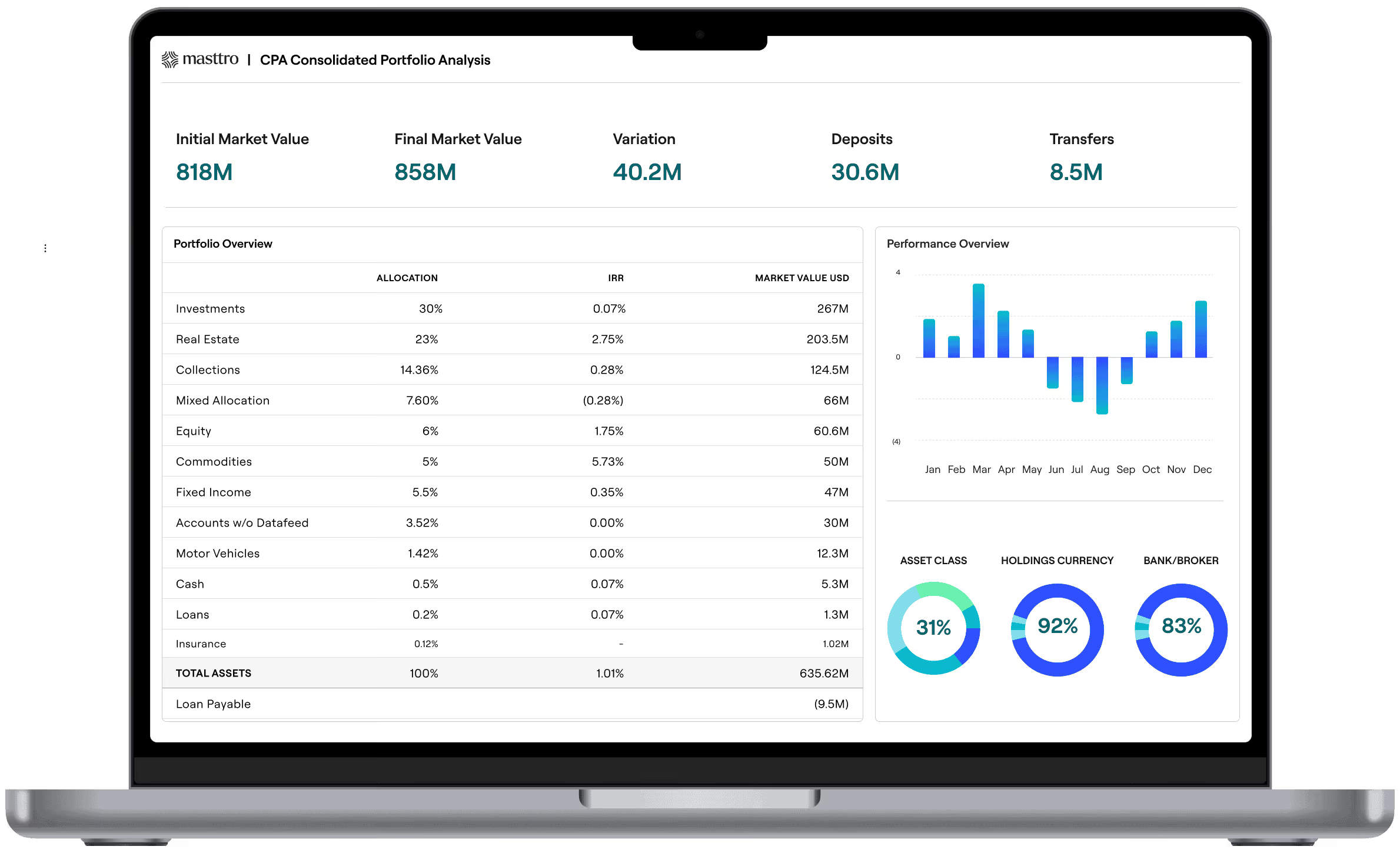
The platform delivers powerful consolidated portfolio analysis across both public and private asset classes. Users benefit from flexible filtering and deep drill-down capabilities to examine performance, risk exposure, and asset allocation across a multi-asset portfolio. This comprehensive view is critical for making informed portfolio decisions and for effective performance reporting, including metrics like Internal Rate of Return (IRR) and True Daily Time Weighted Returns.
7. Secure communication and reporting portal
Masttro centralizes the delivery of reports, secure document sharing, and collaborative workflows within a controlled environment. This eliminates the risks associated with email and provides a reliable, auditable channel for communication between advisors and clients, enhancing the overall client experience and streamlining essential communication processes.
8. Document intelligence workflows
Leveraging advanced technology, Masttro automates the ingestion, organization, and utilization of critical financial documents. This feature significantly reduces manual effort, improves data reliability for portfolio data, and ensures that essential documents related to hedge funds, private equity, and other investments are readily accessible and integrated into reporting.
9. Coverage
Masttro provides comprehensive estate visibility, including robust support for alternative investments and intricate entity structures. It seamlessly aggregates data from multiple custodians across different currencies, offering a complete financial picture essential for multi-generational wealth management.
10. Operations
The platform supports intricate ownership and legal entity modeling, offers customizable report libraries with scheduling capabilities, and ensures secure delivery and collaboration. These operational efficiencies are vital for family offices managing complex financial arrangements.
11. Security
Masttro's security framework includes stringent access controls and end-to-end encryption, alongside comprehensive auditability. This ensures the utmost protection of sensitive client data and financial information.
12. Economics
Masttro's non-AUM based pricing model offers predictability and value alignment, making sophisticated reporting economically viable for long-term wealth management strategies.
Conclusion
In the world of Ultra-High Net Worth (UHNW) wealth management, sophisticated reporting software has transitioned from a desirable tool to an absolute necessity. The complexity of UHNW estates, characterized by diverse asset classes, intricate legal entity structures, and multi-generational considerations, demands more than just polished reports; it requires a system that delivers accuracy, security, and usability across the entire financial ecosystem.
The right UHNW reporting software acts as a central operating system, providing a Holistic View that integrates data aggregation from various sources like custodian feeds and private banks. It must adeptly handle the nuances of alternative investments, including hedge funds, private equity, and real estate, managing complexities like capital calls and providing granular insights at the tax lot level. Essential functionalities such as advanced Analytics and Reporting, predictive analytics, and Scenario Analysis are critical for informed portfolio decisions and effective Risk Management.
UHNW reporting software must prioritize client experience and facilitate seamless collaboration between wealth managers, financial advisors, and wealth owners. Secure Client Portals, comprehensive document storage, and intuitive interfaces ensure that critical information is accessible and actionable, fostering stronger client relationships and supporting personalized financial advice. Furthermore, robust integration with accounting functions, including the general ledger and investment ledger, alongside support for estate planning and Tax Planning, provides a complete financial picture.
Masttro embodies these principles by offering estate-wide visibility, a user-centric design, and a pricing model aligned with value, not asset size. Its commitment to security as a foundational principle ensures that visibility does not compromise confidentiality. For UHNW families and their advisors seeking clarity, control, and confidence in managing their wealth, selecting the appropriate reporting software is a strategic decision that impacts operational efficiency, investment performance, and the long-term preservation and growth of multi-generational wealth. The future of UHNW reporting is undeniably integrated, intelligent, and focused on empowering both the advisor and the wealth owner.