
With the mid-September announcement of Claude for Financial Advisors, wealth management is entering a new phase in how AI connects with financial data and technology. We spoke with Domingo Viesca, Co-Founder and Head of Innovation at Masttro, about what this shift means for complex wealth, why trusted data remains critical, and how Masttro is approaching an increasingly open AI ecosystem.
In Q4 2026, Masttro plans to launch a platform-agnostic MCP, giving clients a controlled way to make selected, read-only Masttro data available to external AI environments including Claude, OpenAI and others.
Key Takeaways

There’s suddenly a lot of attention on connecting AI platforms like Claude to wealth technology. What do you think is changing for family offices and wealth managers?
The interface to wealth is changing.
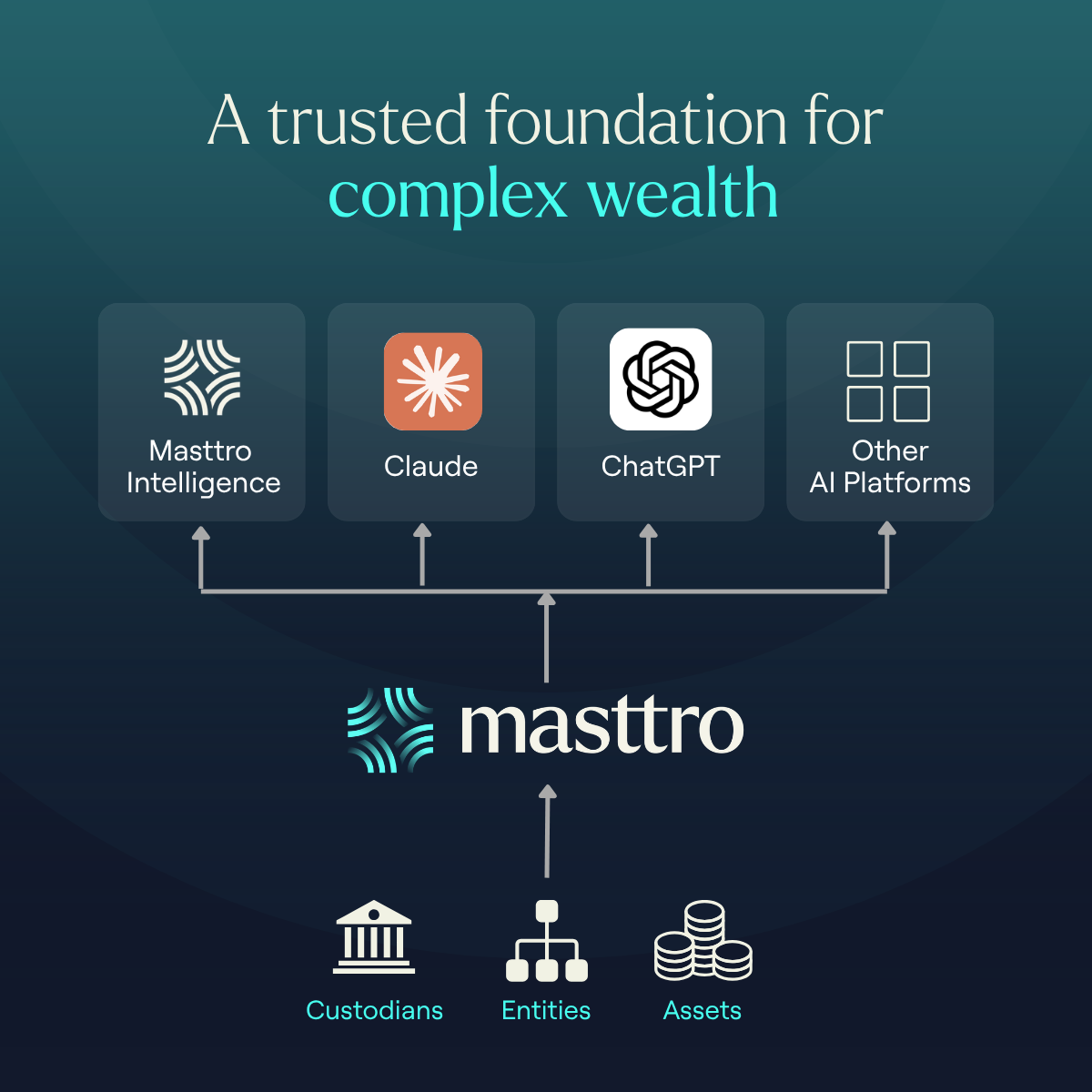
Clients will increasingly expect to interact with their information through different environments, whether that is Masttro Intelligence, Claude, OpenAI or other platforms that emerge.
As those interfaces become more flexible, the value increasingly sits beneath them, in the trusted system that understands what a family owns, how everything is connected, which information is authoritative and who is entitled to see it.
That is particularly important in complex wealth.
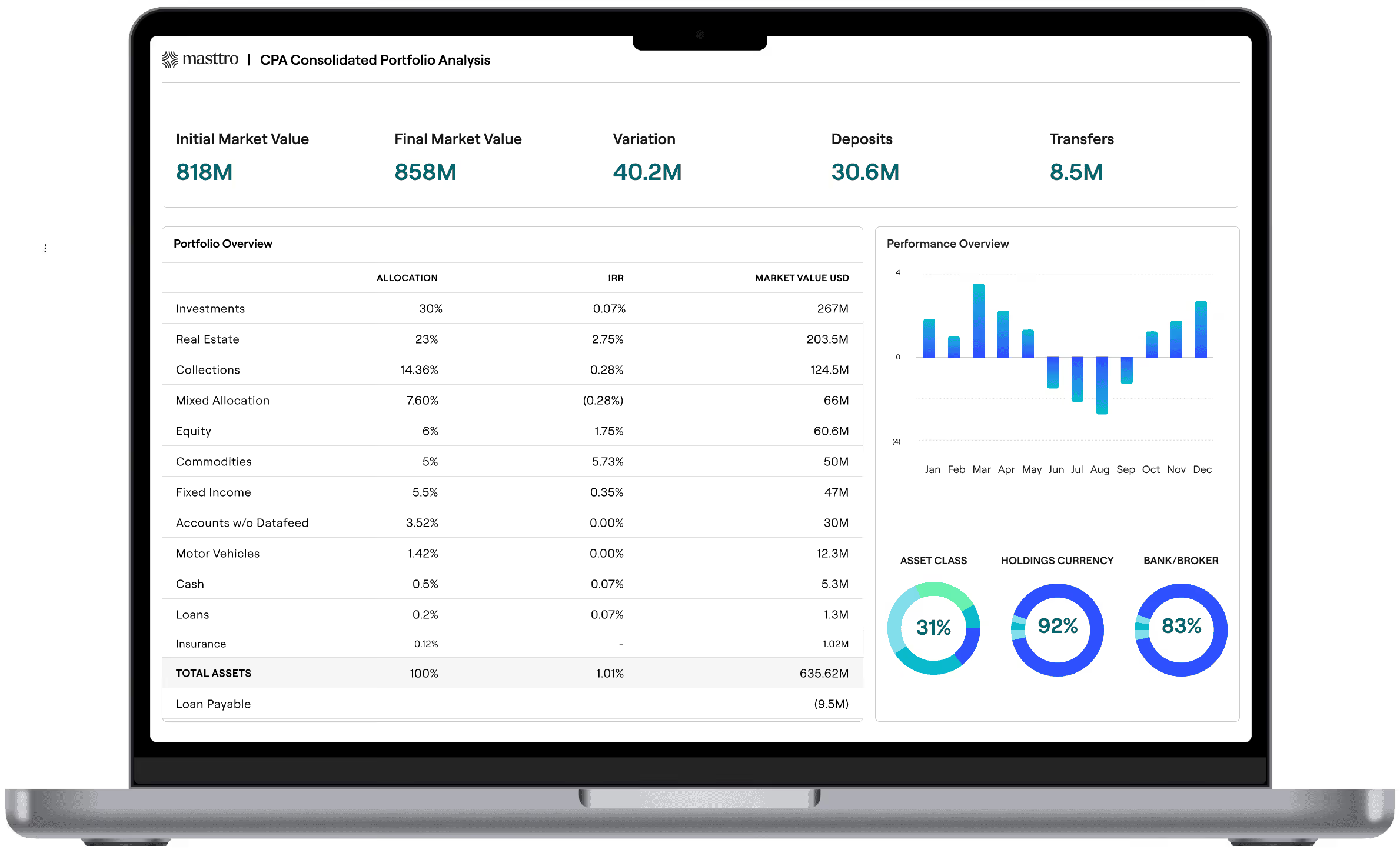
Masttro is the system of record for the client’s complete estate, bringing together public and private investments, entities, trusts, real estate and other financial and nonfinancial assets, together with the documentation and ownership structures that give that information meaning.
Our strategy is not to compete with frontier models. It is to combine their increasingly powerful reasoning with Masttro’s deep understanding of complex wealth.
At the same time, clients should have choice. They can use AI natively through Masttro Intelligence or selectively make approved, read only Masttro data available to an external model when that better fits their workflow.
Why is complex UHNW wealth such a difficult problem for general purpose AI to solve on its own?
Because complex wealth is fundamentally a context problem.
A family may own public securities, private companies, funds, real estate and other assets through trusts, partnerships, holding companies and accounts across multiple jurisdictions, currencies and generations.
Understanding that wealth requires much more than reading numbers. It requires understanding ownership, relationships, documents, methodologies, valuations, commitments and permissions.
Frontier models, like ChatGPT and Claude, are extraordinarily capable reasoning engines, but they do not inherently know what belongs to whom, which information is authoritative, how a financial calculation should be performed or whether the person asking a question is entitled to the answer.
The model provides reasoning. Masttro provides the trusted wealth context that makes that reasoning relevant, precise and actionable.
Why can’t a family office simply upload its data into Claude or ChatGPT and start asking questions?
It can, and for certain use cases that may be entirely appropriate.
The distinction is between giving a model information and allowing intelligence to operate against a continuously governed system of record.
An uploaded file is a snapshot. The model may understand its contents very well, but it does not automatically inherit the ownership relationships, methodologies, provenance, permissions and subsequent changes that give that information its full meaning.
For UHNW families, there is another critical dimension: security, confidentiality and continued control over where their information exists and how it is handled.
Once sensitive wealth information moves into another environment, the family office must understand where that information is processed, what may be retained, who may have access to it, how long it persists, how permissions are enforced and whether those controls continue to satisfy the family’s confidentiality requirements.
The issue is therefore not simply whether an external AI platform is secure. It is whether the family can maintain clear and continuous visibility and control over its most sensitive information as that information begins moving across multiple systems.
Confidentiality is easier to govern when intelligence operates against a trusted system of record than when the complete wealth picture is repeatedly moved to different intelligence environments.
The more important question is therefore not simply whether AI can read the data. It is where the intelligence should operate, what information it requires and what data the client chooses to make available externally.
We believe that decision should remain explicitly with the client.
Why has Masttro focused so heavily on building that trusted data foundation before opening it up to external AI platforms?
Because in the AI era, trusted data becomes even more valuable.
AI can reason at extraordinary speed, but the quality of that reasoning ultimately depends on the quality, precision and context of the information underneath it.
Masttro has spent years building a system of record capable of consolidating a client’s complete estate, including financial and nonfinancial assets, ownership structures, documents, normalized data, precise financial calculations and permissions, within a secure and confidential environment.
That foundation becomes the fuel for AI.
Masttro Intelligence activates the system of record, turning trusted wealth data and context into reasoning, automation and action.
An important part of that architecture is that Masttro Intelligence is model agnostic.
We are not building our intelligence strategy around Claude, OpenAI or any single provider. We can use the models best suited to different capabilities while Masttro continues to provide the wealth context, governance, workflows and orchestration around them.
That creates a powerful dynamic.
As frontier models become more capable, Masttro Intelligence becomes more capable with them.
Clients can benefit from advances across the AI ecosystem without rebuilding their wealth infrastructure around whichever model happens to lead at a particular moment.
In practical terms, what does an MCP change? Why is this different from simply exporting Masttro data and uploading it into Claude or ChatGPT?
MCP provides a controlled way for an external AI environment to interact with selected Masttro data.
It is important to distinguish that from Masttro Intelligence.
Our MCP, launching in Q4 2026, will primarily expose selected capabilities already available through Masttro APIs. It is a controlled, read only data interaction layer, not the Masttro Intelligence environment itself.
Instead of exporting large datasets, clients can authorize an external model to request specific information through governed interfaces.
The client controls whether that access exists and what information is available. The interaction remains read only, and the external model does not inherit Masttro’s complete intelligence context or the ability to modify information inside the platform.
This gives clients flexibility to work in external AI environments while maintaining a clear distinction between access to selected data and the richer intelligence available inside Masttro.
Looking ahead, how do you see Masttro Intelligence, Claude, OpenAI and other AI platforms working together?
We see them as complementary, not competing.
Masttro Intelligence is our primary AI environment because it operates on top of the client’s trusted system of record, with the full wealth context, documents, permissions, calculations and workflows required to reason accurately and act meaningfully. Its architecture is deliberately model agnostic. We are not building Masttro Intelligence around Claude, OpenAI or any single provider. We can incorporate the strongest models for different tasks as the frontier evolves.
That means our clients are not locked into one model’s capabilities. As the models improve, Masttro Intelligence improves with them. This is important because the models will continue to change rapidly. What should remain constant is the trusted wealth foundation, the governance around it and the orchestration of how intelligence is applied.
The second path is client-controlled interoperability.
Some clients will want to work directly in Claude, OpenAI or other AI environments. For them, Masttro can provide selected, read only access to approved data through our MCP server.
So, clients have both options.
They can use the best available AI model in Masttro Intelligence, where it can operate with the richest context and support increasingly sophisticated agentic workflows. Or they can bring selected Masttro data into the external AI environment of their choice.
The strategic advantage is choice without dependency. Masttro remains the trusted system of record and intelligence foundation, while clients benefit from innovation across the entire frontier model ecosystem, wherever they choose to consume it.