
Key Takeaways

FundCount alternatives at a glance
Masttro vs FundCount, head to head
Where the two platforms differ on the criteria that determine a wealth platform evaluation.
For total wealth visualization and entity mapping, Masttro is purpose-built. FundCount offers a general ledger to simplify accounting.
Why do family offices look for FundCount alternatives?
Offices rarely stop working with FundCount because its accounting fails. They move to another platform because their hardest problems sit outside the ledger. Alternatives are 42% of the average family office portfolio in BlackRock’s 2025 Global Family Office Report, and 39% of offices rank consolidated reporting a top-three technology priority in the Citi Wealth 2025 Global Family Office Report.
The product is built for the controller, not the principal
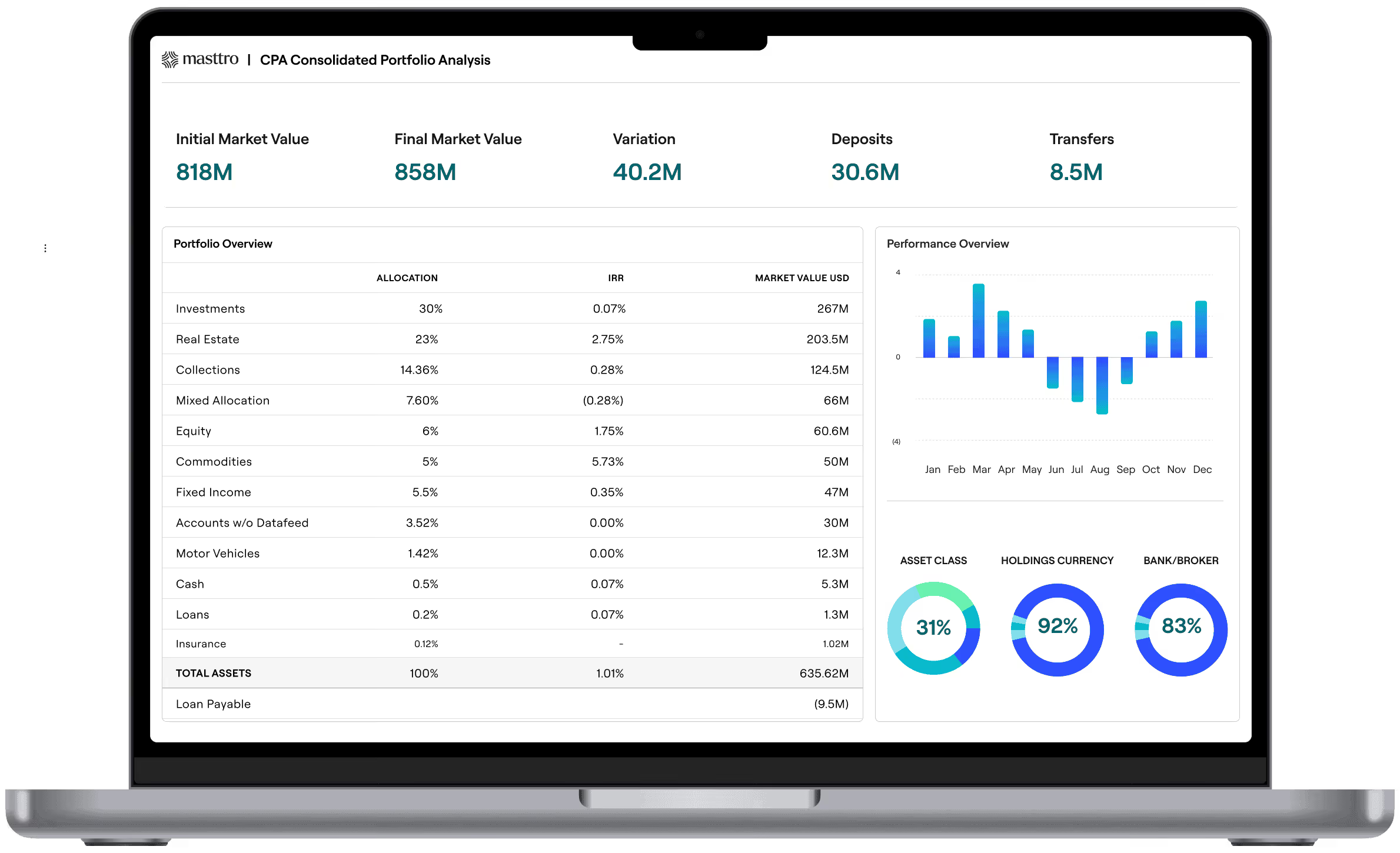
FundCount positions its consolidated view as something the controller no longer assembles by hand. That benefits the accounting team. It does less for a family member who wants to see how a trust, a holding company and a foundation own the same asset. Masttro’s Global Wealth Map and mobile app are built for that reader first.
Connectivity tops out at 50+ native connectors
FundCount fills the gaps beyond its 50+ connectors with PDF parsing and a managed process that downloads from portal-only custodians each morning. Every custodian lacking a native connection becomes a document or a portal login, and across several countries that places a ceiling on how fast your team can reconcile accounts. Masttro’s data aggregation leverages 700+ direct feeds with no screen-scraping.
The price starts at $35,899 and grows with the office
Fundcount’s base pricing excludes digital transformation and hosting fees, and its pricing FAQ lists entities, seats, funds and assets under management or administration among the inputs to the final quote. Masttro’s pricing is fixed and not based on AUM, so growth does not reprice the platform.
Adopting FundCount means migrating the ledger
Every FundCount implementation revolves around its own general ledger as the book of record. For an office whose accountants already trust Sage Intacct or another system, that means migrating the most sensitive system in the office. Masttro’s Truewind integration maps to the existing chart of accounts once, then delivers review-ready journal entries each period.

The 6 best FundCount alternatives for family offices.
1. Masttro: best for families who need the whole estate visible, including alternatives
Masttro serves more than 400 family offices and 10,000+ end users, aggregating 700+ direct custodian feeds across 40+ countries.
What it does well
Masttro supports every asset class, from public markets and private credit to real estate and art, in one reconciled view across companies, trusts, LLCs and foundations. Alternatives AI processes capital calls, distributions and PE and VC valuations, and Documents AI ingests K-1s and NAV statements. In a case study, Jefferson River Capital described the result as “a single source of truth for all of our investments.”
Limitations
Masttro is reporting-first and has no full double-entry general ledger. Pricing is quoted based on complexity, and implementation runs 12 to 14 weeks.
Why Masttro instead of FundCount
FundCount makes the books agree. Masttro makes the full estate visible, with 700+ direct feeds against FundCount’s 50+ native connectors.
2. Addepar: best for institutional-grade portfolio analytics
Addepar reports more than $9 trillion in assets across 1,400+ clients in 60+ countries. Its family office pitch promises “a secure, single source of truth powering holistic portfolio management.”
What it does well
Deep performance and exposure analytics, Navigator scenario modelling, Alts Data Management and private fund benchmarks. It offers an MCP, in beta, which allows users to connect to external AI models.
Limitations
Addepar publishes no pricing. The platform is built for analyst teams, and many offices rely on specialist staff or outside consultants to run it. Estate planning views come through partner integrations such as Luminary.
Why Masttro instead
Masttro delivers comparable consolidation with visual entity mapping, lifestyle assets beside the portfolio, a principal-first mobile experience, fixed pricing, and a working bridge to the office’s ledger today.
3. Eton Solutions (AtlasFive): strong fit for an all-in-one enterprise operating system
Eton reports more than $1 trillion in assets, 1,113+ families and 23+ million transactions processed annually. The company bills itself as “The Only Integrated, Secure WealthAI Solution You Need.”
What it does well
Eton Solutions combines accounting, entity management, bill pay and workflows in one system. EtonAI automates across 250+ document and workflow types. Bring Your Own Key encryption gives offices direct control of their keys.
Limitations
An all-in-one system replaces the operating model along with the software, which is a larger commitment than many of the alternatives on this page. Eton publishes no pricing or custodian count.
Why Masttro instead
Masttro offers the estate view without needing to modify how the office runs. It plugs into existing accounting, connects to 700+ custodians directly, and is designed to be used by the principal and operations team alike.
4. Asset Vantage: best for offices trading one ledger for another
Asset Vantage says it “unites general ledger and performance reporting into a single source-of-truth platform,” and reports activating more than 5,000 data feeds across banks, credit cards and custody accounts. It publishes tiered pricing by entity count and states it does not price on AUM.
What it does well
A true general ledger with partnership accounting, bill pay, a document vault, managed services, and tracking for homes, planes and collectibles.
Limitations
Asset Vantage describes its custodial and bank feeds as T+1 or T+2. It is the closest like-for-like to FundCount in this list, so an office that switches over is trading one accounting-first ledger for another.
Why Masttro instead
If the problem is visibility rather than bookkeeping, a second ledger won’t solve it. Masttro adds direct feeds processing 10m+ daily transactions, native alternatives automation and the Global Wealth Map, which is a system of record for ownership and wealth structures across the family.
5. Archway Group: best for software paired with outsourced accounting
Archway Group reports more than $860 billion in assets on its platform, and has operated independently of SEI since Aquiline Capital Partners acquired SEI’s family office services business in 2025. Its site calls the platform “the book of record private wealth runs on.”
What it does well
Enterprise partnership, portfolio and corporate accounting, bill pay, data aggregation and white-labelled reporting, with the option to delegate bookkeeping, payments and reporting to Archway’s own accountants.
Limitations
Archway is ledger-first in the same way FundCount is. It publishes no pricing or custodian count, and the outsourced model adds a service relationship alongside the software.
Why Masttro instead
For an office keeping its own team and accountants, Masttro adds a live view of the whole estate and sends clean data to the ledger.
6. Landytech (Sesame): good for investment data validation at scale
Landytech reports 500+ custodians, 10,000+ open banking feeds and more than $250 billion under reporting, and says its platform can “reduce time spent on reporting by up to 80%.”
What it does well
Data validation and reconciliation depth, performance and risk analytics, fund-level DPI, TVPI and IRR, and white-labelled reporting built for trust companies and private banks.
Limitations
Landytech’s site lists its general ledger module as “coming soon.” It also carries less depth on multi-generational entity structures and lifestyle assets.
Why Masttro instead
Masttro offers wider direct custodian reach, the dynastic layer Landytech lacks, and a ledger bridge via Truewind.
How to choose: five questions to ask every vendor
- Which of my custodians do you connect to directly? Ask for the list, and how the rest arrive: feed, PDF or a morning portal login.
- Show me one capital call ingested end to end. Notice in, tagged to the right entity, reconciled to the bank account.
- Where does the ledger live after go-live, and who posts to it? If the answer is a migration, price the migration.
- What does this cost in five years if the portfolio doubles? Ask what is counted: entities, seats, funds, custodians, or assets under management.
- Can the principal answer “what do we own?” on a phone, without calling anyone? This simple question can be surprisingly difficult to answer.
See the difference in your own data
To determine how your office’s own custodians, entities and alternatives would be mapped within Masttro, a 30-minute call is sufficient for a walkthrough of your structure, which of your custodians Masttro connects to directly, and how we process alternatives.
Book a demo, or download the Family Office Upgrade Playbook to get a head start on transforming your office.
Frequently asked questions
What is the best FundCount alternative for a family office?
Masttro, for any office whose problem is seeing the whole estate rather than closing the books. It aggregates 700+ direct custodian feeds across 40+ countries, automates capital calls, K-1s and NAV statements, prices on a fixed basis rather than AUM, and feeds the office’s existing ledger through Truewind.
Does Masttro have a general ledger like FundCount?
No. Masttro is reporting-first. Its Investment Sub-Ledger and the Truewind integration turn Masttro data into review-ready journal entries for Sage Intacct and other platforms, and the accounting team keeps posting decisions. As Masttro CEO Jay McNamara put it, “The reporting stays in Masttro, and the accounting stays in the accounting system.”
How much does FundCount cost?
FundCount publishes starting prices of $35,899 a year for a single family office and $26,950 for a multi-family office, plus digital transformation and hosting fees. It is an annual platform license, with the final quote sized by entities, seats, funds, assets under management or administration, and deployment. Masttro’s pricing is fixed, not based on AUM.
How many custodians does FundCount connect to?
FundCount publishes 50+ native connectors, supplemented by PDF parsing, FTP, API and managed RPA for portal-only custodians. Landytech publishes 500+ custodians; Masttro operates 700+ direct feeds across 40+ countries.
Can a family office keep its accounting system if it moves off FundCount?
Yes. With Masttro, the office maps its chart of accounts once at setup, Truewind delivers journal entries into systems such as Sage Intacct each period, and the ledger stays where the accountants want it.
Does FundCount automate K-1s and capital calls?
Yes. FundCount extracts figures from capital statements and K-1s with AI and posts them after human review. Masttro’s Documents AI and Alternatives AI tag each capital call and distribution, capture date and amount, and reconcile it to the office’s bank accounts.
How long does Masttro take to implement?
Twelve to fourteen weeks, including custodian connection and alternatives onboarding. Jefferson River Capital, a $1 billion-plus portfolio with more than 200 alternative investments, went live in three months or less.