Key Takeaways
Your trustees want the foundation's Q1 report by Friday. The custodian's still pricing the alternatives, the trust accountant's numbers don't match the auditor's, and you're three days into reconciling spreadsheets that should agree but don't.
If your trust and foundation reporting still runs through inboxes, Excel tabs, and follow-up calls, this isn't a process problem. It's structural. About 80% of ultra-high-net-worth families hold their wealth inside trusts, foundations, or similar fiduciary structures (STEP, 2024), and family office AUM is projected to grow 73% to $5.4 trillion by 2030 (Deloitte, 2024). The reporting volume keeps climbing. Most SFOs still produce it the same way they did a decade ago.
This guide breaks down what a complete trust and foundation report should actually contain, how to handle multi-jurisdiction complexity without losing methodology consistency, and what to look for when evaluating platforms that automate it.
What Is Trust and Foundation Reporting?
Trust and foundation reporting is the consolidated, fiduciary-grade view of every trust, foundation, private trust company, and related entity inside a family’s wealth structure — covering principal and income, beneficiary distributions, intercompany allocations, tax positions, and asset valuations across jurisdictions. About 80% of UHNW families globally use these structures (STEP, 2024), and the reports that document them have moved from a year-end trustee artifact into something principals, beneficiaries, and external counsel expect to see on demand.
The category sits at the intersection of three disciplines that rarely live inside one team. Performance reporting (what the assets did), fiduciary accounting (who owes what to whom under the trust deed), and tax reporting (what the IRS, HMRC, or local revenue authority needs to see). In a small family with one revocable trust and a brokerage account, those three views can live in a shared workbook. In a UHNW family with a dynasty trust in South Dakota, a Liechtenstein Stiftung, a Cayman holding company, and a US private foundation, they cannot.
Trustees used to deliver a binder once a year. The 2026 J.P. Morgan Family Office Report found that 60% of next-generation beneficiaries now want more frequent visibility than the quarterly cadence 64% of family offices currently provide (J.P. Morgan, 2026). That gap — between what fiduciary reports historically did and what beneficiaries now expect — is the operating pressure behind every platform conversation in this category.
Why Is Consolidated Trust Reporting So Difficult?
Consolidated trust reporting is difficult because the data lives in dozens of systems, the entity structure is rarely linear, and around 80% of family offices still depend heavily on Excel for reporting (Campden Wealth, 2025). The mechanical problem is not analytics. It is reconciliation across entities, custodians, jurisdictions, and reporting calendars that never agree.
Entity Sprawl
A typical UHNW structure includes several revocable and irrevocable trusts, a private trust company, a foundation (and sometimes a separate civil-law Stiftung or Fundación), one or more LLCs holding real estate, and a handful of investment partnerships. Each entity has its own tax ID, its own bank accounts, its own fiscal year, and its own trustee or board. The 38% of single family offices that now operate a PTC (J.P. Morgan, 2026) usually add another layer of governance reporting on top of all of it.
Spreadsheet Risk in Fiduciary Work
The 80% Excel figure is not a vanity stat. Fiduciary work is one of the few areas where a copy-paste error has a measurable legal cost. Errors in DNI (distributable net income) allocations, GST (generation-skipping transfer) inclusion ratios, or principal-and-income splits do not just create restated returns — they create trustee liability. Excel can do the math. It cannot enforce the audit trail of who changed which assumption, when, and under what authority. Auditors and surrogate courts increasingly ask for that trail.
Data Lives Everywhere
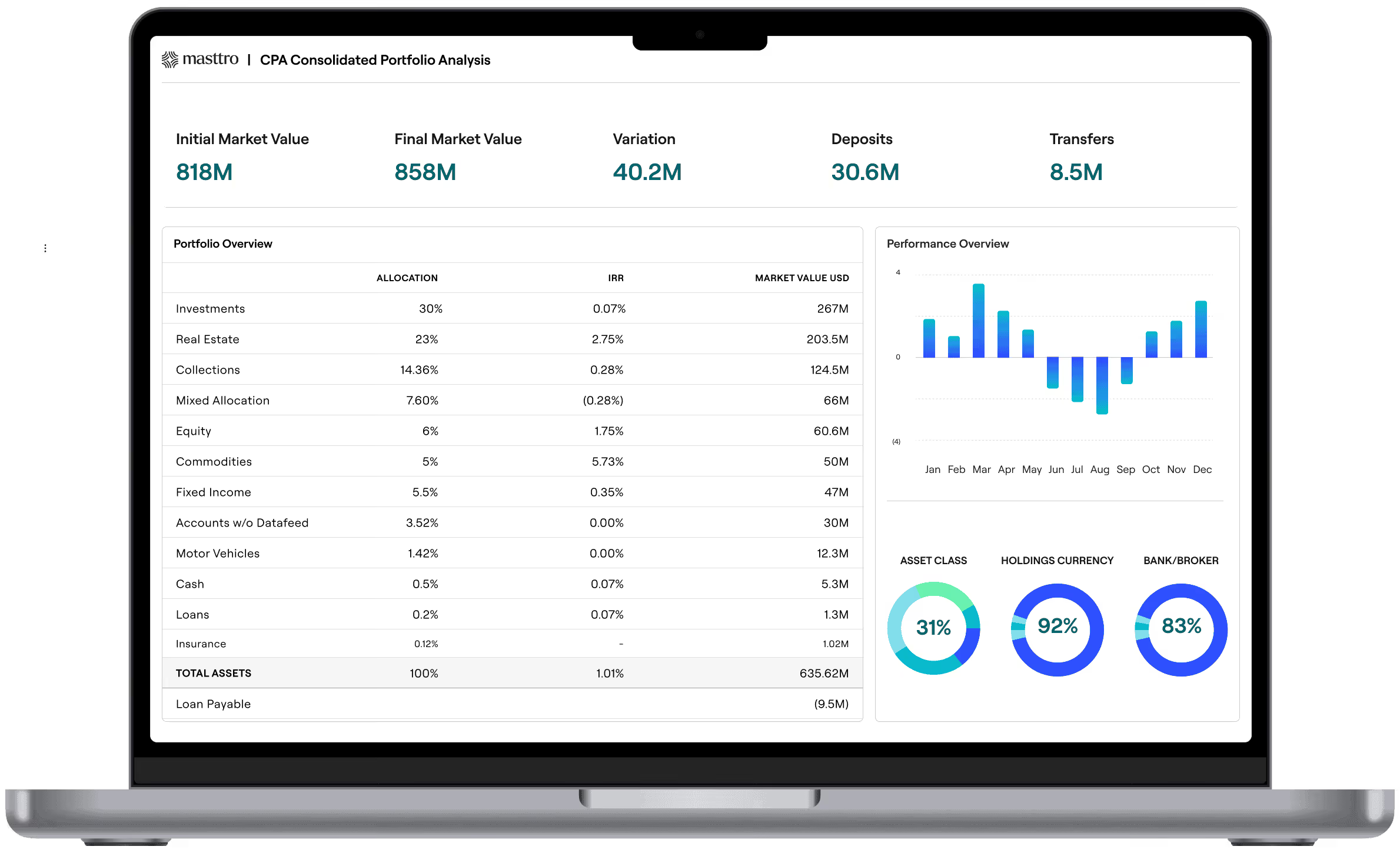
A consolidated report has to absorb custodial holdings from multiple banks, NAV statements from private fund administrators, K-1s arriving months after year-end, capital call notices with their own valuations, real estate appraisals on an irregular cadence, and direct investment marks that come from the family’s own deal team. The reporting cadence of each input is different. The trustee report has to reconcile all of it to a single as-of date.
That reconciliation is the hidden labor that consumes most of a family office accountant’s time. Until it is automated, every other reporting improvement is cosmetic.
What Trusts and Foundations Need Specialized Reporting?
Most UHNW structures include at least five entity types that each require specialized reporting: revocable trusts, irrevocable trusts (including GRATs and dynasty trusts), private foundations and public charities, private trust companies, and offshore structures. South Dakota alone holds over $750 billion in trust assets, up from $57 billion in 2006 (Pew, 2023), and the reporting requirements scale with that growth.
| Entity type | Primary filing | Key reporting trigger | What reporting must track |
|---|---|---|---|
| Revocable trust (grantor) | Reported on settlor's individual return (Form 1040) | Income flows to the settlor during their lifetime | Switch to separate fiduciary treatment at death or irrevocability event |
| Irrevocable trust | Form 1041 plus Schedule K-1 to beneficiaries | Trust files its own return as a separate taxpayer | DNI allocation, principal-and-income split, tier-1 and tier-2 distribution sequencing |
| GRAT | Form 1041 (grantor trust reporting during term) | Annuity payment schedule and term expiry | Section 7520 hurdle rate, annuity payments, remainder value |
| Dynasty trust | Form 1041 plus GST returns where applicable | Any distribution to a skip person | GST inclusion ratio and exemption usage on every distribution across generations |
| US private foundation | Form 990-PF (public document) | Annual 5% qualifying-distribution requirement | Qualifying distributions, 1.39% excise tax on net investment income, self-dealing, excess business holdings |
| Private trust company (PTC) | Regulated-entity filings plus audited financials | Corporate trustee governance and compliance cycle | Board minutes, compliance filings, plus separate fiduciary statements for each trust beneath it |
| Offshore structure (Stiftung, Fundacion, Cayman, BVI, Jersey) | Local return plus CRS and FATCA schedules | Reportable-account status under CRS or FATCA | Entity classification (financial institution, active or passive NFE), reportable persons, base-currency consolidation |
“Masttro allows us to consolidate all custodians and set up the entire legal structure to offer our clients a true holistic vision of their assets.”


Alternatives Reporting: From Below the Line to All of the Above

Revocable and Irrevocable Trusts
Revocable trusts (often grantor trusts during the settlor’s lifetime) report differently from irrevocable trusts. The grantor trust reports income on the settlor’s individual return; the irrevocable trust files its own Form 1041. The reporting platform has to track which is which, and switch reporting treatment at death or at the trust’s irrevocability event. Manual systems frequently miss the change.
GRATs and Dynasty Trusts
Grantor Retained Annuity Trusts (GRATs) require precise tracking of the §7520 hurdle rate, annuity payments, and remainder value. Dynasty trusts — long-term irrevocable trusts designed to skip GST tax across multiple generations — require inclusion-ratio tracking on every distribution to skip persons. A missed inclusion ratio in year three of a 90-year trust can cost more in tax than any other reporting error in the structure.
Private Foundations and Public Charities
US private foundations file Form 990-PF, which becomes public. They must distribute roughly 5% of net investment assets annually and pay a 1.39% excise tax on net investment income. Reporting has to track qualifying distributions, self-dealing transactions, and excess business holdings — none of which apply to private trusts.
Private Trust Companies and Offshore Structures
A private trust company (PTC) acts as corporate trustee for the family’s trusts. Most are chartered in South Dakota, Nevada, Wyoming, or offshore — places with favorable regulation, no state income tax on trust income, and statutory privacy. The PTC itself has to be reported as a regulated entity, with its own board minutes, compliance filings, and audited financials. The trusts beneath it then have to be reported as separate fiduciary entities with their own statements.
Offshore structures (Cayman, BVI, Jersey, Guernsey, Singapore, Bahamas, Liechtenstein) add CRS and FATCA reporting layers on top of all of it. We come back to those in the multi-jurisdiction section.
What Should a Complete Trust Report Include?
Industry guidance from STEP and the American College of Trust and Estate Counsel suggests a complete trust report includes at minimum five core components, produced at least quarterly with annual fiduciary statements (STEP, 2024). A consolidated family-office report rolls those five up across every fiduciary entity in the structure.
1. Statement of Assets and Liabilities
A trustee’s balance sheet. Carrying value (basis) and fair market value for every position, every asset class, and every account, presented per entity and consolidated. For alternatives, this means look-through to the underlying fund’s last published NAV, not a stale prior-quarter mark. For real estate and lifestyle assets (art, aircraft, yachts), it means an appraisal cadence policy and a defensible valuation method on file.
2. Statement of Receipts and Disbursements (Principal and Income)
The fiduciary equivalent of a cash-flow statement, split between principal and income under the trust’s governing instrument and applicable state law (often the Uniform Principal and Income Act). Misclassifying a capital gain as income, or a stock dividend as principal, changes what the income beneficiary is owed and what the remainder beneficiary retains. This is the line item auditors look at first.
3. Statement of Distributions
Who received what, when, under which authority, and with what supporting documentation (trustee minutes, distribution committee approvals, beneficiary request letters). For dynasty trusts and GST-exposed structures, the distribution statement also has to record inclusion ratios and the GST exemption used.
4. Statement of Trustee Fees and Expenses
Trustee fees, investment management fees, legal fees, accounting fees, custodian fees — broken out per entity. The percentage split between principal and income matters because it affects beneficiaries differently.
5. Tax Workpapers and Fiduciary Returns
For US trusts: Form 1041, Schedule K-1 to beneficiaries, state fiduciary returns, GST returns where applicable, and the underlying workpapers (DNI calculation, tier-1 and tier-2 distributions, charitable deduction support). For foundations: Form 990-PF and qualifying-distribution workpapers. For offshore structures: CRS reportable accounts schedules, FATCA classifications, and local return support.
A complete report does not stop at the trustee. It produces a beneficiary-facing statement that is intelligible to a non-finance reader, and a trustee-facing statement that holds up under audit. The two views start from the same data; the presentation is different.
How Do You Handle Multi-Jurisdiction Trust Reporting?
Multi-jurisdiction trust reporting is the consolidation of fiduciary data across structures domiciled in different countries, with different reporting standards, different currencies, and different tax treaties — anchored to a single base currency and a single consolidated view for the principal. Around 28% of UHNW families hold at least one offshore structure, and that share rises to nearly 60% above $500 million in net worth (STEP, 2024).
The Big Five Jurisdictions
For US-based families: South Dakota, Nevada, and Delaware dominate domestic dynasty trust formation. For international structures, Jersey, Guernsey, the Cayman Islands, Singapore, and Liechtenstein remain the most common offshore choices. Each has its own audit standards, its own trust law (common-law Jersey trust versus civil-law Liechtenstein Stiftung), and its own treaty network.
A report that consolidates these has to handle three translation problems at once: the legal characterization of the entity (is a Stiftung a trust or a foundation for US reporting?), the valuation convention (is the underlying held at cost or mark-to-market under local rules?), and the currency of the reporting period (do we mark to year-end spot or to a weighted average?).
CRS and FATCA: The Common Thread
The Common Reporting Standard now covers over 120 jurisdictions (OECD, 2024), and FATCA continues to apply to US persons globally. Trustees of reportable accounts have to classify each entity (financial institution, active NFE, passive NFE), identify reportable persons, and file annually with the local revenue authority for onward exchange.
The operational reality: the trustee, the trust administrator, the custodian, and the family office often all touch CRS classifications. Errors propagate. A modern reporting platform has to store the entity classification once and surface it consistently in every downstream report.
Currency and Valuation Conventions
Multi-currency reporting is not just FX translation. It is choosing — and documenting — the policy. Spot rate at period end, or weighted average for the period? Hedge accounting on illiquid currencies, or transparent FX impact on the income line? Reporting in USD as the principal’s base, in EUR as the Stiftung’s local books, in CHF as the trust company’s accounting currency — all simultaneously, all reconciled.
This is the place where a “real-time reporting” marketing claim collides with the operating reality. T+3 NAVs, K-1s arriving in September for a December year-end, and quarterly trustee committee cycles mean that the data is rarely real-time. What can be real-time is the access layer, the audit trail, and the rollup logic. That distinction matters when evaluating vendors.
How Does Foundation Reporting Differ From Trust Reporting?
Foundation reporting differs from trust reporting in five material ways: foundations are separate legal entities (not fiduciary relationships), US private foundations file public Form 990-PFs, they are subject to a 5% qualifying-distribution rule and a 1.39% excise tax, and they face self-dealing and excess-business-holdings constraints that trusts do not. The number of US private foundations crossed 137,000 in 2023, holding over $1.4 trillion in assets (Foundation Source, 2024).
Form 990-PF: The Public Document
The 990-PF is public. It lists trustees, officers, grantees, expenses, investment income, and the foundation’s complete balance sheet. Families who treat the 990-PF as an afterthought discover late that grantee lists, compensation, and investment positions are visible to journalists and other interested parties. Reporting platforms should produce a 990-PF workpaper that the family reviews before filing, not after.
The 5% Distribution Rule
US private foundations must make qualifying distributions of approximately 5% of the average fair market value of net investment assets each year. The math is straightforward; the data is not. The platform has to calculate the monthly valuation of investment assets, exclude functionally related assets, and track set-asides — and surface the result in time for the foundation’s grantmaking calendar, not after year-end.
Investment Income and Excise Tax
The 1.39% net investment income excise tax applies to interest, dividends, royalties, rents, and capital gains. Reporting has to track gross income, allowable deductions, and the resulting net investment income with enough granularity to support the return. For foundations with private investments and partnerships, this means K-1 line items have to be characterized correctly — passive vs. active, ordinary vs. capital — every year.
Public vs. Private Foundations
Public charities (501(c)(3) public) and private foundations have different rules. Donor-advised funds (DAFs) operate at a public charity and add their own reporting layer for the family that funds them. A consolidated family-office report should distinguish DAF balances and recommendations from private foundation balances and grants — even when the same family controls both.
Foundations vs. Liechtenstein/Panama Stiftungen
A US private foundation is a charitable vehicle. A Liechtenstein Stiftung or Panama Fundación is often a private wealth-holding vehicle that uses the legal form of a foundation but is not subject to US foundation rules. They are reported as separate entities, frequently classified as passive NFEs under CRS, and have to be tracked alongside — not lumped with — the family’s charitable foundations.
The operational rule: never roll a private wealth Stiftung into the same line as a US 501(c)(3) private foundation. The reporting treatment is different, the tax treatment is different, and the audit risk of conflating them is meaningful.
How Does Technology Streamline Fiduciary Reporting?
Technology streamlines fiduciary reporting by automating four workflows that consume the majority of accountant time: look-through aggregation across entities, document extraction from capital calls and K-1s, beneficiary-portal delivery, and immutable audit trails for trustee decisions. Automated reporting adoption among family offices jumped from 46% to 69% in a single year (RBC/Campden Wealth, 2025).
Look-Through Aggregation
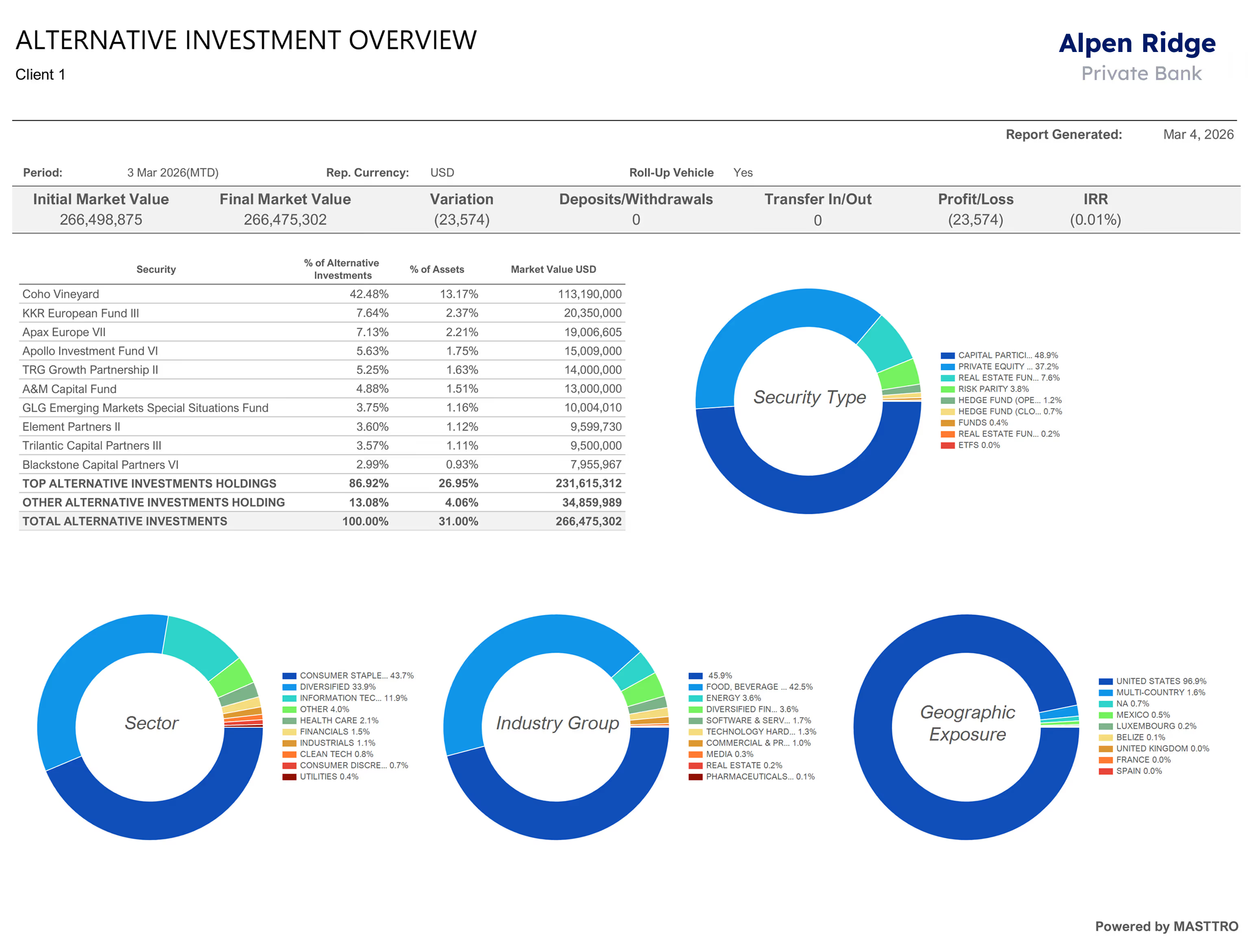
Look-through aggregation is the ability to roll up exposure from the entity level (the trust holds 35% of LP Fund III) to the underlying asset level (LP Fund III holds 12 portfolio companies, of which one is a 4% exposure to a single private company). For a family with overlapping fund commitments across trusts, this is the only way to know real single-name concentration. A modern family-office platform performs look-through across the structure — multiple custodians, multiple administrators, multiple entities — and presents the result to the principal in one view.
Automated Tax Workpapers
AI-powered document extraction can reduce data entry time by 94% on capital call notices and K-1s (Copia Wealth Studios, 2025). The mechanical work of reading a K-1 — finding the lines, classifying the income, allocating to the correct beneficiary — is the kind of task where document AI has measurable impact. The output still needs an accountant review, but the starting point is structured data, not a PDF.
Beneficiary Portals
A beneficiary portal is a permissioned view into the consolidated report. Each beneficiary sees their relevant entities, their distribution history, their projected income — and not the rest of the family’s positions. This is the technology answer to the 60% of beneficiaries who want more frequent updates. The portal does not change the underlying reporting cadence; it changes the access cadence.
The portal also reduces the volume of one-off reporting requests that family-office accountants spend evenings answering. Self-service is not a luxury at this scale; it is operational survival.
Audit Trails for Trustee Decisions
Every distribution, every fee approval, every valuation override needs to be traceable. Who proposed it, who approved it, when, under what authority, and against what supporting document. This is the trail surrogate courts and external auditors increasingly expect. A modern platform stores it as part of the workflow, not as a separate logging system that requires manual upkeep.
The cumulative effect across all four workflows is measured in days of accountant time per quarter, not in marginal efficiency gains. When automated reporting adoption jumps 23 percentage points in 12 months, that is what is moving.
How Do You Choose a Trust Reporting Platform?
Choose a trust reporting platform by evaluating it on the five operational realities of fiduciary work — entity-first data model, fiduciary accounting depth, multi-currency native, beneficiary permissioning, and direct custodian feeds — not on the marketing surface. Over 80% of family offices plan significant technology investment within two to three years, and 81% of single family offices plan to invest in three or more digital technologies (EY/Wharton, 2024).
Entity-First Data Model
The most consequential question to ask any vendor: how does the system model entities? A platform built for institutional asset management often treats the entity as a tag on an account. A platform built for family offices treats the entity as a first-class object with its own balance sheet, its own distributions, its own tax characterization. The difference shows up immediately in trust reporting, where the entity is the report.
Fiduciary Accounting Support
Does the platform natively handle principal-and-income allocation under the Uniform Principal and Income Act? DNI calculations? Tier-1 / tier-2 distribution sequencing? GST inclusion ratios? Form 1041 workpapers? Form 990-PF qualifying distributions? If these are “we can integrate with your tax preparer,” that is an integration cost, not a platform capability.
Multi-Currency, Multi-Jurisdiction Native
A platform that handles multi-currency reporting as an FX feed bolted onto a USD ledger will struggle with the actual problem: trusts that book in CHF, distribute in EUR, and consolidate to USD for the principal. Multi-currency has to be in the data model, not in the report layer.
Beneficiary Permissioning
Granular, row-level permissioning — not just per-user roles. Beneficiary A sees their irrevocable trust and DAF balances; Beneficiary B sees their dynasty trust and the family foundation; the trustee sees everything. The permissioning model has to be configurable without engineering work, because beneficiary structures change.
Direct Custodian and Administrator Feeds
The number of direct custodian and fund-administrator feeds the platform maintains is a proxy for how much manual data entry survives. Masttro maintains direct feeds from 750+ custodians across 40+ countries, which is the operating baseline at this audience tier. Fewer feeds means more manual ingestion, which means more reconciliation labor, which means slower reports.
SOC 2 Type II and ISO 27001 certifications are the floor. Given that 75% of single family offices have faced phishing attacks (EY/Wharton, 2024), MFA, audit logging, role-based access, and dedicated tenant isolation are non-negotiable.
FAQs
What is the difference between a trust and a foundation?
A trust is a fiduciary relationship: a trustee holds legal title to assets for named beneficiaries under common-law rules. A foundation is a separate legal entity (a corporation in the US, a Stiftung or Fundación in civil-law jurisdictions). Around 80% of UHNW families globally use trust structures (STEP, 2024), while many also operate a private foundation, often for charitable giving alongside private wealth structures.
How often should trusts produce financial reports?
Industry guidance suggests at least quarterly reporting with annual fiduciary statements. Yet 64% of family offices still produce consolidated reports only quarterly, and 60% of next-generation beneficiaries want more frequent updates (J.P. Morgan, 2026). Modern trust platforms enable monthly or near-real-time reporting through beneficiary portals without adding staff workload.
What software do family offices use to report on trusts?
Family offices typically use multi-entity wealth platforms that combine performance reporting with fiduciary accounting. About 69% of family offices have adopted automated reporting, up from 46% the year prior (RBC/Campden Wealth, 2025). Trust-capable platforms support principal-and-income allocation, DNI calculations, and Form 1041 workpapers natively, rather than as bolt-ons.
How do GST and estate tax rules affect trust reporting?
Generation-skipping transfer (GST) tax requires trustees to track inclusion ratios on every distribution to skip persons. Dynasty trusts in states like South Dakota now hold over $750 billion in assets (Pew, 2023). Reporting must show GST exemption usage, inclusion ratios, and remainder-beneficiary classifications across multiple generations. Errors here can cost millions in unintended GST tax.
How are charitable foundations reported differently?
US private foundations file Form 990-PF, which becomes public, and must distribute roughly 5% of net investment assets annually. The 137,000+ US private foundations hold over $1.4 trillion (Foundation Source, 2024). Reporting must track qualifying distributions, the 1.39% excise tax on net investment income, self-dealing transactions, and excess business holdings — none of which apply to private trusts.
What are private trust companies and why do family offices use them?
A private trust company (PTC) is a chartered entity that acts as corporate trustee for the family’s trusts. About 38% of single family offices now operate a PTC (J.P. Morgan, 2026), most chartered in South Dakota, Nevada, Wyoming, or offshore. PTCs offer governance control, continuity across generations, and the ability to hold non-traditional assets — operating businesses, concentrated stock, lifestyle assets — that institutional trustees often refuse.
How does multi-jurisdiction reporting handle CRS and FATCA?
The Common Reporting Standard now covers over 120 jurisdictions (OECD, 2024), and FATCA continues to apply to US persons globally. Trustees classify each entity (financial institution, active or passive NFE), identify reportable persons, and file annually with the local revenue authority for onward exchange. The reporting platform has to store entity classifications once and surface them consistently in every downstream report.
What is “look-through” reporting and why does it matter for trusts?
Look-through reporting rolls exposure up from the entity level (the trust holds 35% of LP Fund III) to the underlying asset level (LP Fund III holds 12 portfolio companies, one of which is a 4% exposure to a single private company). For a family with overlapping fund commitments across trusts, look-through is the only way to measure real single-name concentration. It also matters for fiduciary duty — a trustee cannot demonstrate prudence without knowing what is actually inside the trust.
How should family offices report lifestyle assets held in trust?
Lifestyle assets — art, vehicles, aircraft, yachts, jewelry, wine, real estate — held inside a trust still require a defensible valuation method and appraisal cadence on file. The reporting platform should present these alongside investment positions, not in a separate “other” bucket, so the principal sees the full balance sheet. Insurance values, appraised values, and basis should all be visible.
“The biggest value for us has been gaining a complete and organized view of our entire patrimonial structure. Today, we have a much clearer map of what we own, where it is held, and how the different entities and investments are connected.”
“The global wealth map is a critical piece that is a huge selling point to clients and prospects.”
“Masttro allows us to answer all the different questions from the owner’s perspective. What assets do I have? Where do I have them? Who knows about this information and who is in charge of it?”