Key Takeaways
You’re three weeks into rebuilding the family’s ownership diagram in Visio, and you already know it’ll be stale the day you ship it. Fourteen entities, six trusts, three jurisdictions, wired together in a structure nobody outside the office can read on a single screen. Next quarter, you do it again.
That cycle is what estate mapping software is supposed to end. But most family-office software claims to handle “estate planning” but can’t actually render the cross-entity, cross-jurisdiction structure you operate against every day. Planning tools draft documents. Mapping tools draw the picture. They are not substitutes, and buying the wrong one is the most common reason a software selection gets thrown out within 18 months.
This guide covers what estate mapping software actually is, how it differs from estate planning, a 6-step framework for evaluating real mapping capability, a head-to-head of the five platforms that ship native entity-tree visualization (Masttro, Addepar, Eton Solutions, Asora, Vyzer), realistic pricing, and the most expensive mistake families make when shopping.
What Is Estate Mapping Software?
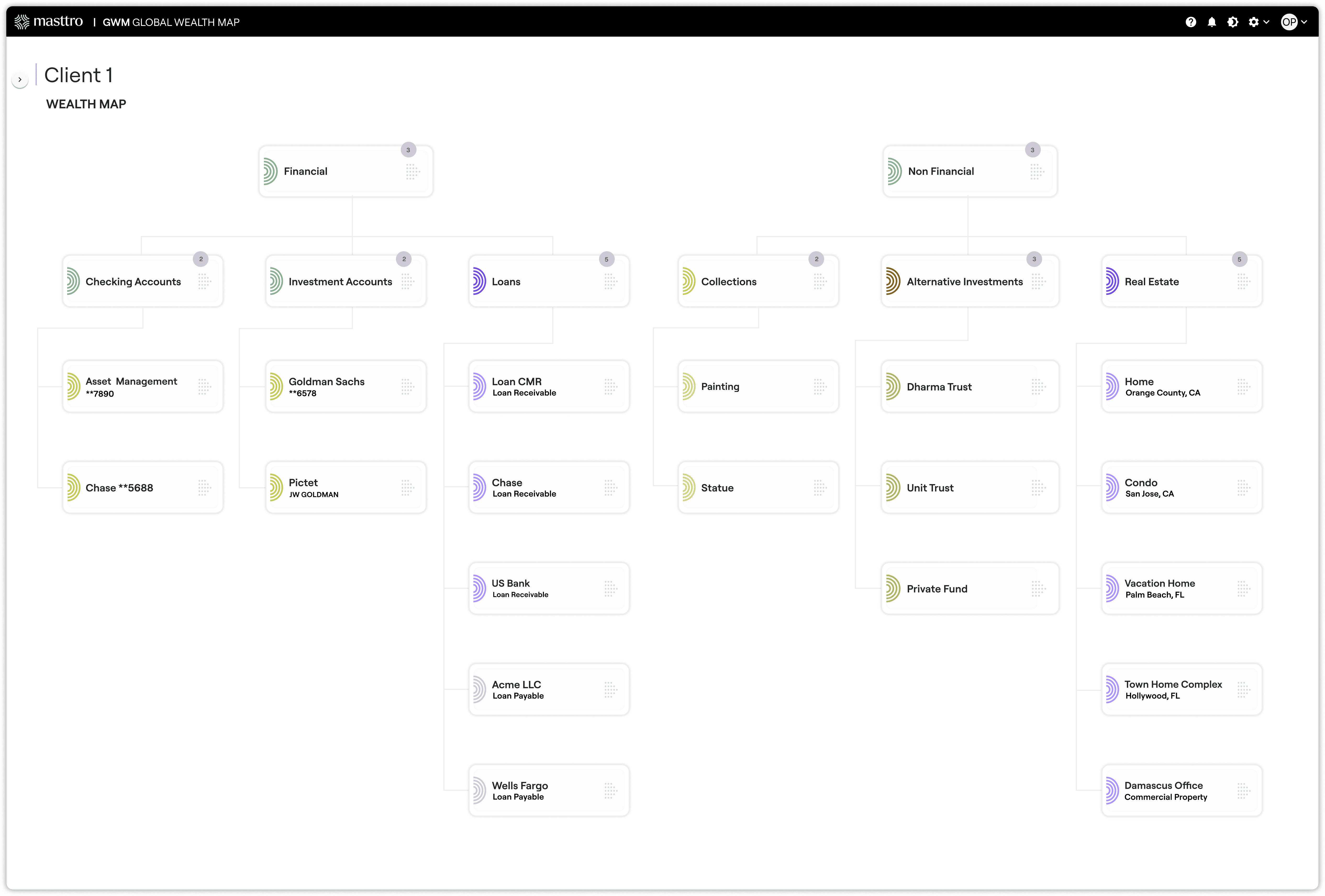
Estate mapping software visualizes a family’s wealth across entities, trusts, beneficiaries, and jurisdictions: the structural picture. Typical UHNW families may operate 14 or more entities, 6 or more trusts, across 3 or more jurisdictions, and estate mapping, with a tool like Masttro’s Global Wealth Map, is the layer that renders that structure as something a principal, a COO, and an heir can all read on one screen.
It works from a defined set of inputs and produces a defined set of outputs:
- Inputs: the legal entity register, trust deeds, beneficiary lists, and jurisdictional rules
- Outputs: ownership graphs, generation-by-generation diagrams, and scenario maps (what happens if a beneficiary inherits, divorces, or passes away)
Just as important is what estate mapping software is not. It is not a planning tool (Wealth Docx, Trust & Will), not a CRM, and not an accounting tool. Those systems answer different questions. Estate mapping answers one question precisely: who owns what, through which vehicles, in which jurisdictions, and on whose behalf.
Family offices are increasingly treating ownership visualization as an operational need, separate from both estate planning (legal) and portfolio reporting (financial). Most family-office software guides don’t name this split, but family offices feel it daily: the planning binder lives with the lawyers, the performance numbers live in the reporting platform, and the actual ownership structure lives nowhere — until a mapping tool gives it a home.
Estate Planning vs Estate Mapping: What’s the Difference?
Estate planning is the legal and strategic process: drafting wills, structuring trusts, and designing succession. Estate mapping is the visualization layer that shows how the plan actually plays out across entities. Most family-office software pages conflate the two on page one, and that conflation is exactly what costs buyers money.
Here is the practical division of the market:
- Planning tools (lawyer-facing): Wealth Docx, Trust & Will, NetDocuments with estate-planning add-ons. These help draft and store legal instruments.
- Mapping tools (family-office-facing): Masttro, Addepar (limited), Eton Solutions, Vyzer. These render the resulting structure.
Family offices need both, but they serve different cadences. Mapping is the daily operating tool; planning is the every-three-to-five-years strategic exercise. A family revisits its estate plan when tax law shifts or a generation turns over. It looks at its estate map every time a new entity is formed, a position moves, or a beneficiary’s circumstances change.
The fastest way to tell the two apart on a demo is to ask the vendor a single question: “Show me a multi-generation family with multiple entities and a collection of trusts, and your software would render the ownership map.”
In family-office RFPs, the first three things Masttro is asked to render live are almost always the same: a three-generation ownership tree, a trust-within-a-trust nesting case, and a cross-border holding structure. These are the moments where feature lists stop mattering and the data model either holds up or breaks. Buyers who lead with these tests, rather than a spec sheet, consistently make better selections.
Why Does Estate Mapping Matter for Family Offices in 2026?
Three forces make estate mapping a 2026 buying priority: rising entity complexity, accelerating generational wealth transfers, and scenario modeling becoming genuinely viable.
- Family offices continue to add legal vehicles faster than spreadsheet workflows can absorb, and family office AUM is projected to grow 73% to $5.4 trillion by 2030 (Deloitte, 2024). More entities means more edges in the ownership graph, and a faster decay rate on any hand-drawn diagram.
- An estimated $84 trillion will transfer over the next 20 years (Cerulli Associates, 2025). Each transfer event reshapes the map, and families increasingly want to see the before and after before they execute.
- FATCA, CRS, and beneficial-ownership registries demand audit trails and a defensible record of who owns what, and when. For UHNW families, the same scrutiny applies internally: who can see the map, and on whose terms, is a question that belongs in any platform evaluation.
Across Masttro’s customer base, entity-mapping queries have climbed steadily over the last 24 months as families add entities and jurisdictions faster than manual workflows can keep up. The pattern is consistent: the map stops being something a family looks at once a year and becomes something the office consults weekly. The same operational shift shows up in multi-entity portfolio reporting, where the entity, not the account, becomes the reporting unit.
How Do You Evaluate Estate Mapping Software? (6-Step Framework)
There is no universal number-one platform; fit depends on entity count, jurisdictional spread, and how the family-office stack already aggregates data. Use this 6-step framework to score candidates objectively rather than reacting to a feature list.
- Entity-tree visualization depth — can it render 3+ generations cleanly on one screen?
- Trust nesting + beneficiary overlays — can it handle a trust that owns a company that owns another company?
- Cross-jurisdiction support — different rules per country, presented coherently
- Scenario modeling — what happens if a beneficiary inherits, divorces, or passes away?
- Audit trail + version history — estate maps change quarterly; you need to see what changed
- Data-layer integration — does it pull from your aggregation platform, or duplicate the work?
In Masttro’s pre-sales evaluations across family-office prospects, the framework above consistently separates platforms that demo well from platforms that survive a real structure. The single most common reason a selection goes wrong is a data model that cannot represent the family’s actual entities, which is why steps one, two, and six carry the most weight.
Three of these steps deserve a closer look, because they are where vendors most often diverge.
Entity-Tree Visualization Depth
Visualization depth is the single most important capability; every other feature depends on it. If the tool cannot render the structure cleanly, scenario modeling and audit trails are built on sand.
What to test:
- Multi-generation rendering (3+ generations cleanly, on a single screen)
- Ownership-percentage display versus entity-only display
- Drill-down from the structure all the way to position level
Beneficiary Overlay + Trust Nesting
The LP-of-an-LP-of-a-trust case is where most vendors break down. A clean two-level chart is easy; a beneficiary who appears across three nested trusts with different distribution rules is not.
What to test:
- Beneficiary visibility across nested trusts
- Spouse, minor, and contingent beneficiary categorization
- Distribution-rule annotations attached to the right node
Cross-Jurisdiction Support
Cross-jurisdiction mapping is the differentiator between consumer estate-planning tools and genuine family-office software. A US-only tool looks fine until the family adds a Cayman holding company.
What to test:
- Common UHNW structures: US grantor trust + Cayman holding + Liechtenstein foundation
- Jurisdiction-specific rule annotations (US Form 706 vs UK IHT)
- Currency presentation across the structure
Side-by-Side Comparison: Platforms With Estate Mapping Capability
Only a handful of platforms actually ship entity-tree visualization. The matrix below scores each on the 6-step framework, using “native,” “partial,” “roadmap,” or “none” rather than star ratings. Masttro is included and disclosed.
| Platform | Entity-tree depth | Trust nesting | Beneficiary overlay | Cross-jurisdiction | Scenario modeling | Audit trail | Integration depth | Target segment |
|---|---|---|---|---|---|---|---|---|
| Masttro | Native | Native | Native | Native | Native | Native | Native (aggregation + reporting + docs) | SFO + MFO |
| Addepar | Partial | Native | Partial | Native | Native | Native | Native (public-market focus) | High AUM family offices, RIAs |
| Asora | Partial | Partial | Partial | Partial | Roadmap | Native | Native (privacy-first) | European SFOs |
| Vyzer | Partial | Partial | None | Partial | Roadmap | Partial | Partial | Emerging family offices |
| AssetVantage | Partial | None | None | Partial | None | Native | Native (accounting-led) | Accounting-centric FOs |
| Gogravity | Roadmap | None | None | None | None | Partial | Partial | Emerging |
| Aleta | Partial | Partial | None | Partial | None | Partial | Partial | European SFOs |
“Visually, from a user interface perspective, this is by far the easiest platform to add assets and to see our family mapping.”

Expanding Your Family Office Capabilities

How Much Does Estate Mapping Software Cost?
Cost depends less on the headline number and more on what the meter is running against. Some platforms charge per user. Some charge per entity. And some, including most of the bundled wealth platforms, tie pricing to assets under management, meaning your software bill goes up every time the portfolio does, whether or not the family added a single entity or trust.
Masttro does not price on AUM. The thinking is simple: the work the platform does is driven by structure complexity (entities, trusts, jurisdictions, document volume), not by how much the portfolio happens to be worth in any given quarter. A family that doubles in net worth without adding entities should not pay double for the same map.
Here is roughly where the major platforms land in 2026, based on publicly available pricing and reported buyer experience.
Asora
Asora publishes the most transparent pricing in the category: tiered plans starting around €800/month, scaling with tracked net worth, plus a one-time implementation fee of 25% of the annual rate. Add-ons run €250/month each (additional investment accounts, alts data ingestion). The tradeoff: pricing is net-worth-tiered, so a family whose holdings appreciate sharply moves up tiers even if the underlying structure has not changed. (Asora pricing)
Vyzer
Vyzer sits at the lightweight end. Its Family Office plan runs $873/month month-to-month, or $699/month billed annually (roughly $8,400 a year). Professional and RIA plans are custom. The tradeoff: the low sticker price reflects a thinner mapping data model. Vyzer handles emerging-complexity families well and shows its limits at the LP-of-an-LP-of-a-trust case.
Addepar
Addepar does not publish standard pricing. Quotes are customized based on portfolio complexity, user count, integrations, and implementation scope. For current pricing, contact Addepar directly.
The five pricing models, and what each one really costs you
The model matters as much as the headline number:
- Per-AUM: Common in bundled wealth platforms. Predictable in flat markets, painful in bull markets. The platform did not get more valuable because the S&P rallied.
- Per-net-worth tier: A softer version of per-AUM (Asora’s model). Same dynamic, but step-function rather than continuous.
- Per-entity / per-structure: Scales with what actually drives the workload. The downside: families that add entities mid-year can get hit with mid-year true-ups.
- Per-household: Clean for multi-family offices serving many families. Less useful for an SFO.
- Flat tier: Simplest, but watch the entity ceilings. Vyzer’s Family Office plan is a flat tier; it works until the structure outgrows it.
The costs that derail budgets
Almost always quoted last:
- Entity-discovery onboarding: $10k–$30k. Most consistently underestimated line item across every platform.
- Custom visualization templates: $8k–$25k.
- Training: $5k–$15k.
- Implementation fees: Asora publishes 25% of annual; Addepar and Eton quote case by case; expect six figures on complex deployments.
The honest test before signing: ask the vendor what your invoice looks like in three years if your AUM doubles but your entity count stays flat. If the number goes up materially, you are paying for the wrong thing.
Common Mistakes When Evaluating Estate Mapping Software
The most expensive mistake is choosing a planning tool (lawyer-facing) when the family office needs a mapping tool (operating-facing), or vice versa. Six recurring errors account for most regret:
- Confusing planning software with mapping software. Wealth Docx drafts documents; Masttro and Addepar render structures. They are not substitutes.
- Buying for a feature list instead of pressure-testing on the family’s actual structure. A spec sheet says “visualization”; a live demo on your 8-entity, 4-trust case tells the truth.
- Underestimating entity-discovery effort. Most families do not have a single source of truth, and the gap surfaces during onboarding, not before.
- Choosing a standalone mapping tool when an integrated family-office platform exists. A bolt-on map that does not pull from your aggregation layer becomes another thing to maintain.
- Skipping cross-jurisdiction support because “we only have US entities today.” UHNW families add jurisdictions every few years; the tool should be ready before the structure is.
- Accepting no audit trail or version history. Estate maps change quarterly, and family members want to see what changed and when.
The throughline across all six: families that buy on a feature checklist regret it more often than families that buy on a live demo of their own structure.
Top Estate Mapping Platforms for Family Offices in 2026
These are editorial picks scored against the 6-step framework above. Transparent disclosure: Masttro is included because it is one of the few platforms that ships native entity-tree visualization, and it is the publisher of this guide.
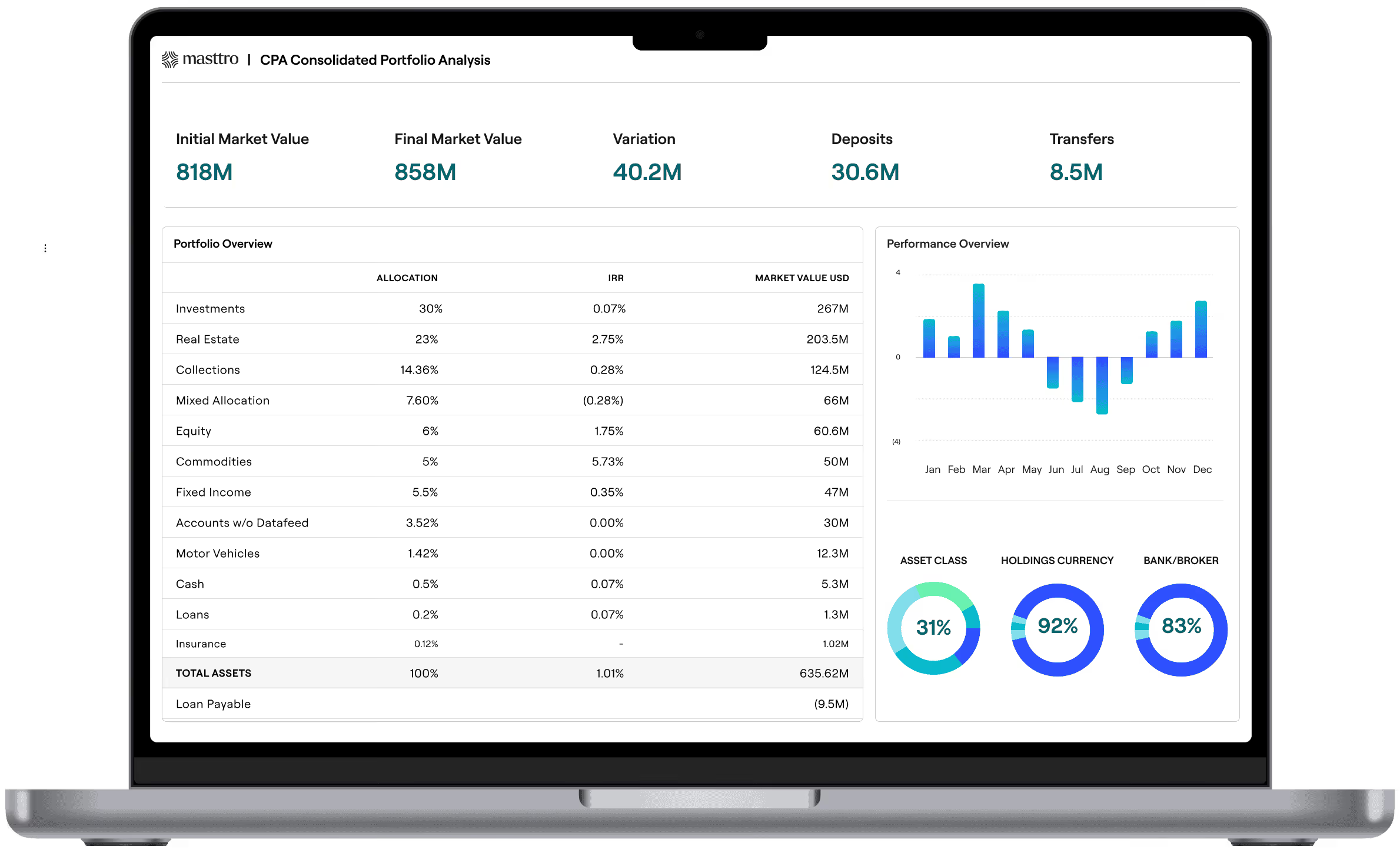
Masttro — best for single- and multi-family offices needing deep entity-tree visualization integrated with aggregation, reporting, and document storage. The Global Wealth Map feeds directly into Consolidated Portfolio Analysis, with data flowing in from 750+ direct custodian feeds, so the map reflects the current structure without manual imports or reconciliation gaps. Client-controlled encryption means the map is visible only to those you authorize.
Addepar — best for $1B+ family offices with heavy public-market reporting, where estate mapping is a complement to performance analytics rather than the center of gravity.
Vyzer — best for emerging family offices that want a lightweight starting point and can grow into deeper mapping later.
Frequently Asked Questions
What is estate mapping software?
Estate mapping software visualizes a family’s wealth structure across entities, trusts, beneficiaries, and jurisdictions. It is the operating diagram family offices use to see how ownership flows, not a tool for drafting legal documents. Common providers include Masttro, Addepar, Eton Solutions, and Vyzer.
How is estate mapping different from estate planning?
Estate planning is the legal and strategic process (wills, trusts, succession). Estate mapping is the visualization layer that shows how the plan plays out across entities.
What software do family offices use for estate mapping?
The five platforms that ship native entity-tree visualization with beneficiary overlays in 2026 are Masttro, Addepar, Eton Solutions, Asora, and Vyzer. Selection depends on entity count, jurisdictional spread, and whether the family office already runs an aggregation platform.
How long does it take to implement estate mapping software?
Family offices with a clean entity register can deploy in 3–6 weeks. Family offices reconstructing the legal and ownership inventory from scratch typically take 8—14 weeks. The entity-discovery phase is the biggest variable.
Conclusion
Estate mapping is no longer a one-off planning artifact; it is the family-office operating diagram. As entity counts rise, as an estimated $84 trillion changes hands over the next two decades (Cerulli Associates, 2025), and as cross-jurisdiction structures become the default, the families that can see their own wealth clearly will govern it better than the families still rebuilding diagrams in Visio every quarter.
The buying decision comes down to a few honest tests: does the platform render your actual structure on a live demo, does its data model fit the entities you really hold, and does it keep the map current without a quarterly rebuild? Score candidates on the 6-step framework, pressure-test the planning-versus-mapping distinction, and budget realistically for entity discovery. Do that, and the map becomes what it should be — a tool the office reads every week rather than a slide it dusts off once a year.
This comparison is prepared by Masttro. Masttro is not affiliated with, and this content is not endorsed or sponsored by other providers mentioned in this article. All trademarks are the property of their respective owners.
Talk to a Masttro Estate Mapping Specialist
Bring your family’s actual structure. We’ll render it live on a 30-minute demo.
“Masttro has helped us uncover and map companies and assets that were not clearly identified or centralized before.”
“The global wealth map is a critical piece that is a huge selling point to clients and prospects.”
“Masttro allows us to answer all the different questions from the owner’s perspective. What assets do I have? Where do I have them? Who knows about this information and who is in charge of it?”