Key Takeaways
In ultra-high-net-worth families, assets are more than stocks or real estate. A meaningful share of wealth typically sits outside the portfolio. Think: art, vintage cars, jewelry, rare wines, sports memorabilia, and other long-held assets.
When family offices begin reporting on passion assets as part of their estate, these alternative investments become difficult to work with. Details live in appraisals and insurance schedules. Values are outdated and documentation is inconsistent. No one is comfortable relying on the numbers for important decisions.
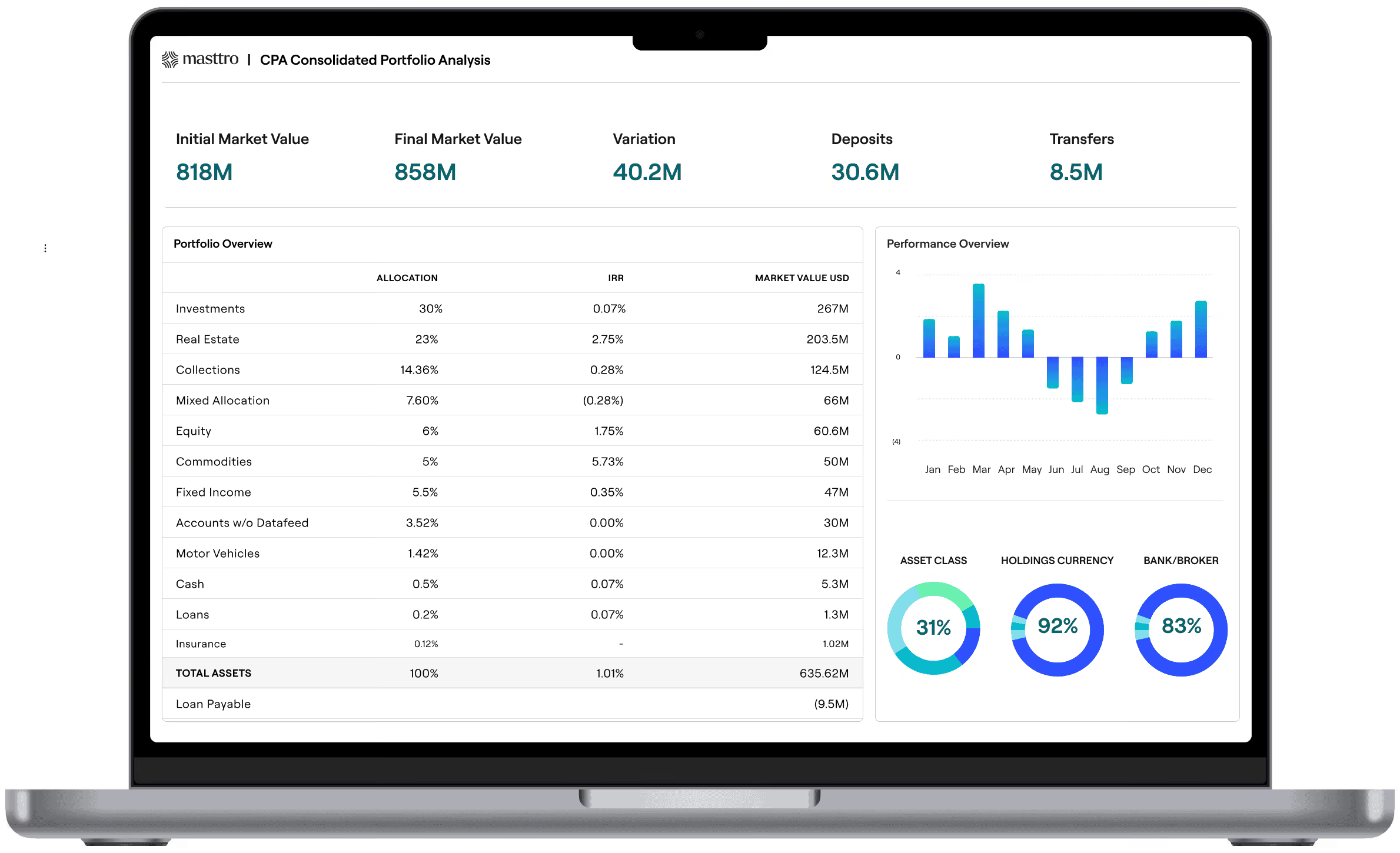
Masttro brings passion assets into the same system used by family offices to track traditional investment performance as well as other alternatives. There are no separate spreadsheets or disconnected records. You know what the alternative asset is, where documentation lives, and when it was last valued. That adds clarity to estate planning and risk decisions.
Defining what belongs in that system is where most family offices start.
What Passion Asset Reporting Covers
Passion asset reporting applies the same discipline used for financial portfolios to assets that historically lived outside formal reports. This is more than curation or presentation. It's about oversight, documentation, and integration into total wealth management. Passion assets are treated as managed components of the balance sheet.
It covers:
- Art collections and passion assets
- Physical assets tied to insurance, custody, and location
- Assets connected to family legacy, estate planning, and generational transfer
Why Non-Financial Assets Are Hard to Manage
Alternative investments introduce challenges that traditional wealth systems aren't designed to handle.
Common issues include:
- No standardized alternative investment report across asset types
- Valuations are tracked offline or updated inconsistently
- Insurance, appraisal, and provenance documents are scattered
- Limited shared visibility across family members, advisors, and fiduciaries
These gaps create real exposure. Insurance may trail current values and estate plans get built on partial information. Advisors don’t always have a clear record of what exists, where it’s held, or how it connects to the rest of the balance sheet.
Over time, that makes collections harder to protect and plan around.
Collections & Passion Assets Overview Report
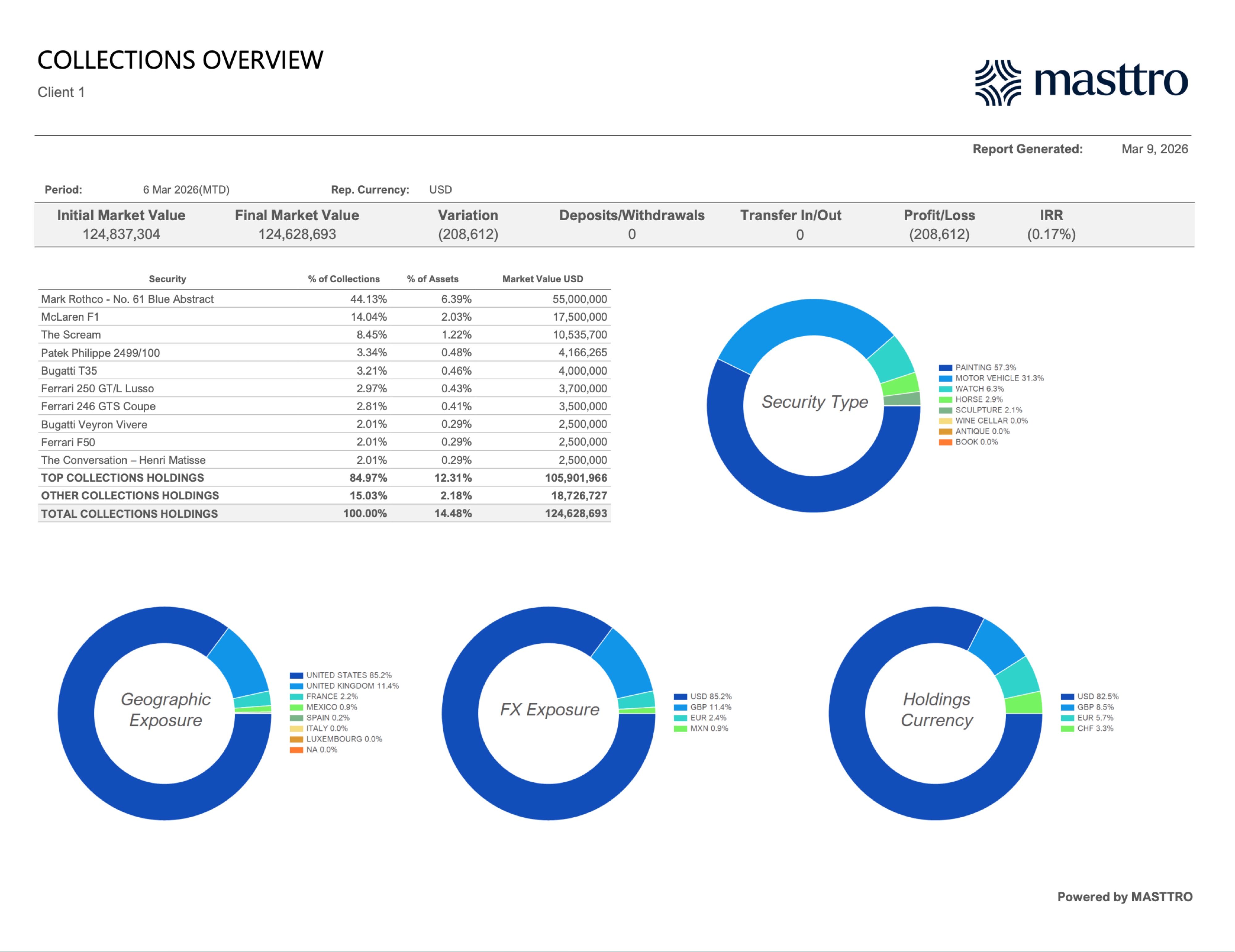
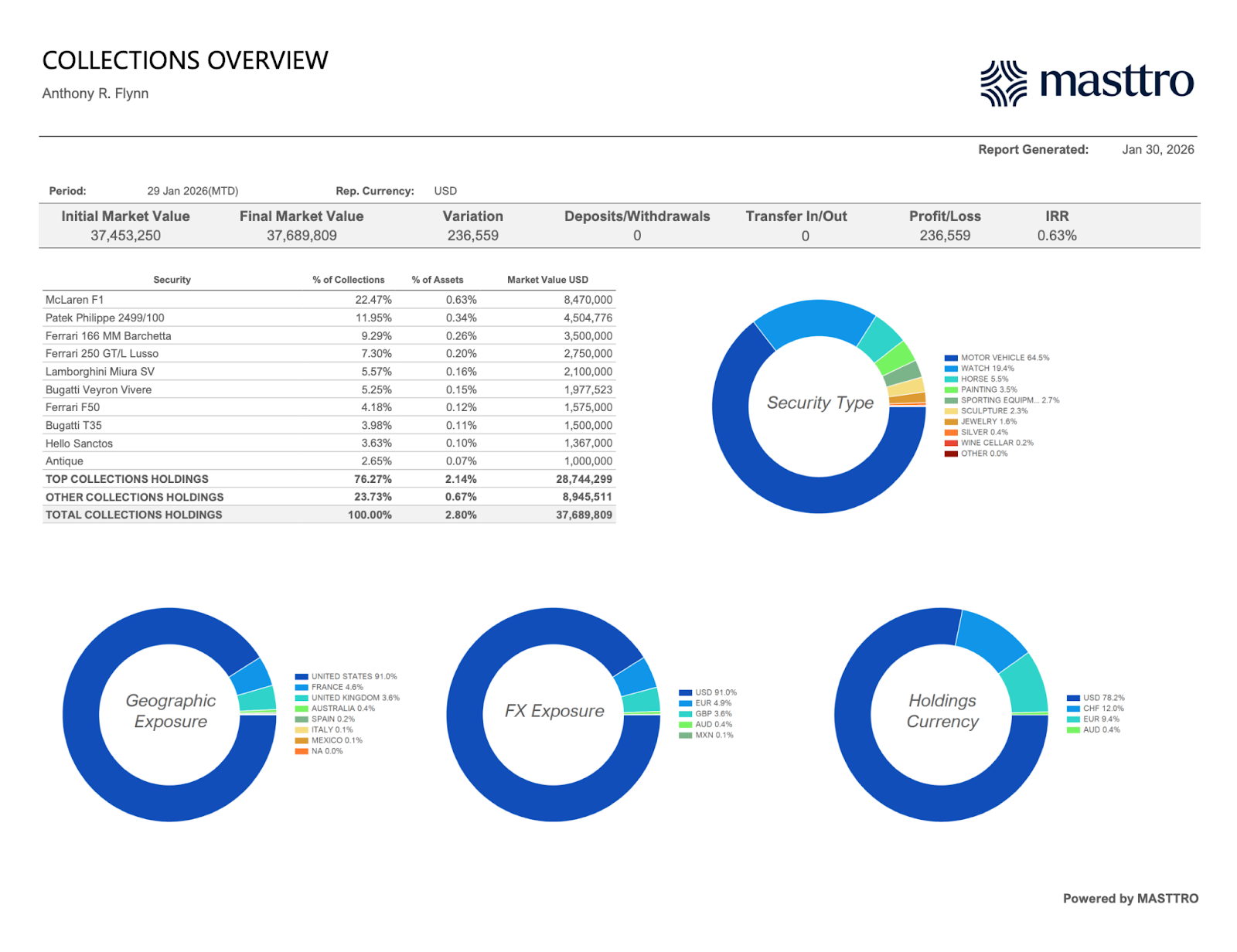
At Masttro, our Collections Overview Report provides a consolidated view of non-financial assets. It's designed for principals and senior advisors who need clarity without asset-level detail.
What the report shows
Total collection value and performance metrics
- Initial and final market value for the reporting period
- Net variation and profit or loss
- IRR calculated at the collection level
Top collection holdings
- Ranked view of the most valuable individual assets
- Percentage of total collections and total assets
- Clear separation between top holdings and the long tail
Asset type composition
- Breakdown by category including watch collections, works of art, jewelry, fine wine, and more.
- Immediate visibility into concentration by asset type
Geographic exposure
- Asset location by country
- Insight for insurance planning, custody review, and risk assessment
Currency exposure
- FX exposure based on asset location and valuation currency
- Holdings currency view to understand conversion impact
Why it matters
This report brings institutional discipline to collections that are managed outside core systems. Families and advisors gain clarity into value, concentration, and exposure. All without relying on spreadsheets or disconnected inventories.
They get an auditable snapshot of collections as part of total wealth. All ready for succession planning, review, and decision-making.
“We went from having no consolidation tool or data feeds to having both capabilities in a single platform - that also happens to track private equity investments perfectly.”


Five Dashboards Every Wealth Owner Needs

Inventory Report
The Inventory Report replaces scattered spreadsheets and manual logs with one maintained record. Each asset is documented the same way. Risk reviews, planning work, and reporting can include non-financial assets alongside the portfolio.
Portfolio Summary
This section frames the scale of the collection before reviewing individual assets.
It includes:
- Total number of collection assets
- Aggregate cost basis and market value
- Share of total portfolio assets
- Reporting currency and period
For wealth owners holding passion assets across multiple categories, inventory reports can organize holdings by asset type and include visual documentation of each item. Common categories include fine art, jewelry and precious items, watches, motor vehicles, and horses.
Fine Art Inventory
Paintings and sculptures
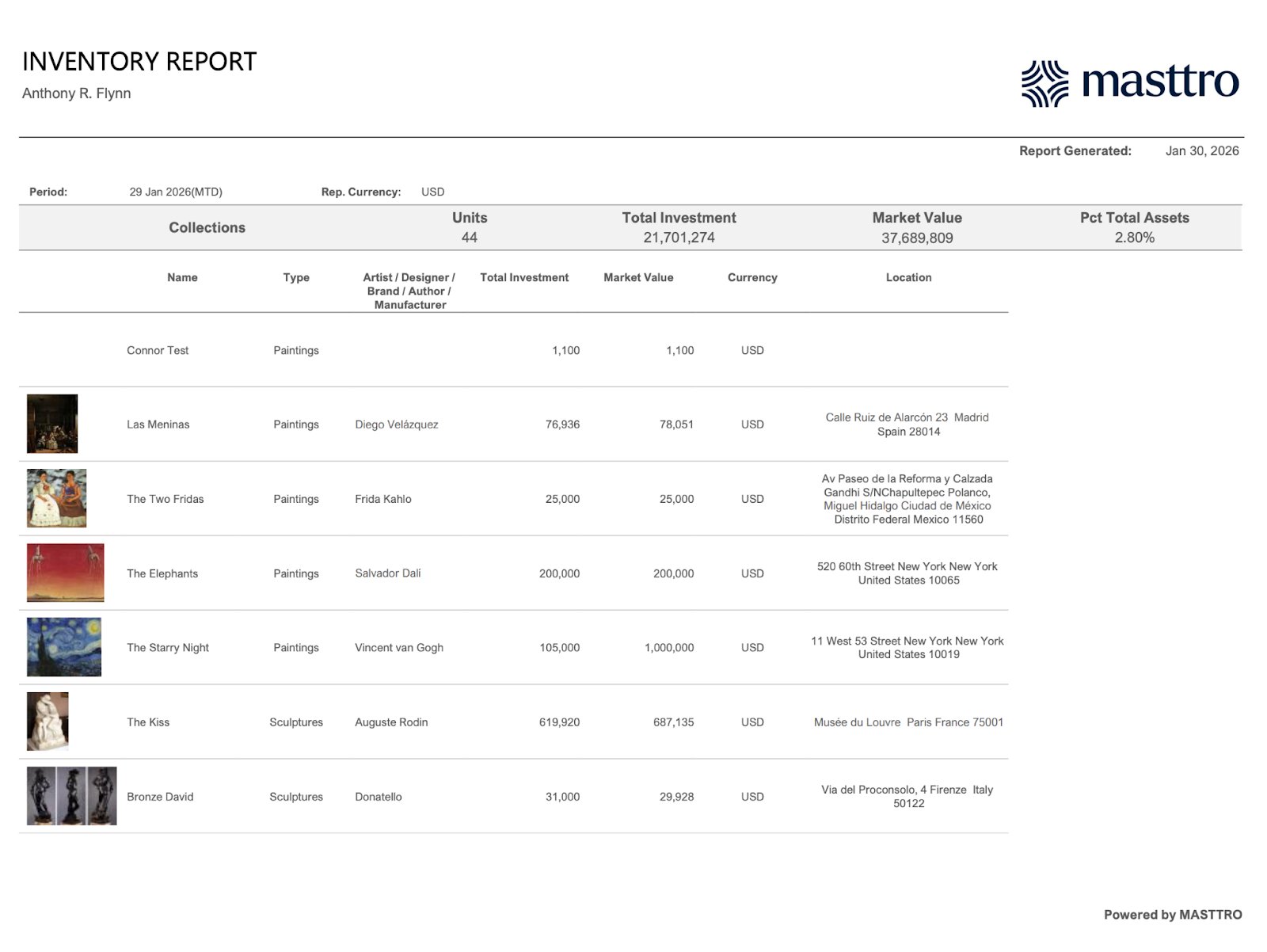
This section lists individual artworks with consistent attribution and valuation fields.
Includes:
- Artwork name and medium
- Artist or creator
- Total investment and current market value
- Currency and physical location
Used for valuation tracking, provenance review, and coordination with appraisers and insurers.
Jewelry and Precious Items
Jewelry and silver collections
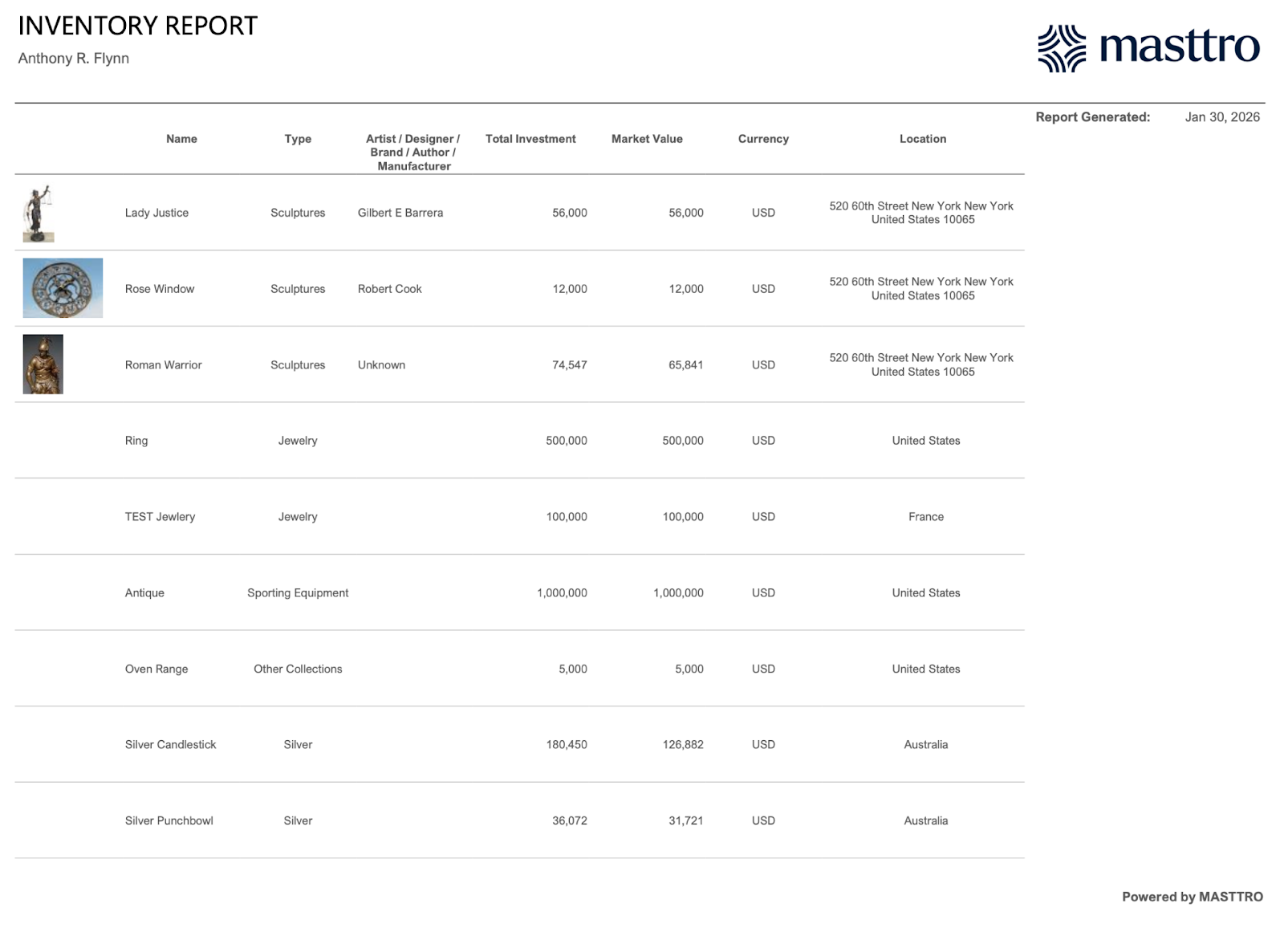
This section captures high-value portable assets that require tighter documentation and custody oversight.
Includes:
- Item name and category
- Total investment and market value
- Currency
- Location
Supports insurance scheduling, estate documentation, and audit readiness.
Watches Inventory
High-value timepieces
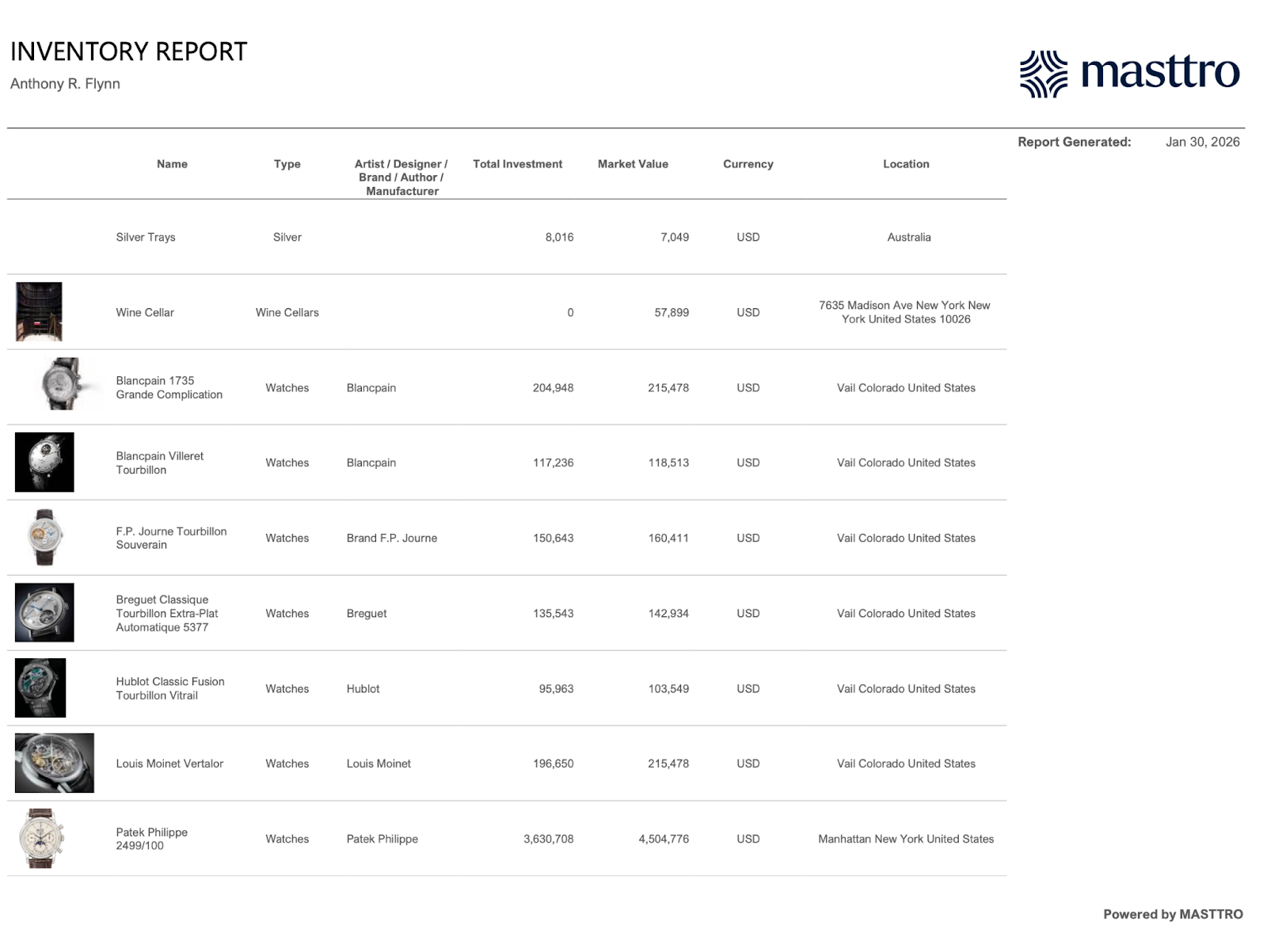
This section provides a structured register of collectible watches.
Includes:
- Brand and model
- Total investment and current market value
- Currency
- Location
Used to track appreciation, geographic dispersion, and concentration.
Motor Vehicles
Collector vehicles, super cars, and luxury automobiles.
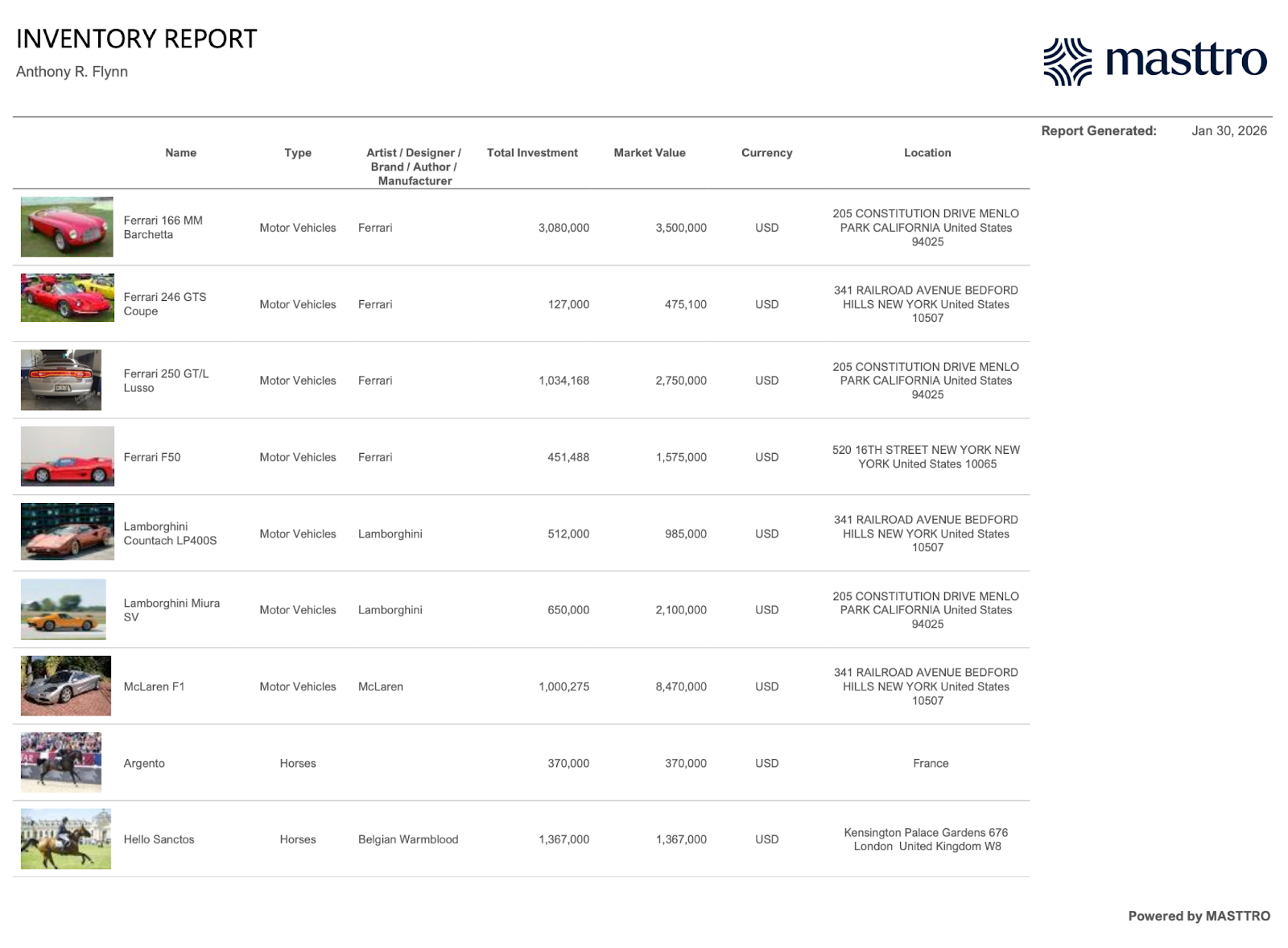
This section documents automotive assets held within the collection.
Includes:
- Vehicle make and model
- Manufacturer
- Total investment and market value
- Currency
- Storage location
Supports insurance review, custody planning, and concentration analysis.
Horses and Sporting Assets
Equine and sporting collections

This section documents living or performance-based assets.
Includes:
- Asset name and category
- Breed or classification
- Total investment and market value
- Currency
- Location
Used for operational oversight, insurance coordination, and estate continuity planning.
Why the Inventory Report Matters
The Inventory Report replaces spreadsheets and manual registers. It offers a single, auditable source of truth for assets under management. Every asset is documented consistently. That makes it easier to manage risk. You can also improve support, and integrate non-financial assets into total wealth reporting.
Fact Sheet Report
Single-Asset Clarity for Complex Collections
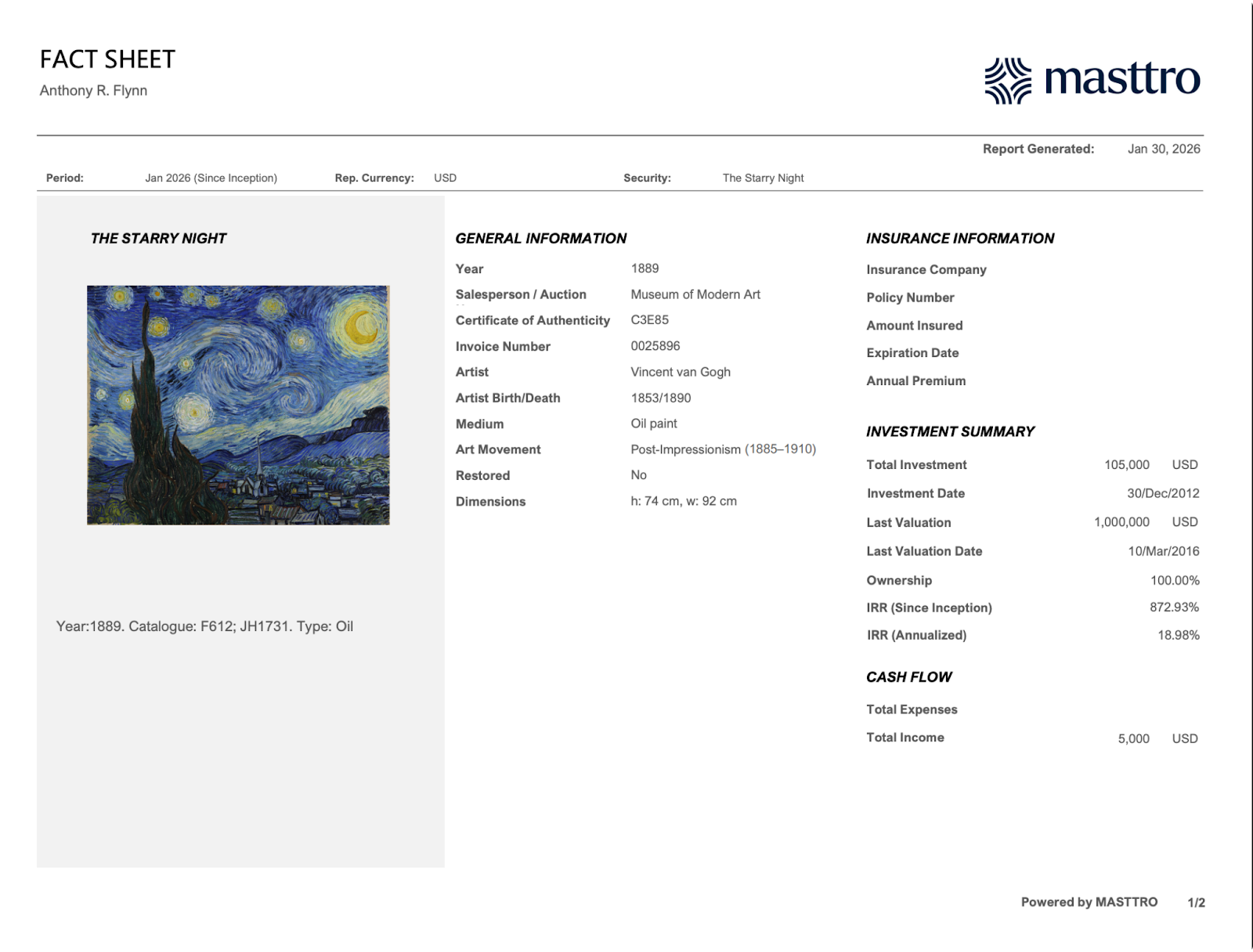
The Fact Sheet Report provides a complete, asset-level view of a single collection holding. It is designed to stand alone as a shareable, decision-ready record.
Asset Identification and Visual Context
Each fact sheet opens with a clear visual reference. A large image anchors the report alongside the asset name and category. Supporting notes highlight distinguishing details such as rarity, condition, or historical context.
This removes ambiguity and allows stakeholders to immediately confirm the asset being reviewed.
General Information and Specifications
This section documents the defining characteristics of the asset. Fields adapt based on asset type.
Examples include:
- Who created fine art, when it was made, what it’s made of, its style, size, and how authenticity is documented.
- Vehicle make and model, engine and chassis numbers, originality, and current condition.
- Wine collection attributes tied to storage
- Equine details like registration, breed, pedigree, discipline, and status
This serves as the authoritative reference for provenance and classification.
Insurance Information
Insurance data is centralized directly on the fact sheet.
Captured fields include:
- Insurance provider
- Policy number
- Insured value
- Expiration date
- Annual premium
Keeping this information alongside the asset reduces risk and simplifies coordination with insurers.
Investment Summary and Performance
This section quantifies how the asset has performed over time.
It includes:
- Total investment
- Acquisition date
- Most recent valuation and valuation date
- Ownership percentage
- IRR since inception
- Annualized IRR
This makes it easy to assess how a single asset contributes to overall wealth. It may also guide future investment decisions.
Cash Flow Tracking
For assets with ongoing economics, the fact sheet tracks:
- Total expenses
- Total income
This provides clarity into carrying costs, monetization, and net impact over time.
Why the Fact Sheet Matters
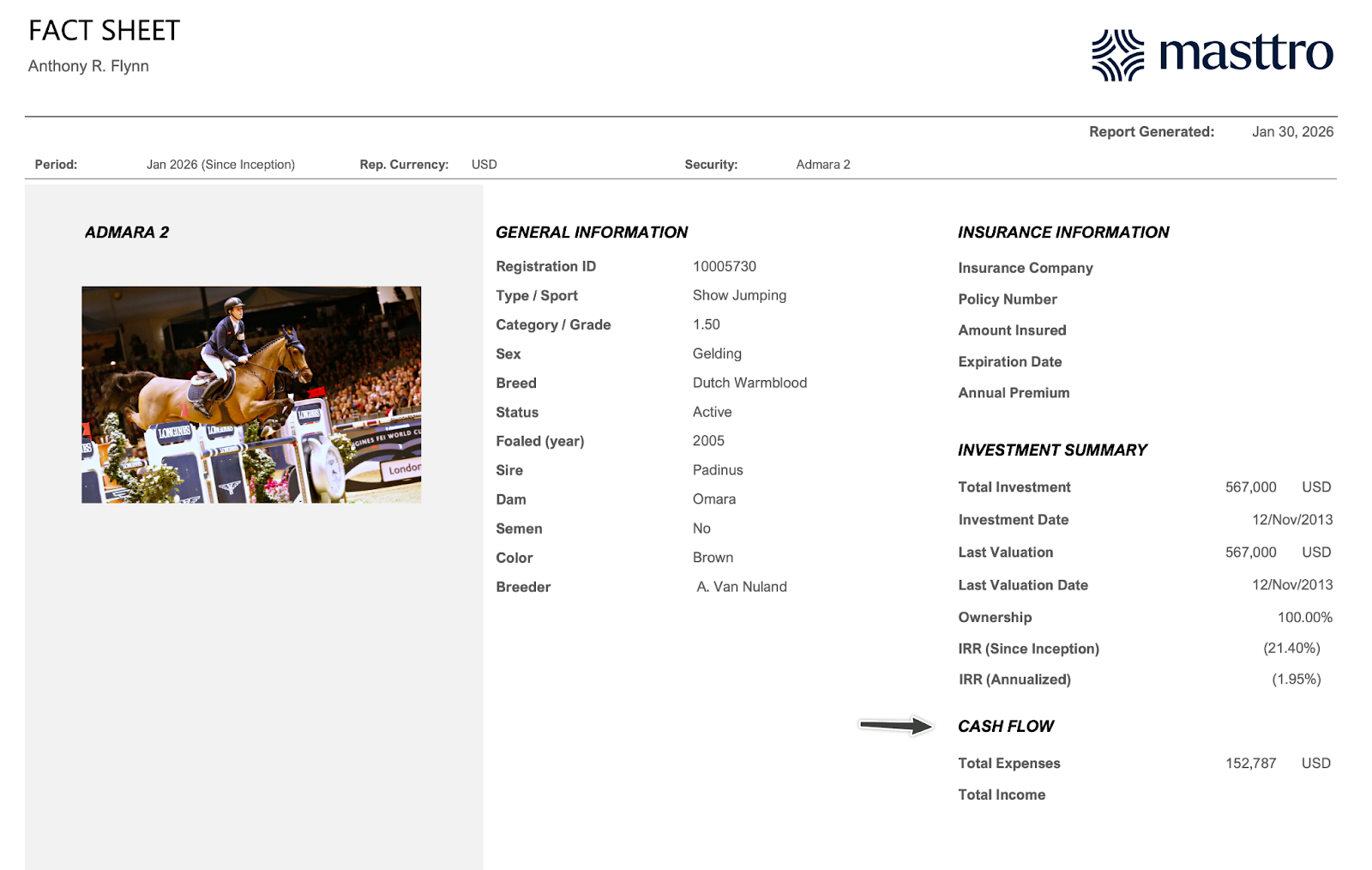
The Fact Sheet Report turns a single collection asset into a fully documented, auditable record. Visual context, specifications, valuation, insurance, and performance live in one standardized format.
This comes together in a cleaner workflow, stronger documentation, and greater confidence. That makes all the difference when managing high-value non-financial luxury assets.
Purpose-Built Reporting for Modern Family Offices
Family offices need passion assets to be managed with the same structure and accountability as the rest of the estate. When these assets sit outside core reporting systems, visibility fades and planning becomes reactive. Purpose-built family office software brings collections, inventories, and individual asset records into one unified reporting environment, aligned with how portfolios, entities, and alternatives are already managed.
Valuations, documentation, insurance, and performance remain connected and current, allowing non-financial assets to be reviewed, governed, and planned as part of total wealth. This creates clearer oversight today and a more durable framework for long-term preservation and generational planning.
To see how this works in practice, explore our guided product tours.
“[We like] how customizable it is and the ability to load information regarding non-financial assets.”
“I appreciate the ease of use and the pre-produced library of reports that Masttro provides. It has significantly streamlined our processes, allowing us to produce reports in minutes that would have taken hours before.”
"I find Masttro simple to use. It's great because it allows us to keep all our assets in one place and use it as a repository for documents, track investments, and create dashboards and reports on assets."