"I start getting bombarded with documents from all these different things and I'm like — did I send this one out? Sometimes you have so many accounts you forget." — Family Office Principal
For many family offices, it takes more time and effort to produce a real estate report than the CFO would like to admit. The reason for this is usually something like: "It depends on how many things need chasing." And things often need chasing.
The real bottleneck is that the data that drives real estate reporting doesn't live in one place. It lives in custodian portals, fund administrator statements, and in some cases spreadsheets which only one person knows how to use. Every time a report is needed, the consolidation process across these data sources begins again at zero.
Key Takeaways

It’s a case of tooling that’s not keeping up with the times. The Excel-and-email infrastructure that most family offices rely on was designed for a different era of complexity.
In 2005, a family might have had ten to fifteen holdings across two or three custodians. Today, a family with comparable inflation-adjusted wealth might hold positions across seven or more legal entities, twenty-plus alternative investments with irregular valuation cycles, real estate in multiple states, and direct stakes in private companies.
So, even when the wealth level is comparable, the infrastructure required to manage it is not.
What Problems do Family Offices Face when Reporting on Real Estate?
1. The Fragility Problem.
The numbers in a real estate report are softer than they look. Property values are appraisals from a quarter or two ago, income figures lag whatever the operator most recently sent over, and cost assumptions often go untouched for a year at a time. The report can be technically correct and still describe the portfolio as it was nine months back. The real fragility is the gap between the model and reality, and it widens every quarter the data ages.
2. The Duplication Problem
In a typical family office reporting workflow, the same number gets entered multiple times before it ever reaches the family. It moves from the custodian portal into the consolidated model, then into the report template, and finally into a board presentation. Each leg of this journey is another opportunity for mistakes, typos, or formatting issues. By the time a data point is in front of the principal, it’s been duplicated across multiple systems, increasing the risk of errors.
3. The Time-horizon Problem
Quarterly reporting can consume entire teams. Instead of spending the last two weeks of every quarter rebuilding reports, team members should be communicating with fund managers, modeling new investment opportunities, or managing entity structures.
It may not seem meaningful that time and resources occasionally go toward tracking custodial statements that were emailed to the wrong address, or chasing down a K-1 that nobody logged. But multiply that across four quarters a year and you've quietly traded a meaningful chunk of the team's calendar for clerical work.
Why do Generic Wealth Tools Fall Short for Family Office Real Estate?
Not all reporting tools fail in the same way. It’s widely understood that Excel is fragile at scale, but even wealth management platforms that are marketed as upgrades to Excel often create a different set of problems — and for family offices specifically, those problems can be just as costly.
The core issue is that most wealth platforms were built for financial advisors managing large numbers of households with relatively standard portfolios. The reporting logic, the data models, and the entity structures are all designed for a world where complexity is related to the volume, not the depth.
Family office complexity is almost exactly the opposite: fewer entities, but extraordinary depth. Nested ownership structures. Alternatives with custom capital call schedules. Real estate with multiple ownership percentages across different trusts. Operating companies that blur the line between investment and business.
How Masttro Intelligence Generates Real Estate Reports with AI
Before getting into specific report examples, it helps to understand what makes Masttro Intelligence different from bolted-on AI features that other platforms are beginning to market.
Masttro Intelligence is not a general-purpose AI assistant that has been given access to some of your data. It is a purpose-built, agentic AI system that operates entirely within your Masttro instance — which means it only ever reads your data, never anyone else's, and every answer it gives is grounded in the actual positions, transactions, documents, and entity structures that have been built inside your platform.
Five Real Estate Reports You Can Generate with AI
The following are real report types that Masttro Intelligence generates from plain-language prompts. Each example includes the actual prompt your team might use and a description of what the output contains.
Report 01. Real Estate Portfolio Performance Summary
When you need it: Quarterly reviews, board meetings, principal briefings. Any time someone asks, "how is real estate performing?"
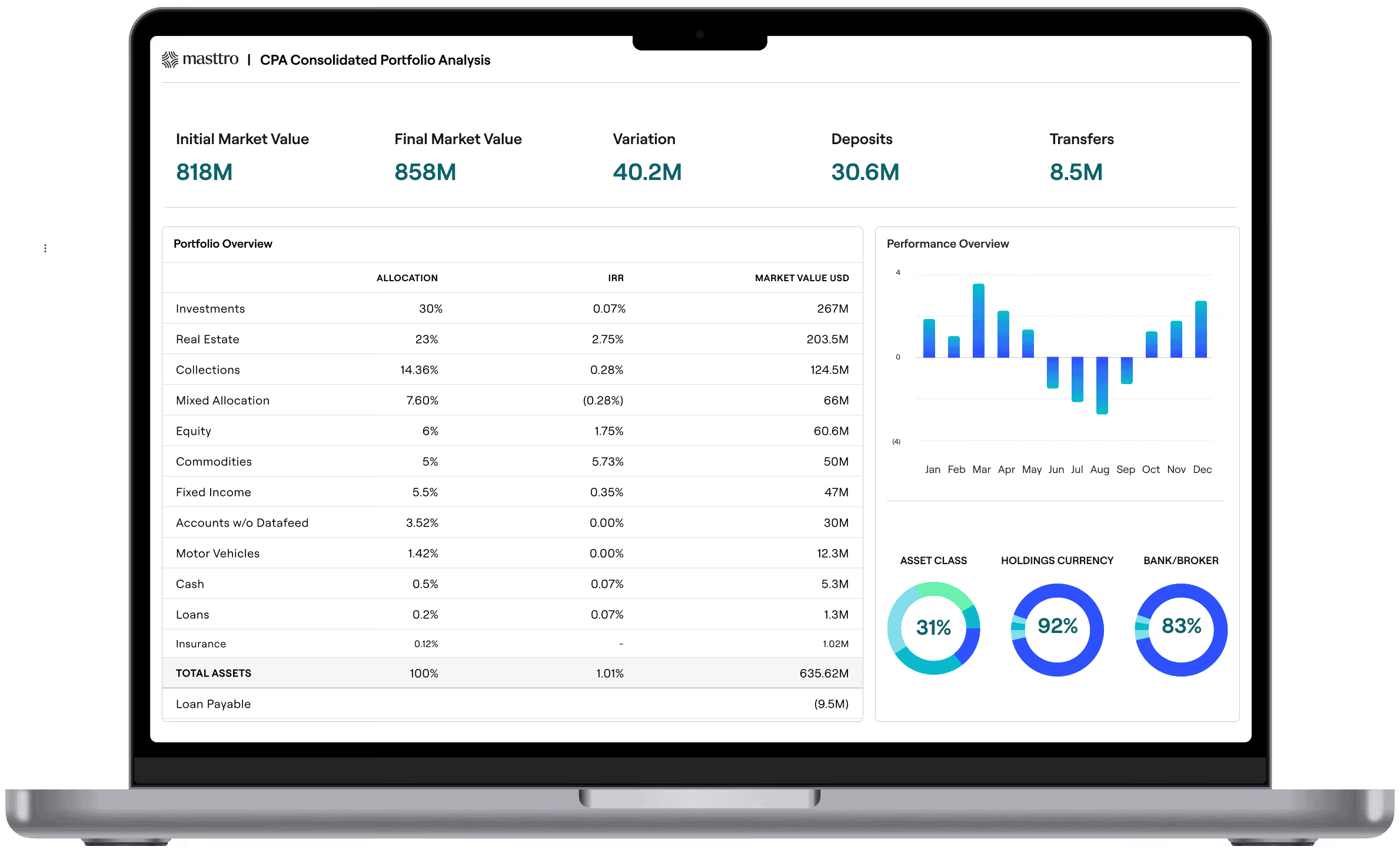
This is the foundational real estate report. It’s a consolidated view of how your positions are performing across your entire portfolio, benchmarked against the time horizon and comparison point you choose. Masttro Intelligence generates this by reading the position data, valuations, and transaction history that have been consolidated into your instance.
“Generate a real estate portfolio performance summary for 2025 — all properties, ranked by market value, gain and loss, IRR”

The output can be published directly to named recipients inside the platform — with commentary added before sending — or exported as a PDF or Excel file. It reflects data as of the moment you run it, not as of the last time someone manually updated a spreadsheet.
Report 02. Property-by-Entity Ownership Breakdown
When you need it: Tax planning, estate reviews, ownership structure analysis. Any time the question is not just "what do we have" but "who owns what, and in what structure."
Family offices organize real estate across multiple entities for estate planning, tax efficiency, and governance reasons. The result is that one family's real estate exposure might be distributed across a revocable trust, an irrevocable trust, an LLC, and direct holdings — each with different ownership percentages and tax treatment. Masttro's Global Wealth Map captures this structure at every level, and Intelligence can surface it in a single report.
“Show me all real estate holdings broken down by entity structure”

Report 03. Cash Flow & Income Report
When you need it: Tax preparation, liquidity planning, quarterly reviews. Any time you need to know what actually came in and went out — not just paper returns.
Real estate generates income in ways that are often difficult to track across a consolidated portfolio (e.g., distributions, dividends, capital returns, interest payments). The timing varies, the sources are numerous, and in a multi-entity structure the same cash flow event may touch several nodes in the wealth map. Masttro consolidates all of this and Masttro Intelligence makes it queryable in seconds.
“For Prologyc Industrial Park, summarize its investment summary, latest valuation, and recent transactions.”

Report 04. Property Documents — Deeds, Leases, Appraisals & Insurance
When you need it: Tax season. Audits. Due diligence. Any time someone asks "where is that document?"
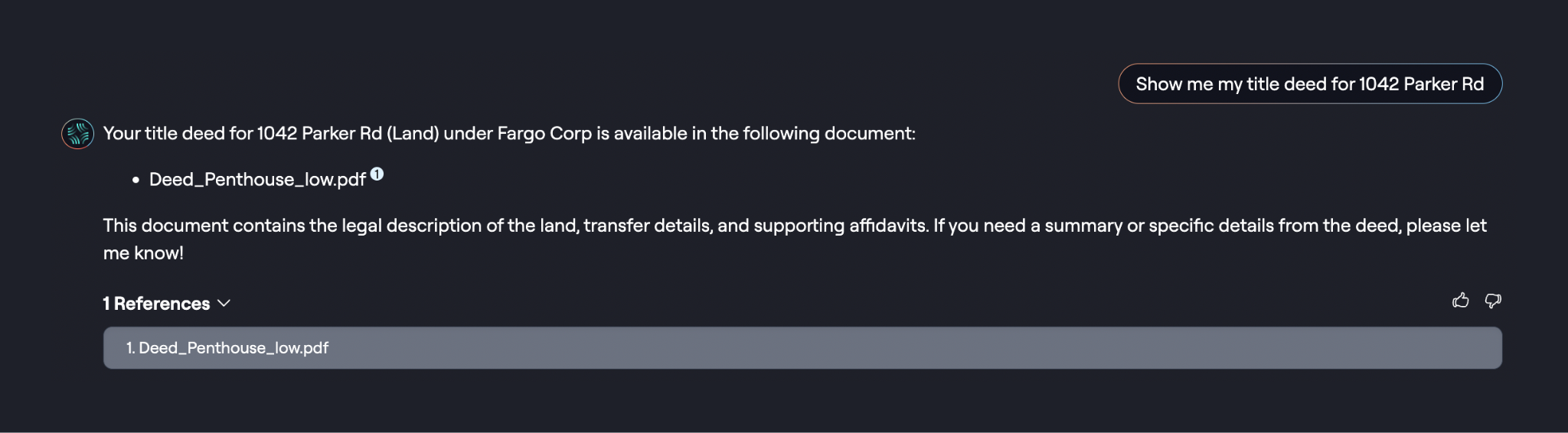
This is among the most time-saving features of AI for teams that spend significant time hunting down documents. Every property in Masttro can have documents stored directly against it — statements, K-1s, agreements, deeds, appraisals, insurance policies, amendments — and Intelligence can surface any of them with a natural language query.
“Show me my title deed for 1042 Parker Rd”
Report 05. Principal Real Estate Brief — On Demand
When you need it: Any time a principal asks a question and doesn’t want to wait three days for a report cycle.
This is the report that changes the relationship between a principal and their wealth data. It’s not a scheduled quarterly document or a formatted briefing that the team spent a week assembling. Teams can now provide live, accurate, plain-language answers to questions the principal is actually asking, at the moment they are asking.
Family office operators consistently describe the same pressure: the principal calls, asks a question, and the answer requires a manual data pull. The principal gets an answer two days later, by which point the conversation has moved on. Masttro Intelligence means the answer is available in sixty seconds, whether the question comes from the principal directly or from their team.
“Give me a plain-English overview of our real estate — what we own, how it's performing, and anything I should know heading into Q1”

When a principal can ask their wealth platform a direct question and get a direct answer — on their phone, on a Sunday, before a Monday morning call — the family office stops running on a report-production cycle and starts running on a shared data layer. The principal stops being dependent on a weekly briefing cycle and starts having their wealth genuinely on demand.
Four Components to Managing Real Estate in Masttro
- When a fund statement, K-1, capital call notice, or any other document arrives — via email, manual upload, or automated feed — Masttro’s Documents AI reads it, classifies it, identifies which investment vehicle it belongs to, and stores it linked to that position. With each new document that’s ingested, Masttro updates valuations, capital call balances, and commitment amounts without manual intervention.
- The Reports Playground is a conversational interface for generating structured reports from your data. You describe what you want — time period, asset class, entity filter, output format — and the system generates a PDF or Excel file. No template to configure. No data to pull manually. You can ask for a cash flow report for the last two quarters, an equity detail report for Q4 sorted by sector contribution, or a portfolio summary filtered to a specific trust structure. Masttro builds it.
- The Platform Assistant is a free-form conversational interface that can read every record in your platform and use the data to answer any question. The assistant can build interactive dashboards, surface comparative performance analysis, answer follow-up questions, and iterate on outputs based on your feedback. One prompt can produce a complete dashboard. The next prompt can add a drill-down table. The system will ask clarifying questions if it needs more context.
- Client Documents gives anyone on your team — or the principal directly — the ability to search across all stored documents in natural language. "Show me the most recent homeowner's insurance policy for the property on 32nd Street" returns a direct link to the document. No folder navigation or searching through inboxes. The document is there, versioned, and current.
What we hear from users switching from competitors
Addepar is a capable platform for many institutional use cases. But family offices who've used it consistently describe the same friction: it's powerful, but it requires significant internal expertise to configure and maintain. Reporting customization requires a technical user. Entity structures need to be rebuilt manually. Alternative data often still requires manual tracking outside the platform. When we ask prospects what made them start looking for alternatives, the most common answer is: "We were spending more time maintaining Addepar than we were using it."
The deeper problem is that most platforms treat reporting as an output of a static system. You configure a report template. You run it and get a document. If the document doesn’t answer your question, that means building a new template, which means you're back to a technical configuration task rather than getting an answer.
AI changes the equation. Instead of a static library of report templates, you have a system that understands your data and can answer questions about it in natural language. The question "how much in distributions did we receive from real estate across all entities in the last two quarters?" doesn't require a new template. It requires a well-structured prompt and a platform that has all that data consolidated in one place.
Case Study: Futura Asset Advisors Multi Family Office

Generate your Real Estate Management Reports on Demand
There's a version of your family office where the principal can pick up their phone and ask a question — any question, at any time — and get a direct, accurate, comprehensive answer in under a minute. In this world, your team spends their time on strategy, communication, and execution rather than on chasing statements and rebuilding models.
That version isn't theoretical. It's what family offices running Masttro experience today.
The real estate reporting use case is one of the clearest demonstrations of AI’s impact across wealthtech. Because real estate has always carried an outsized reporting burden involving more data sources, more document complexity, and more manual tracking, the contrast between the old way and the AI-powered way is stark.
The question for family offices and wealth advisors that haven't made the shift yet is a straightforward one: how many more quarterly reporting cycles are you willing to absorb before the cost of switching is lower than the cost of staying the same?