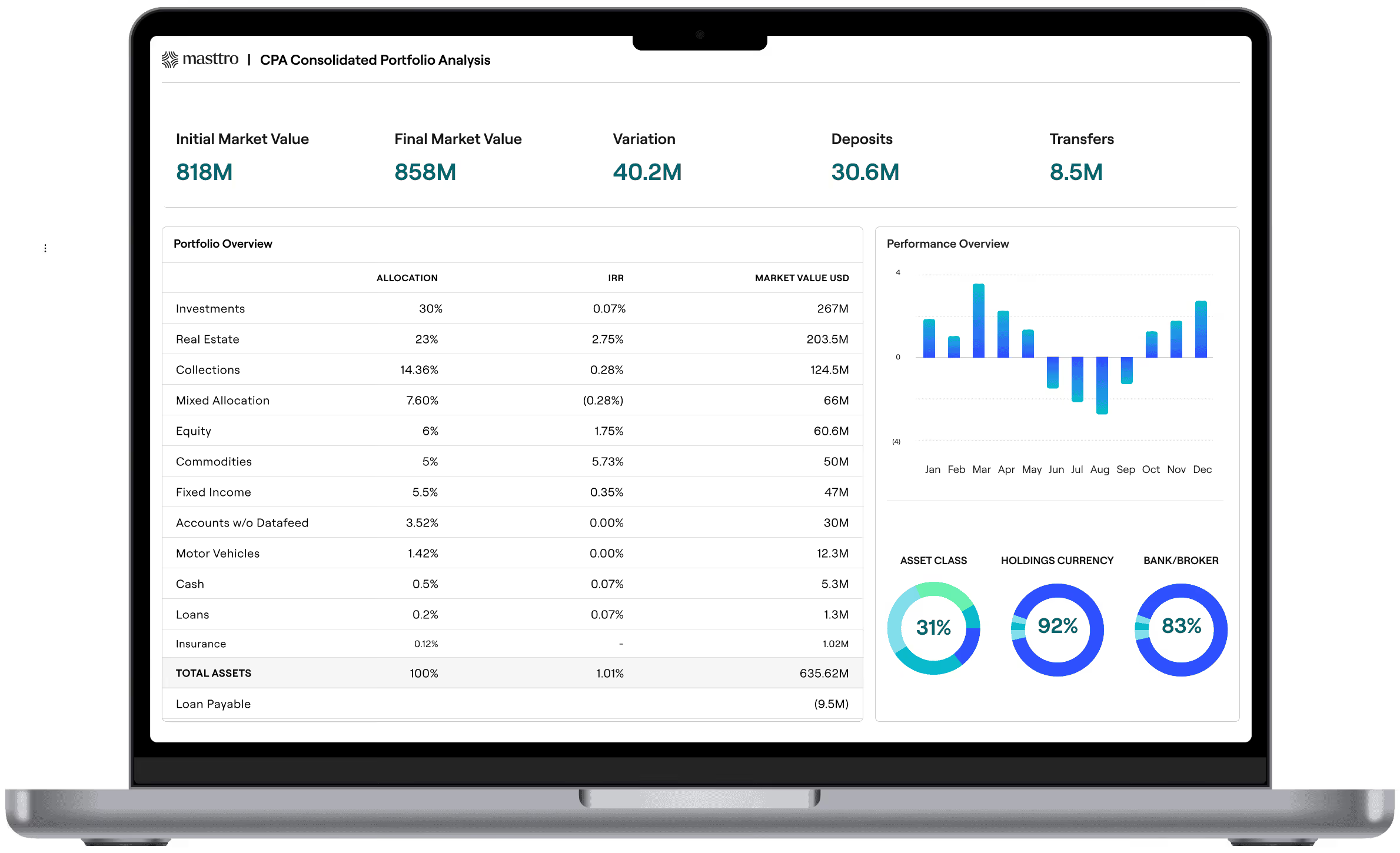
AI reporting is the difference between your team spending their Sunday recreating a report from scratch versus them pulling a board-ready brief in sixty seconds. With Masttro Intelligence, conversational AI even operates directly inside your wealth data, enabling insights and answers to be surfaced without formal, structured reporting.
Key Takeaways

Quarterly reporting used to take a week. Now it takes a prompt.
The reporting burden at a family office scales with complexity. For decades, that has meant pulling data from multiple custodians, rebuilding excel models, and praying that nothing changes overnight.
With a platform like Masttro, your data is already unified and queryable with AI, empowering anyone on your team to get answers in plain language. Reports, dashboards, and answers are now continuously available resources rather than point-in-time snapshots.
These aren’t hypothetical capabilities. Each of the following reports can be generated inside Masttro Intelligence using conversational prompts — pulling directly from your automatically-ingested, consolidated data.
Why does AI reporting matter for family offices right now
Reporting demands have scaled with complexity in family offices, but the workflows have not kept up. Controllers and analysts still spend hours on data assembly — pulling statements, normalizing formats, reconciling positions, and rebuilding the same workbooks they built the previous quarter.
When the data is already unified inside Masttro — custodian feeds, manager statements processed through Document AI, entity hierarchies, ownership percentages, beneficiary mappings — the team’s focus shifts to asking the right question, instead of chasing the underlying numbers. The principal can ask for a real estate snapshot in plain English, and get one. The controller can ask for a cash flow projection through quarter-end, and get one.
The strategic shift is happening: operations teams are now decision-support centers rather than reporting factories.
How does Masttro Intelligence work under the hood?
AI is only as useful as the data it sits on. Most LLM reporting demos fall short the moment a family office tries them on real data because the underlying entity structure isn’t actually consolidated.There is no single source of truth for the model to query.
Masttro Intelligence is different because the platform underneath it is doing the unglamorous work first:
- Data ingestion runs across direct custodian feeds, manager portals, manually uploaded statements, and bespoke flat files
- Document AI parses unstructured fund statements, K-1s, capital calls, and distribution notices into structured positions, cash flows, and commitments
- The wealth map ties every position to its legal owner, ownership percentage, and entity hierarchy
- Reconciliation runs continuously, so the data the AI sees today reflects yesterday’s prices and last night’s cash movement
- Permissions are enforced at the entity and field level. The AI returns only what the user is already authorized to see in the platform
This all means that prompting the AI isn’t asking the model to guess. It’s asking it to query a clean, auditable, permissioned dataset and render the result.
1. Net Worth and Portfolio Holdings
The most common question a principal asks is also the simplest: what do I own, and how is it doing?
Historically, answering this required pulling positions from every custodian, marking them to current prices, layering in alternatives at last reported NAV, and rendering the result in a clean table.
With Masttro Intelligence, it’s a single prompt in plain English.
Example prompt:
“What are the top 10 holdings by market value? Show as a table, include cost and profit/loss, sort by profit/loss.”
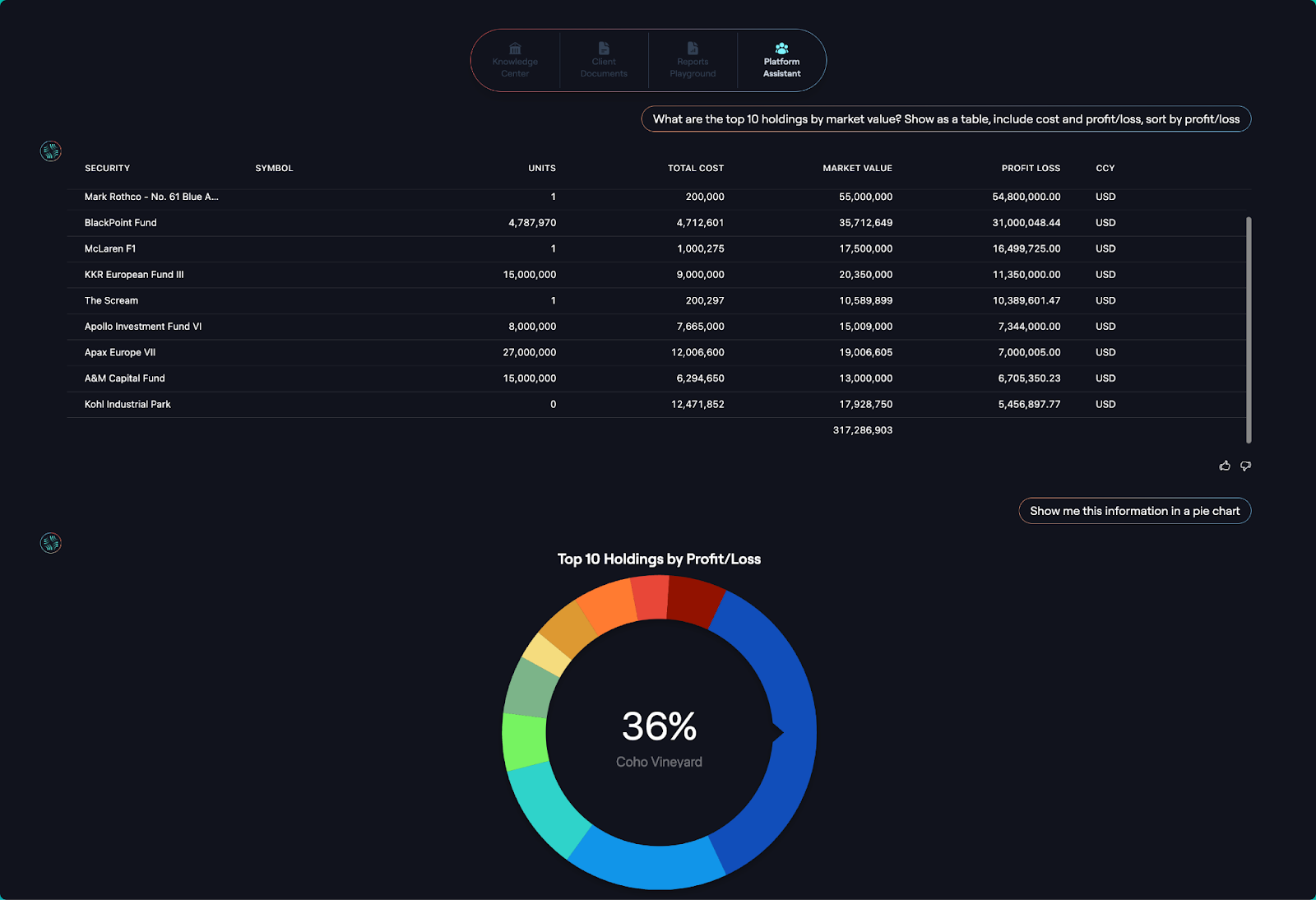
The output is a ranked table with current market value, cost basis, and unrealized gain or loss for every position. It’s pulled from the up-to-date, consolidated wealth map and adheres to user permissions on entity visibility.
Useful follow-ups:
- “Now show the same table but only for positions inside the Greenfield Trust”
- “Break down the top 3 holdings in each asset class with a pie chart”
- “Add a column showing percent of total portfolio for each holding”
This is the report a wealth owner uses to start a conversation. It’s also the one a CIO uses to start a rebalancing review.
2. Private Investment Performance Report
Family offices often hold significant alternative allocations. That means tracking committed capital, capital called, unfunded commitments, and MOIC across dozens of funds.
Masttro Intelligence consolidates all of this data — updated automatically via Document AI as fund statements arrive — and lets you pull a ranked performance table across your entire alternatives book in seconds.
Example prompt:
“Show me my top 10 private equity holdings over the past year.”
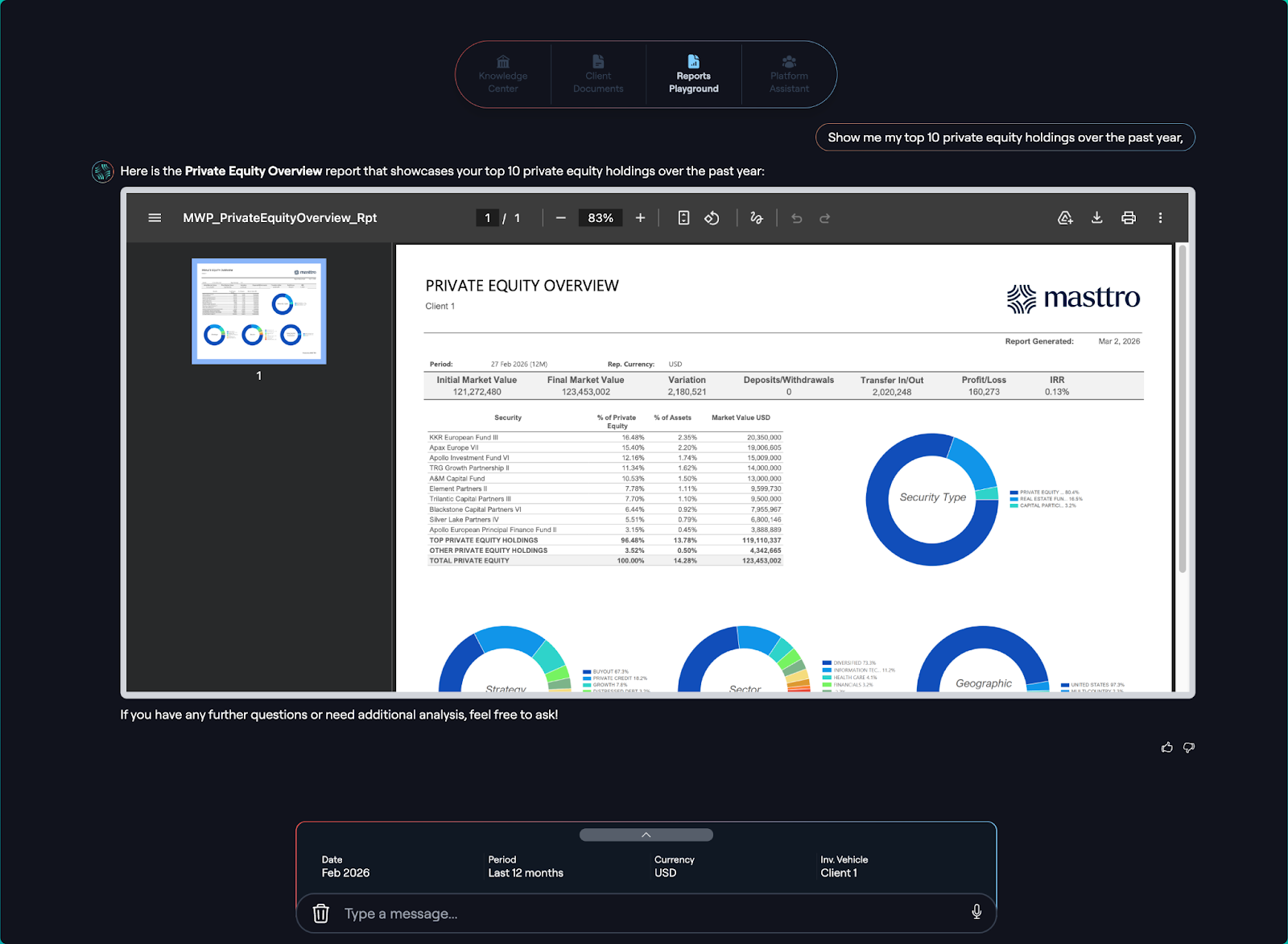
The model returns a ranked table by performance, with commitment, called capital, distributions, current NAV, MOIC, and IRR. Because Masttro maintains the full cash flow history for each fund position, the IRR is a true money-weighted return, not a guess based on NAV deltas.
Useful follow-ups:
- “Filter to funds with vintage years 2018 through 2021”
- “Show me unfunded commitments across all PE funds and the expected call schedule for the next four quarters”
- “Which managers are above and below their target return for the strategy?”
A quarterly alternatives review takes your controller three days to assemble. With Documents AI, a version can be ready in ninety seconds.
3. Equity Detail and Benchmark Attribution Report
Understanding the performance of your public equity portfolio involves more than a market value snapshot. Masttro lets you build custom-blended benchmarks from any Bloomberg-tracked index and measure your holdings against them.
You can take this even further with Masttro Intelligence. Ask for sector-level contribution, top and bottom performers, or a benchmark attribution analysis and get it formatted exactly how you want.
Example prompt:
“Generate an equity detail report for Q4 2025 showing performance by sector versus our blended S&P/Russell benchmark.”

The output is a structured attribution table: portfolio return by sector, benchmark return by sector, allocation effect, selection effect, and total contribution. The CIO can read this and immediately see whether outperformance came from sector tilts or stock picks.
Useful follow-ups:
- “What were the five largest contributors and five largest detractors at the security level?”
- “Show the same view for the trailing 12 months instead of Q4”
- “Compare our equity book’s volatility to the blended benchmark”
This is the analytical layer that distinguishes a reporting tool from an investment platform. The conversation can keep going until your question is actually answered.
4. Cash Flow and Distribution Summary by Entity
During quarterly close and tax season, family office operators need a clear picture of what came in, what went out, and from where. Masttro consolidates cash flow data across every entity in the wealth map — operating companies, trusts, real estate holdings, investment accounts — and Intelligence lets you interrogate it across any time window. Get a distribution summary from a specific fund, or a consolidated cash flow view across all entities, with a single prompt.
Example prompt:
“Show me a cash flow projection through the end of the quarter.”

The output combines known scheduled inflows (interest, dividends, expected fund distributions) with known outflows (capital calls, recurring expenses, scheduled distributions to family members) to produce a forward-looking liquidity view by entity and by week.
Useful follow-ups:
- “Which entities are projected to have a cash shortfall before quarter-end?”
- “Pull all distributions from Apollo Fund IX over the last three years”
- “Show me realized vs. unrealized income year-to-date for tax planning”
The tax team uses this view to anticipate estimated payments. The CFO uses it to manage liquidity across entities without selling positions to fund a call.
5. Global Wealth Map Consolidated Report
Principals and family members don’t want to wade through raw data. They want a clear picture of the whole. Masttro’s Global Wealth Map report pulls every node of the entity structure into a single view, including market value, percent of assets, and total cost.
The report also offers a category breakdown across alternatives, real estate, marketable securities, financials, and loans. Masttro Intelligence can generate all of this with narrative commentary in seconds and publish it directly to named recipients within the platform.
Example prompt:
“Build our Q4 family wealth summary — consolidated across all entities, with market value and asset class breakdown.”

The output is the report the family actually wants: total wealth, change versus prior quarter, asset class allocation with target ranges, top-level entity breakdown, and a short narrative summarizing the quarter’s drivers. It exports as a branded PDF for the family meeting or as an Excel workbook for the office.
Useful follow-ups:
- “Add a year-over-year comparison column to the asset class breakdown”
- “Generate the same report but split by branch of the family”
- “Publish this to the next-gen group’s portal but mask absolute dollar values”
This is the report that used to take a week to assemble. It is now the starting point of the conversation, not the deliverable.
6. Real Estate Portfolio Table
Real estate creates a documentation burden unlike any other asset class. Appraisals, leases, insurance policies, work orders, and loan documents, all tied to properties, may sit inside multiple entities at varying ownership percentages. Masttro Intelligence can pull a real-time table of your full real estate portfolio, including valuations, ownership percentages, and direct links to stored documents, all in a single conversational query. It knows which documents are current, which are amended, and where they live.
Example prompt:
“Show me a table of my real estate assets and a pie chart based on market value per security type.”

The output is a property-by-property table with current appraised value, original cost, ownership entity, ownership percentage, mortgage balance, and a clickable link to the most recent appraisal document — alongside a visual breakdown of the portfolio by property type.
Useful follow-ups:
- “Pull the most recent insurance certificate for every property”
- “Show me which appraisals are more than three years old”
- “What’s my total mortgage exposure across the real estate book, by lender?”
For the operating team, this turns a quarterly document audit into a five-second query.
7. Risk Analysis by Country, Sector, or Counterparty
Risk concentration is the question principals ask after a headline. When a country, sector, or counterparty starts showing up in the news, the family wants to understand the exposure now. They do not want to wait until after the analyst has rebuilt a roll-up workbook.
Example prompt:
“Show a table of all the holdings with risk country exposure to United Kingdom and a market value chart, excluding Helix Tower.”

The output is a filtered table of every position with material UK exposure, with an option to exclude specific holdings that the user has already accounted for. Because Masttro tags every position with country, sector, currency, and counterparty exposure, the query runs against the full book, with public equities, private funds, real estate, and operating company stakes all accounted for.
Useful follow-ups:
- “Now show exposure to the same sector but in every other geography”
- “What’s our total counterparty exposure to a single prime broker?”
- “Run a 10% drawdown scenario on the UK book and show the impact on total net worth”
The Four AI Tools Inside Masttro Intelligence
Masttro Intelligence isn’t a basic AI chat. It’s a set of four purpose-built AI tools that can access and analyze the same secure data that powers the global wealth map. Each is designed for a different user and a different question.
Knowledge Center
A Masttro-native assistant that walks any team member through platform navigation — find investment vehicles, locate documents, understand entity structures — without training. The Knowledge Center is what new analysts use in their first week to find anything in the platform without asking a senior operator.
Client Documents
Search across every stored document in your instance in plain language. Ask for your most recent homeowner’s insurance policy. Get a direct link to the file — instantly. Document AI has already extracted dates, parties, amounts, and document types, so a query like “show me every loan document maturing in the next 18 months” returns the actual list, not just a search result.
Reports Playground
Generate any report — equity detail, cash flow by quarter, alternatives performance, entity-level P&L — directly from a prompt. Outputs as PDF or Excel with one click. The Playground is what controllers use to replace the recurring “rebuild the same workbook” task. Once a useful report is generated, it can be saved as a template and rerun by anyone on the team with the same prompt.
Platform Assistant
Free-form conversational AI that builds interactive dashboards, surfaces custom performance tables, and answers complex cross-portfolio questions — all from natural language. The Platform Assistant is the surface principals and CIOs actually use day to day. It’s the one that turns “how are we doing?” into a board-ready answer in the time it takes to type the question.
Permissions, Auditability, and What AI Does Not Do
Family offices don’t have a tolerance for AI that sees more than it should. Every prompt inside Masttro Intelligence runs against the same permission model that governs the rest of the platform: entity-level access, field-level masking, and named-recipient publishing. A next-generation family member asking the Platform Assistant for the family wealth summary sees only the branches and assets they’re authorized to see. The CIO asking the same question sees the full consolidated picture.
Every prompt is logged. Every output is auditable. Every report generated through the Playground records the underlying query, the data state at the time of generation, and the user who ran it — which means the report a family member sees today can be reproduced exactly tomorrow.
A few things AI does not do inside Masttro:
- It does not make investment decisions. Reports surface analysis. Allocation and trade decisions remain with the team.
- It does not invent data. If a position lacks a current price or an alternative lacks a recent NAV, the response flags the gap rather than fabricating a number.
- It does not bypass document custody. When a report links to a document, it links to the original — not a regenerated summary.
The goal is to remove the assembly step, not the judgment step.
How do you get started with Masttro Intelligence?
For existing Masttro clients, Intelligence is available inside the platform — no integration project, no new vendor, no additional data setup. The same wealth map and document repository that drive reporting today power every prompt.
For family offices not yet on Masttro, the path to AI reporting starts with consolidation. The investment is in getting the data right: custodian feeds, entity structures, ownership percentages, document repositories, and benchmark configuration. Once that foundation is in place, AI reporting becomes the natural surface on top of it.
The typical onboarding sequence is:
- Map the entity structure and ownership hierarchy
- Connect custodian and manager data feeds
- Process the historical document archive through Document AI
- Configure benchmarks, asset classifications, and reporting templates
- Roll out Intelligence to principals, family members, and the operating team
Most offices reach the point where they’re generating reports conversationally within the first quarter on the platform.
Building a Successful Family Office Tech Stack

Frequently Asked Questions
What kinds of reports can Masttro Intelligence generate?
Any report supported by the underlying data model — net worth, holdings, performance, attribution, cash flow, distributions, capital calls, real estate, risk exposure, document searches, and consolidated entity rollups. If the data exists in the wealth map, it can be queried in plain language.
Does the AI see data the user isn’t permitted to see?
No. Every prompt runs against the user’s existing entity and field-level permissions. A family member sees only their slice of the wealth map; the CIO sees the whole structure. The model cannot return data the user couldn’t already access through the platform UI.
How does this compare to general-purpose AI tools like ChatGPT or Copilot?
General-purpose models don’t have access to a family office’s consolidated, reconciled, permissioned wealth data. Masttro Intelligence is purpose-built on top of the wealth map, which is why the answers are precise, auditable, and board-ready rather than approximate.
Can outputs be saved as recurring reports?
Yes. Any report generated in the Playground can be saved as a template and rerun on a schedule, with the latest data, by anyone on the team who has permissions for the underlying entities.
Does AI replace the controller or analyst?
No. AI removes the assembly and formatting work — the parts of the job that scale poorly with complexity. Controllers and analysts spend the recovered time on judgment, exception handling, and decision support, which is the work that actually requires a human.
How fresh is the data behind a prompt?
As fresh as the source feeds. Custodial positions and prices update intraday on Masttro’s standard feeds; alternatives update as statements arrive and are processed by Document AI; manual entries update immediately when posted. Every response reflects the latest reconciled state.
The bottom line
Reporting used to be the workflow that defined the family office calendar. With AI sitting on top of a properly consolidated wealth map, reporting stops being a workflow at all — it becomes a question and an answer. The team that used to spend the week before a board meeting rebuilding workbooks spends it preparing the conversation those workbooks were supposed to enable.
Ask once. Get the answer you actually need.