
Tax loss harvesting seems straightforward at first: sell losing positions, capture the deduction, and reinvest strategically. But for family offices managing complex, multi-custodian portfolios, the execution gap between theory and reality can lead to lost alpha.
The first problem is reporting lag. Monthly custodial statements are backward-looking, and in volatile markets, a harvestable loss can appear, deepen, and reverse within days. By the time a portfolio manager reviews last month's data, the window has closed (and the potential tax benefit has been lost).
The second problem is wash-sale exposure. When trades execute across multiple custodians without a centralized view, identical or substantially similar securities can be purchased within the 30-day wash-sale window without anyone realizing it.
The IRS doesn't grade on effort. Wash-sale violations disallow the loss entirely.
The third problem is perhaps the least visible: manual reconciliation cost. As one analysis of family office data challenges notes, the operational burden of consolidating and reconciling fragmented data sources can consume more resources than the organization aims to save by tax loss harvesting.
In addition to creating reporting challenges, fragmented data actively undermines the after-tax alpha that sophisticated families want. Without some data aggregation capabilities, the reward for harvesting tax losses may not be worth the effort.
Key Takeaways

Data Aggregation: The 'Decision System' for After-Tax Alpha
Working with fragmented data makes manual tax loss harvesting more costly, but it also limits what you can actually do with the data. Rather than treating it as a backward-looking set of records, envision your data environment as a basis for proactive decision-making. The distinction matters because you need to look forward to see opportunities.
Traditional reporting tools look backward. A true data aggregation platform looks forward, consolidating positions, cost basis, and unrealized gains and losses across custodians in real time. The result is what many call a “single source of truth”: one unified data layer that eliminates the reconciliation delays and conflicting figures across spreadsheets which normally delay decision-making.
Without that unified view, harvesting opportunities often simply expire. In Q4 of each year, when most tax-loss selling activity takes place, resources tend to be spread thin and timelines tend to be compressed. Unless tax-loss harvesting opportunities are uncovered and planned for ahead of time, they may not be executable.
That’s why data aggregation for complex portfolios must include real-time cost-basis tracking. When a platform continuously monitors lot-level positions across all accounts, advisors can identify and act on harvesting windows intra-month, instead of just at quarter-end. Systematic opportunity identification is only possible when the underlying data is both complete and current.
Data aggregation infrastructure can also set the stage for an even more meaningful change: moving from reactive, year-end harvesting to a continuous, volatility-driven strategy.
Alternatives Reporting: From Below the Line to All of the Above

How to Move from Year-End to Continuous Harvesting
The scramble to capture losses before year-end has long been the default approach, even within sophisticated family offices. Today, we understand that this approach is likely leaving money on the table.
Continuous tax-loss harvesting changes the math. Research suggests that systematic tax loss harvesting can reduce your tax bill, which creates reinvestable savings that can compound in the future. So why doesn’t every investor optimize their tax loss harvesting strategy?
The reason is simple: Markets don't create losses on a schedule. Volatility events (e.g., rate shocks, earnings surprises, geopolitical disruptions, etc.) generate harvesting opportunities throughout the year. If you miss a February drawdown because your next review is in December, the opportunity is gone forever.
If your data layer supports automated alerts, the system can be configured to identify harvestable positions as soon as thresholds are met and notify you. This allows for immediate execution without wash-sale violations or coordination errors. However, continuous harvesting is only possible when the underlying data infrastructure can support it, and portfolios with significant private markets exposure require unique workflows to pull in and consolidate the necessary data.
Tax-Loss Harvesting With Alternatives and Illiquid Holdings
Continuous harvesting strategies work elegantly for liquid public equities. The real complexity begins when the family office portfolio includes many instances of the following:
- Private equity
- Operating businesses
- Real estate
- Hedge fund allocations
- Private credit & direct lending
- Digital assets & cryptocurrency
The more non-public assets a portfolio holds, the more difficult it can be to execute tax-loss harvesting based on aggregated data. At the highest levels of wealth, private markets often make up the majority of the portfolio.
Tracking the cost-basis for non-public assets is difficult. Private equity investments involve capital calls over multiple dates, each of which creates a separate lot with its own basis. Real estate adds depreciation schedules, improvement costs, and entity-level structuring.
Ultimately, the cost-basis records for non-public investments live in PDFs, partnership K-1s, and emails from fund administrators. Today, family offices and RIAs are using AI to automatically process and extract data from these disparate sources. However, generating a consolidated complete view of any complex UHNW portfolios also requires integrating these document outputs into a broader aggregation platform alongside the public holdings.
The realistic goal for complex portfolios isn't perfect data. It's the possession and visualization of sufficient data to drive sound harvesting decisions without waiting for information that may never arrive in clean form. Even the most-celebrated long-term investors make decisions based on incomplete information or subjective opinions on what tax efficiency actually means across generations.
Long-term Investing Perspective and Common Tax-Loss Harvesting Myths
The much-respected strategy of holding assets “indefinitely” illustrates a distinction that family offices and UHNW RIAs cannot afford to forget: tax loss harvesting is tax deferral, not tax elimination.
Harvested losses reduce today's liability, but deferred gains eventually come due. For multigenerational families, that distinction becomes irrelevant upon the death of the principal, when stepped-up cost basis can reset the clock entirely.
That distinction highlights the most persistent tax-loss harvesting myth: the $3,000 annual deduction limit. Capital losses first offset capital gains dollar-for-dollar, with no ceiling. The $3,000 limit only applies to how much capital losses can offset regular income. This makes continuous harvesting across a nine-figure portfolio genuinely transformative.
It’s transformative because tax deferral is a wealth-compounding mechanism. Capital preserved today compounds over decades, often outpacing the eventual tax bill (particularly so when future heirs stand to benefit from basis step-ups).
None of it works, however, without a rigorous reporting foundation for tax loss harvesting built on accurate, real-time data. Every strategic advantage, no matter how savvy, collapses if cost-basis records are stale or positions are misidentified. That's why aggregation tools are more important than many investors and advisors realize.
What to Look for in Tax-Loss Harvesting Software
All the strategic insight in the world means nothing without the right infrastructure to support it. For family offices serious about systematic tax loss harvesting, the software foundation rests on three non-negotiable capabilities.
- Automated data feeds. Server-to-server custodian integrations deliver real-time position data far more reliably than middleware or screen-scraping 3rd party software.
- Real-time cost-basis tracking with wash-sale monitoring. Look for coverage across every account and entity. Missed entries waste harvesting opportunities, but they also create compliance risk.
- AI-powered document processing for tax-loss harvesting. Family offices and UHNW families don’t need a PDF with every last detail on it; they need the relevant information to flow where it’s useful, when it’s needed.
Consistent, automated aggregation is the difference between a tax strategy and a tax risk. Reliable data infrastructure lets you harvest losses with precision without increasing headcount or compromising on operational efficiency.
From Reactive Harvesting to Continuous Tax Alpha
As family office and UHNW portfolios grow more complex, tax-loss harvesting can't depend on quarter-end reviews and manual reconciliation. Backward-looking reports can't surface opportunities at the speed of markets or proactively track wash-sale exposure across custodians.
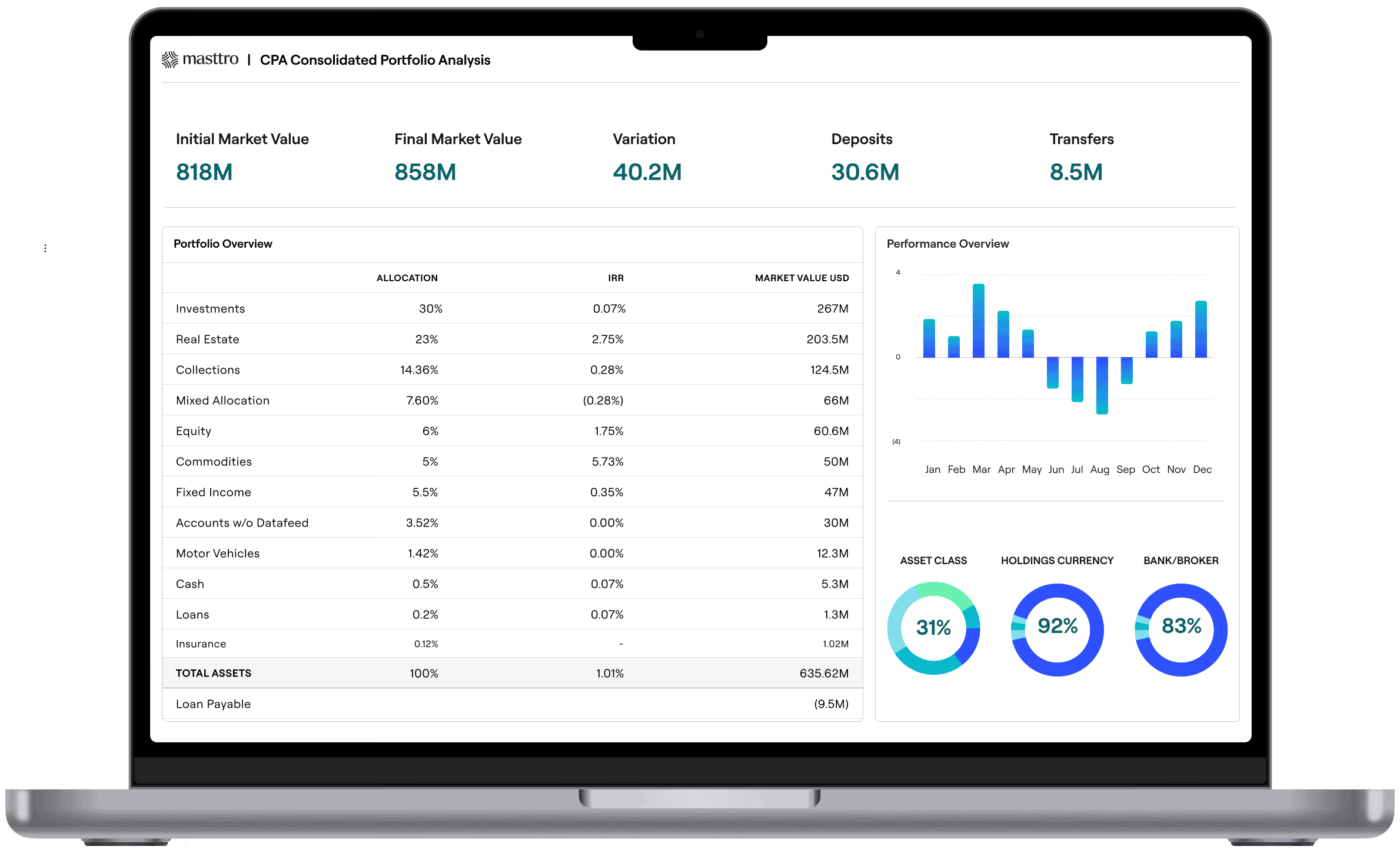
Masttro helps you turn tax-loss harvesting from an annual scramble into a continuous discipline, unifying real-time positions, lot-level cost basis, and AI-extracted data on private holdings into a single decision layer. Family offices and UHNW investors see harvestable losses the moment they appear, across every account, custodian, and asset class.
For family offices seeking after-tax alpha from systematic harvesting, automated data aggregation is more than back office architecture. It's the shared information layer that makes continuous, compounding tax efficiency possible.
Schedule a demo today to see how real-time aggregation, lot-level cost basis, and AI document processing power continuous harvesting in a platform built for modern family offices and RIAs.